
By NaJade · DJ in Bangkok · Published November 3, 2026
This guide is part of DJ headphones: the complete guide.
Both go on your ears. That’s roughly where the similarity ends.
If you’re starting out, it’s tempting to buy one pair of headphones for everything — DJing, producing, listening on the train. Sometimes that works. But DJ headphones and studio headphones are designed for opposite jobs: one has to cut through a loud club, the other has to reveal every flaw in a quiet room. Knowing the difference saves you money and helps you hear what actually matters.
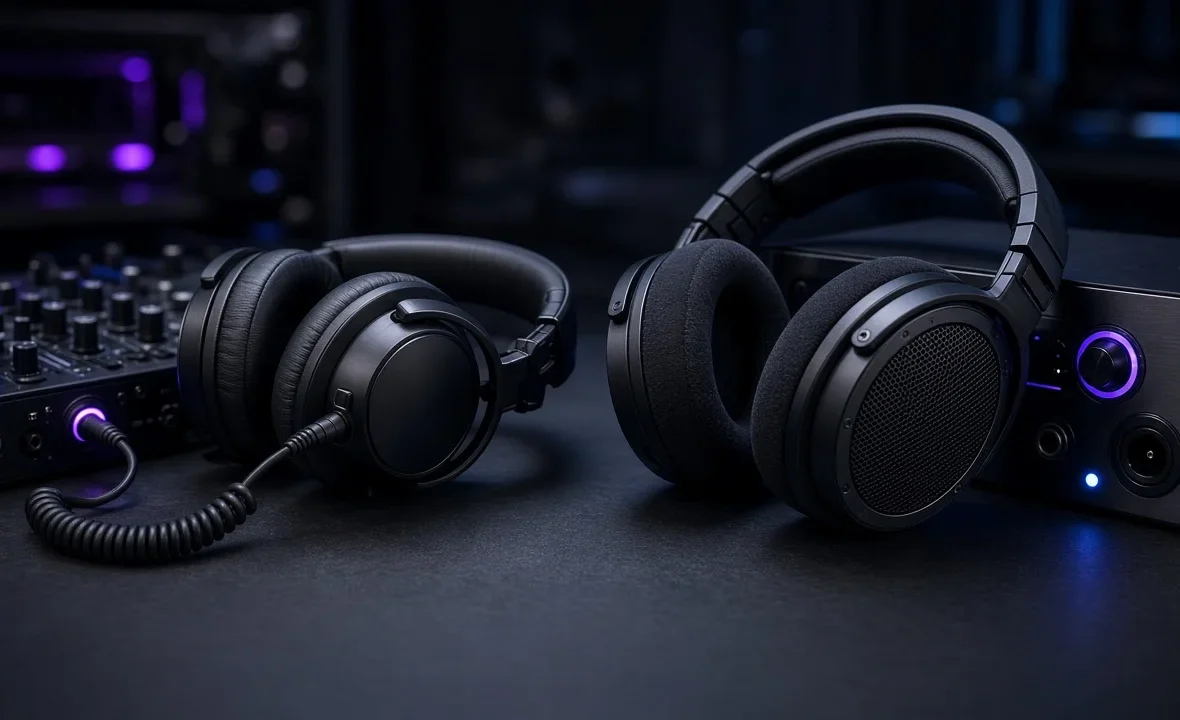
DJ headphones are built for loud booths: closed-back, high isolation, punchy bass, swivel cups and tough cables for one-ear cueing. Studio headphones are built for accuracy: flatter sound for mixing and production, often open-back and more comfortable for long sessions. For DJing, buy closed-back DJ headphones first.
The Short Version
| Feature | DJ headphones | Studio headphones |
|---|---|---|
| Main job | Cueing in a loud room | Accurate listening for mixing and production |
| Design | Closed-back, often on-ear | Closed or open-back, usually over-ear |
| Isolation | High — blocks booth noise | Moderate (closed) to almost none (open) |
| Sound | Punchy, forward bass and mids | Flatter, more neutral, detailed |
| Build | Swivel cups, folding, rugged | Comfort-first, sometimes fragile |
| Cable | Often coiled, detachable, single-sided | Often straight and long |
| Volume | Designed to go very loud cleanly | Designed for moderate levels |
What Makes DJ Headphones Different
A club booth can be painfully loud, with the monitors pointed at your head. DJ headphones are built to win that fight. beyerdynamic explains in its comparison of DJ and studio models that its DJ headphones are tuned for high volume with low distortion, use synthetic leather pads for stronger passive isolation, and have lockable, partly coiled cables for movement at the mixer.
- Isolation: closed cups and tight pads keep the booth out, so you can hear the cue track clearly.
- Rotating cups: you can hold one cup to your ear and leave the other off — the classic one-ear cueing stance.
- Bass emphasis: a punchy low end helps you hear the kick drum for beatmatching over a loud room.
- Durability: they get dropped, thrown in bags and sweated on. Replaceable pads and cables matter.
Classic examples include the Sennheiser HD 25, Pioneer DJ HDJ-X10 and Audio-Technica ATH-M50x (which straddles both worlds). I’ve reviewed several: Sennheiser HD 25, HDJ-X10 and ATH-M50x.
What Makes Studio Headphones Different
Studio headphones exist to tell you the truth. Producers and engineers use them to judge EQ, balance and stereo image, so they aim for a flatter, more neutral response rather than an exciting one.
- Open-back models let air and sound pass through the cups. They sound more spacious and natural, but leak sound and offer almost no isolation — useless in a booth.
- Closed-back studio models, such as the beyerdynamic DT 770 PRO, isolate better and are used for recording and tracking.
- Comfort is a priority, with soft velour pads and lighter clamping force for long sessions.
- Impedance varies widely. Some high-impedance studio models need a headphone amp or audio interface to reach full volume; most DJ models are low-impedance and run happily from a controller.
Can One Pair Do Both?
Yes — with compromises. A closed-back, low-impedance, reasonably neutral pair can handle bedroom DJing and basic production. That’s why models like the ATH-M50x are so popular with beginners. SoundGuys’ best DJ headphones roundup is a good place to compare current options.
| Your situation | What to buy |
|---|---|
| Learning to DJ at home | Closed-back DJ headphones or a hybrid like the ATH-M50x |
| Playing gigs regularly | Dedicated DJ headphones with high isolation |
| Producing and mixing music | Studio headphones (plus monitors if possible) |
| Doing both seriously | Two pairs — one for each job |
Never use open-back studio headphones for a gig. You won’t hear your cue, and you’ll end up turning the volume dangerously high. Protect your ears either way — see DJ hearing protection. For production work, pair your headphones with proper speakers: studio monitors for DJs.
What to Buy First
- If DJing is your priority: buy a closed-back DJ pair with swivel cups and replaceable parts. Start with the best DJ headphones for beginners.
- If production is your priority: buy neutral studio headphones and learn how they sound with reference tracks.
- If budget allows one pair only: go hybrid — closed-back, low impedance, neutral-ish, with a detachable cable.
A Note From NaJade
My first pair of "DJ" headphones were actually open-back studio cans a friend gave me. They sounded beautiful at home. At my first bar gig in Bangkok, I couldn’t hear a thing in them over the speakers, and I spent the night beatmatching by watching waveforms and guessing. That was the moment I understood isolation isn’t a feature — it’s the whole point. I bought a closed pair the following week. Today I use DJ headphones in the booth and a separate studio pair at home for editing and checking mixes. If you can only have one pair right now, make it the one built for the job you’ll do most.
Related: the DJ headphones guide, best DJ headphones for beginners, how to cue in DJ headphones, and the V-MODA M-100 review.
Frequently Asked Questions
What is the difference between DJ headphones and studio headphones?
Can I use studio headphones for DJing?
Can I use DJ headphones for music production?
Are open-back headphones good for DJing?
What impedance should DJ headphones have?
Do I need two pairs of headphones?
About the Author
NaJade is a Bangkok-based DJ playing progressive house, melodic EDM, pop, and Thai music across clubs, rooftops, and weddings in Thailand. He teaches beatmatching and mixing to beginners both in person in Bangkok and online over Zoom. When he’s not behind the decks, he’s documenting the journey on YouTube, Instagram, and TikTok.