
By NaJade · DJ in Bangkok · Published September 29, 2026
This guide is part of DJ headphones explained: the complete guide.
Military-grade metal, a bass-forward tuning EDM DJs love, and the only headphone here you can customise with your own name. Worth the premium? Here’s the honest verdict.
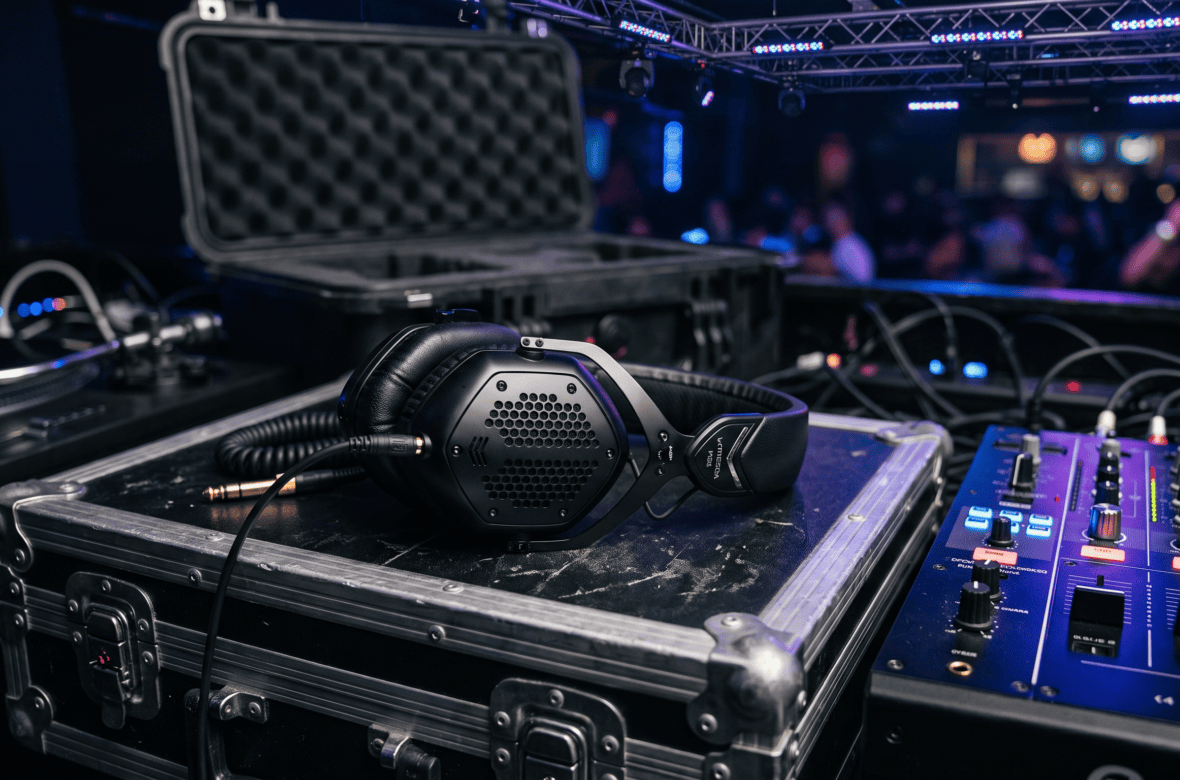
The V-Moda Crossfade M-100 Master is the headphone people buy when they want a DJ pair that looks and feels like a piece of designed hardware rather than studio equipment. Steel-reinforced headband, a hexagonal shield design you can have laser-engraved, a cable that’s been bend-tested absurdly hard, and a tuning that leans into low end without turning to mud. It’s the road-warrior choice, and among DJs who play bass-heavy music it has a devoted following. It’s also pricier than the alternatives and has one real ergonomic flaw worth knowing before you buy.
The V-Moda M-100 Master (~$249) is the durability-and-design choice: steel-reinforced headband, military-standard drop testing, replaceable laser-engravable shields, and a bass-forward but clear tuning that suits EDM and hip-hop. Reviewers rate it technically more resolving and better built than the ATH-M50x. The catches: a high clamping force some find uncomfortable, vents that leak sound, and a real price premium.
M-100 Master at a Glance
| Spec | M-100 Master | What it means for you |
|---|---|---|
| Type | Closed-back, over-ear, folding | Collapses small into an exoskeleton case |
| Sound | Bass-forward, V-shaped, clear and resolving | Made for electronic music; kicks hit hard |
| Build | Steel-reinforced headband, military-standard drop tested | The toughest headphone in this guide |
| Cable | Detachable, heavily bend-tested; dual inputs | Share audio with a second listener |
| Customisation | Replaceable shields, laser engraving available | Put your DJ name on your headphones |
| Clamp | High clamping force | Great grip, but can press on long sessions |
| Isolation | Good, but vented — leaks some sound | Slightly behind the ATH-M50x here |
| Price | ~$249 | A clear premium over the M50x |
(Prices and available shield options change — check the official V-Moda site before ordering, especially if you want custom engraving.)
Why DJs Choose the M-100 Over Cheaper Rivals
Two reasons, and neither is about specs. The first is survivability: this is a headphone built to be thrown in a bag, sat on, dropped off a booth, and keep working — the steel-reinforced headband and drop-tested frame are the actual product, and DJs who’ve replaced three pairs of plastic headphones understand exactly why that matters. The second is how it feels to own. The metal, the hexagonal shields, the option to have your name engraved on the side — it’s a piece of gear you’re pleased to put on a table, and for DJs building a brand and photographing their setup, that’s a real if unquantifiable benefit. Reviewers who’ve compared them directly also rate the M-100 as technically more resolving and better built than the ATH-M50x — you’re not just buying looks.
What’s Great About the M-100 Master
A Low End Built for Electronic Music
The tuning is unapologetically bass-forward and, crucially, still clear — this isn’t a muddy consumer bass boost. Kick drums land with genuine weight, sub frequencies have presence, and definition holds across the range so you can still hear hi-hats and vocals clearly. For progressive house, EDM, hip-hop and anything else where the low end is the track, that’s an advantage rather than a colouration to work around. If you beatmatch on kick drums in a loud room, this signature makes the job easy.
Genuinely Road-Proof
The steel-reinforced headband, drop testing to a military standard, and a detachable cable rated through an absurd number of bend cycles add up to a headphone that survives DJ life. It folds down small and ships with a hard exoskeleton case, so it packs properly rather than rattling loose in a bag. If you gig regularly and have watched cheaper headphones die at the hinge or the cable entry, this is where the money goes.
The Customisation Nobody Else Offers
The hexagonal side shields are replaceable and can be ordered in different finishes or laser-engraved with your name or logo. For a working DJ that’s not vanity so much as branding — your headphones appear in every photo and clip you post, and having your name on them is free marketing you paid for once. It also means the most visible wear part can be swapped rather than looking scuffed forever.
What to Watch Out For
- The clamping force is high. The most consistent complaint, and the one to take seriously — it grips firmly, which is great for stability and less great after two hours. Try before buying if you can.
- It leaks sound. The vented design means isolation, while good, sits behind the ATH-M50x and well behind the HD 25. Not ideal for the loudest booths or for recording near a microphone.
- The price premium is real. At around $249 it’s roughly $100 more than the M50x, and the sonic gap is smaller than the price gap. You’re paying for build and design.
- Not a neutral production headphone. The V-shaped, bass-forward tuning is fun and DJ-friendly, but it’s the wrong reference for mixing — see my studio monitors guide if you produce.
- Narrow soundstage, as with all closed-backs at this size. Fine for DJing, limiting for wide stereo work.
- Heavier than the alternatives, which is the flip side of the metal construction.
Who the M-100 Master Is Really For
It’s for gigging DJs who play bass-heavy music and want a headphone that survives touring, for anyone who has already broken cheaper pairs, and for DJs building a visual brand who want gear that photographs well and carries their name. Skip it if the clamping force bothers you, if you need maximum isolation in loud clubs (HD 25), if you want neutral tuning for production (ATH-M50x), if long-session comfort is the priority (HDJ-X10), or if you’re a beginner minimising spend (HDJ-CUE1).
A Note From NaJade
I have a soft spot for this one, and I’ll be honest that part of the appeal isn’t rational. There’s something genuinely good about gear that feels built — metal instead of plastic, a case that protects it, your name on the side. For a DJ who’s serious about the craft and about how they present, that matters more than a spec sheet admits. The rational case holds up too: if you play electronic music in real venues, the bass tuning helps you beatmatch and the build means you buy once. But I won’t oversell it. The clamp is real, and if you have a head that dislikes pressure you will not learn to love it — that’s the one thing to test rather than read about. And at $100 more than an M50x, this is a want rather than a need. If the money is tight, buy the M50x and spend the difference on music. If you’re gigging weekly and tired of replacing headphones, buy this and stop thinking about it for five years.
Compare every option in my complete DJ headphones guide, or see the wider DJ gear for beginners series. Want help choosing gear that suits how you actually play? My DJ lessons run in person in Bangkok or online over Zoom.
Frequently Asked Questions About the V-Moda M-100 Master
Is the V-Moda M-100 Master good for DJing?
V-Moda M-100 Master vs ATH-M50x: which is better?
Is the V-Moda M-100 Master comfortable?
Can you customise V-Moda headphones?
Is the M-100 Master good for music production?
How durable are V-Moda headphones?
About the Author
NaJade is a Bangkok-based DJ playing progressive house, melodic EDM, pop, and Thai music across clubs, rooftops, and weddings in Thailand. He teaches beatmatching and mixing to beginners both in person in Bangkok and online over Zoom. When he’s not behind the decks, he’s documenting the journey on YouTube, Instagram, and TikTok.