
By NaJade · DJ in Bangkok · Published September 29, 2026
This guide is part of DJ headphones explained: the complete guide.
Thirty years old, $150, made mostly of plastic — and still the headphone in every serious booth on earth. Here’s why nothing has replaced the HD 25, and who shouldn’t buy it.
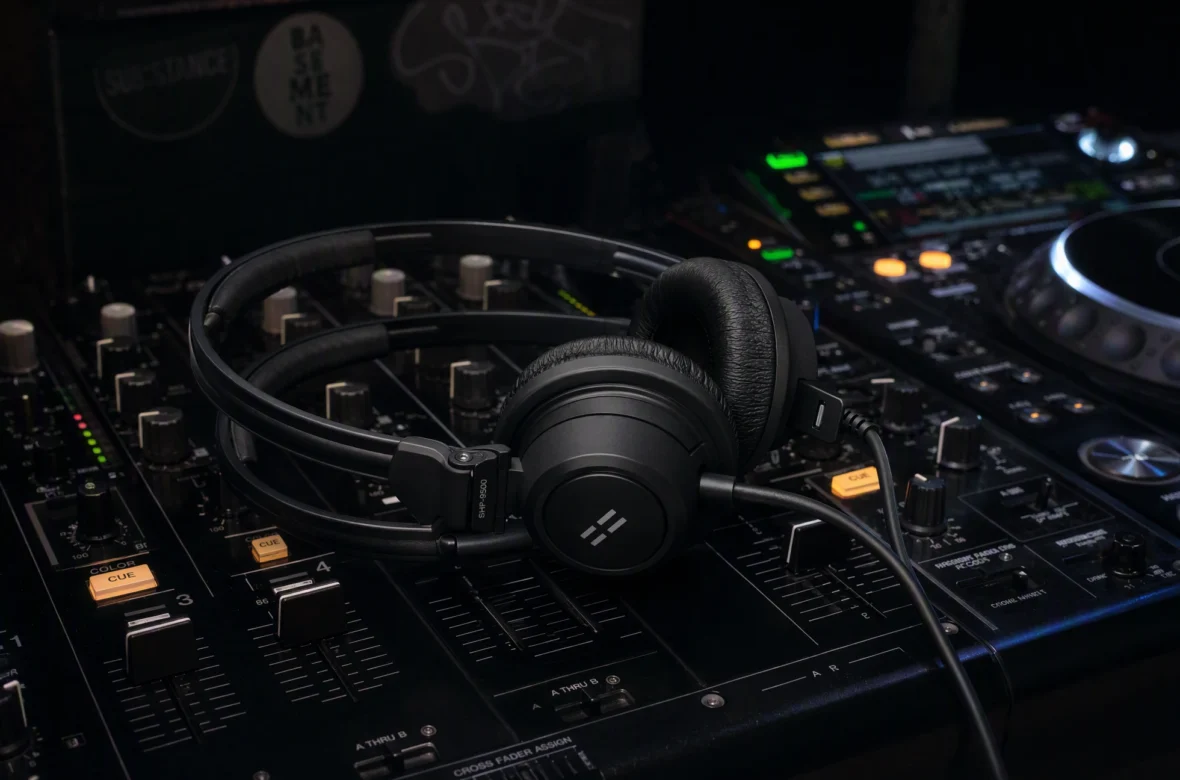
The Sennheiser HD 25 is the closest thing DJ gear has to a universal constant. Look behind the decks at a festival, in a Berlin club, in a broadcast truck, and you’ll spot the same split headband and small on-ear cups that launched over three decades ago. It hasn’t survived on nostalgia: no one has built a closed-back monitoring headphone that does the job better at the price, and its combination of feather weight, brutal isolation, and complete repairability keeps it the professional default. At around $150 it’s also refreshingly attainable. Here’s the full honest picture — including the comfort trade-off that makes some DJs hate it.
The Sennheiser HD 25 (~$150) is the industry-standard DJ headphone — around 140g, roughly 30dB of passive isolation, a 70-ohm load that any mixer drives loud and clean, and a split-headband on-ear design that stays put during one-ear monitoring. Every single part is individually replaceable, which is why pairs last a decade. The catches: on-ear clamping isn’t for everyone, and the look is pure function.
HD 25 at a Glance
| Spec | HD 25 | What it means for you |
|---|---|---|
| Type | Closed-back, on-ear (supra-aural) | Presses on the ear, seals out the room |
| Weight | ~140g | Among the lightest pro headphones made |
| Isolation | ~30dB passive | Hear cues clearly in 100dB+ rooms |
| Impedance | 70 ohms | Loud and clean from any mixer or phone |
| Frequency response | 16Hz–22kHz | Tight, truthful low end for beatmatching |
| Headband | Split, adjustable | Stays put through one-ear monitoring |
| Repairability | Every part individually replaceable | The secret to decade-long ownership |
| Price | ~$150 (Light version cheaper) | The pro standard, attainably priced |
(Prices vary — check current pricing on the official Sennheiser site. Beware the naming: HD 25 Plus adds accessories, HD 25 Light uses a single headband and lighter clamp.)
Why It’s Still the Standard After 30 Years
Three reasons, all practical. It isolates like almost nothing else — the on-ear clamp plus closed backs manage roughly 30dB of passive isolation, which means in a genuinely loud room you can still hear your cue at safe volumes. It’s nearly weightless at ~140g, so it disappears during a four-hour set and survives being hung off one ear all night — the split headband grips your head in a way over-ears simply can’t. And it refuses to die: capsules, pads, headband, cable — every component unclips and replaces for small money, which is why working DJs report pairs lasting ten years and beyond. That combination is the whole product, and no rival has matched all three at once.
What’s Great About the HD 25
A Sound Built for Beatmatching
The HD 25 isn’t tuned for pleasure listening — it’s tuned for work. The bass is tight and immediate rather than boosted and warm, with no muddy spill into the low mids, which makes kick drums and percussion jump out cleanly — exactly what you beatmatch on. Mids are clear, highs are crisp, and the whole signature stays composed at high volume with distortion far below what competing DJ headphones manage. It’s honest sound, and honesty is what monitoring needs.
Repairability as a Superpower
This deserves its own section because it changes the economics entirely. Cables are the first thing to die on any DJ headphone; on the HD 25 a replacement costs pocket change and clips in yourself in minutes. Same for pads, the headband padding, even individual driver capsules. Amortised over a decade of service, this is comfortably the cheapest professional headphone you can own — and it’s why broadcast and touring professionals, who abuse gear hardest, standardised on it.
Perfect for Hot Booths
A quietly underrated advantage for anyone DJing in Thailand or anywhere warm: on-ear designs run far cooler than over-ears. Sealed over-ear cups turn into ovens in a rooftop bar in April; the HD 25’s small cups keep air moving. Combined with the low weight, it’s the least fatiguing headphone I know for long sets in real heat.
What to Watch Out For
- The clamp divides people. The pressure that creates the isolation presses directly on your ears, and some people never get comfortable with it. Try before buying if you can — this is the number-one reason DJs choose over-ears instead.
- Zero glamour. It looks like broadcast equipment because it is. If aesthetics matter to your brand, the HDJ-X10 or V-Moda M-100 photograph better.
- Watch the variant naming. The HD 25 Light drops the split headband and clamps lighter — cheaper, but it loses part of what makes the standard model work. Most DJs should buy the standard split-headband HD 25.
- Not a luxury listen. The clinical tuning that’s perfect for monitoring is less cosseting for pleasure listening than warmer over-ears.
- Small soundstage. On-ear closed designs image narrowly — irrelevant for DJing, noticeable for production work, where the ATH-M50x crosses over better.
- Everyone has them. If being different matters, this is the least different choice in DJing.
Who the HD 25 Is Really For
It’s for working and aspiring DJs who want the professional default: maximum isolation, minimum weight, decade-long service life, honest monitoring sound, and easy repairs — especially anyone playing hot venues or travelling light. It’s also the best value-per-year purchase in DJ headphones. Skip it if on-ear pressure genuinely bothers you (the over-ear HDJ-X10 is the comfort pick), if you want one headphone for DJing and studio production (ATH-M50x), or if you’re a beginner minimising spend (HDJ-CUE1 first, this later).
A Note From NaJade
The HD 25 is what I tell students to buy when they’re ready for their “forever” headphones, and the reasoning is boring in the best way: it’s the only headphone where every worn part costs coffee money to replace, so the pair you buy at the start of your DJ life can genuinely still be on your head ten years in. The isolation is the other half — the first time you play a genuinely loud room with proper isolating headphones, you realise you’ve been cranking your cue to dangerous volumes just to hear it, and your ears are the one piece of equipment you can never replace. My honest caveat is comfort: the clamp is real, some heads never adjust, and no spec sheet can tell you which kind of head you have — so try a pair on before you order if you possibly can. And if the look bothers you, remember what it signals: every engineer and touring DJ who sees them knows you bought a tool, not an accessory.
Compare all the options in my complete DJ headphones guide, or start from the beginner headphones guide. Want help building good monitoring habits that protect your hearing? My DJ lessons run in person in Bangkok or online over Zoom.
Frequently Asked Questions About the Sennheiser HD 25
Why is the Sennheiser HD 25 the industry standard?
Is the HD 25 comfortable?
What’s the difference between HD 25, HD 25 Plus, and HD 25 Light?
Is the HD 25 good for beatmatching?
How long do HD 25s last?
HD 25 vs Pioneer HDJ-X10: which should I buy?
About the Author
NaJade is a Bangkok-based DJ playing progressive house, melodic EDM, pop, and Thai music across clubs, rooftops, and weddings in Thailand. He teaches beatmatching and mixing to beginners both in person in Bangkok and online over Zoom. When he’s not behind the decks, he’s documenting the journey on YouTube, Instagram, and TikTok.