
By NaJade · DJ in Bangkok · Published September 28, 2026
The biggest rivalry in DJ gear — more features for less money on one side, the industry standard on the other. Here’s the honest, whole-picture verdict.
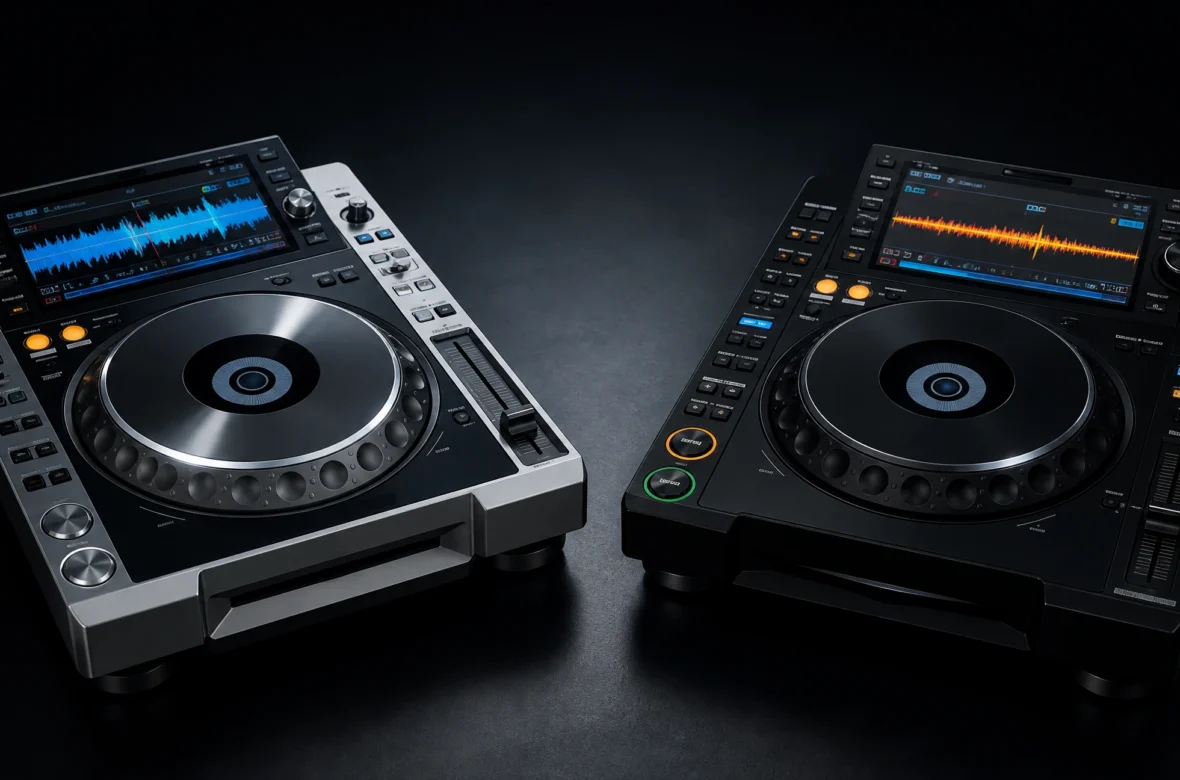
If you’re buying serious DJ gear in 2026, you’re really choosing between two ecosystems: Pioneer DJ (AlphaTheta), the industry standard that fills virtually every club booth on earth, and Denon DJ, the challenger that consistently offers more hardware for less money. I’ve written full guides to both ranges — the complete Pioneer guide and the complete Denon guide — and this article is the piece that sits between them: the honest comparison of philosophies, ecosystems, and what each choice actually costs you. There’s no universal winner here, but there is almost certainly a right answer for you.
Pioneer DJ (AlphaTheta) is the industry standard — its CDJs and DJMs fill club booths worldwide, its layout is the skill that transfers, and its resale values hold. Denon DJ consistently gives you more hardware for the money — bigger screens, Wi-Fi streaming, built-in features Pioneer charges extra for — and its Engine DJ software is free. Choose Pioneer if club gigs are the goal; choose Denon if spec-per-dollar and standalone freedom matter more.
The Two Philosophies
Understand the strategy of each company and every product decision makes sense. Pioneer sells the standard. Its CDJ players and DJM mixers are what clubs install, what riders specify, and what a generation of DJs trained on — so its gear can be conservative, and priced with confidence, because compatibility with the professional world is the product. Denon sells the spec sheet. As the challenger, it wins by giving you more: bigger touchscreens, Wi-Fi streaming, more inputs, built-in networking — features that arrived on Denon gear years before Pioneer’s equivalents, at prices Pioneer rarely matches. Neither approach is wrong. They’re aimed at different buyers.
Head to Head: Where Each Brand Wins
| Category | Pioneer DJ (AlphaTheta) | Denon DJ | Winner |
|---|---|---|---|
| Club presence | Virtually every professional booth | Rare in club installs | Pioneer, decisively |
| Value for money | Premium pricing | More features per dollar across the range | Denon |
| Software | rekordbox — free tier + paid plans | Engine DJ — completely free | Denon |
| Streaming on hardware | Arrived later, on newer units | Wi-Fi streaming standard for years | Denon |
| Resale value | Holds value exceptionally well | Depreciates faster | Pioneer |
| Skill transfer | Home layout = booth layout | Similar, but not identical | Pioneer |
| Standalone all-in-ones | XDJ / Opus range | Prime range pioneered the category | Denon, narrowly |
| Ecosystem lock-in | rekordbox-centric | Engine imports rekordbox/Serato libraries | Denon |
The Club Question Decides More Than Anything Else
Here’s the single most important fact in this comparison: walk into almost any club booth in Bangkok, Berlin, or anywhere else, and you’ll find Pioneer CDJs and a DJM mixer reading rekordbox-prepared USB drives. If your ambition is club and festival gigs, practising on Pioneer gear means the booth feels like home, and your USB prep workflow matches what the venue expects. That’s not marketing — it’s the practical reality that keeps Pioneer’s prices high and its used gear valuable. Denon’s counter is genuine: Engine DJ imports rekordbox libraries, so you can own Denon at home and still export a rekordbox drive for club nights. But it’s an extra step, and muscle memory transfers imperfectly. Be honest about your goals before you choose.
Where Denon Genuinely Wins
- Spec per dollar, consistently. The Prime 4+ undercuts Pioneer’s equivalent while offering a bigger touchscreen, more channels, and features like a built-in LAN hub on the X1850 that Pioneer’s $2,699 DJM-A9 still lacks.
- Free software, forever. Engine DJ Desktop costs nothing, with no tiers to decode — versus rekordbox’s confusing plan matrix.
- Streaming came first. Wi-Fi streaming from Apple Music, TIDAL, Beatport and more has been standard on Denon hardware for years.
- Easy migration in. Engine imports rekordbox, Serato, and Traktor libraries — switching to Denon doesn’t mean rebuilding years of prep.
- The SC6000/SC6000M players match or beat CDJs on raw features (dual layers, bigger screens, onboard analysis) for dramatically less money.
Where Pioneer Earns Its Premium
- The booth standard. Skills, prep, and muscle memory transfer directly to professional venues — the whole argument in five words.
- Resale value. Pioneer gear depreciates slowly and sells fast; Denon gear loses value quicker. Over a full ownership cycle this narrows the real price gap.
- Ecosystem maturity. rekordbox’s club integration (CloudDirectPlay, Pro DJ Link, USB export to any CDJ) is deeper than anything Denon offers outside its own hardware.
- Beat-grid reliability. Engine DJ draws real criticism for grids on tempo-shifting edits and transition tracks — a genuine issue for open-format DJs, covered honestly in my Engine DJ guide.
- Serato flexibility on battle/scratch gear. Pioneer’s DJM-S11 supports both Serato and rekordbox where rivals pick one.
How to Choose: The Honest Decision Path
- Club or festival ambitions? Buy Pioneer, or at minimum learn rekordbox prep thoroughly regardless of hardware.
- Home, mobile, weddings, bars — your own rig every time? Denon’s value advantage is real and the club argument barely applies. The Prime range is superb here.
- On a tight budget for a standalone system? Denon wins on price at almost every tier — see the Prime GO+ and SC Live 2.
- Planning to resell and upgrade over the years? Pioneer’s resale strength matters more than sticker price suggests.
- Already deep in one software library? Moving to Denon is easy (Engine imports everything); moving from Denon back to rekordbox is messier. Factor the one-way door.
A Note From NaJade
People want this to be a football match, and it’s really a mirror: the right brand depends on which DJ you’re honestly planning to be. I’ll give you my own reasoning as one data point. I play club-style gigs in Bangkok, so booth familiarity matters to me, and rekordbox prep is non-negotiable for the rooms I want to play — that pushes me toward Pioneer thinking even though I genuinely admire what Denon packs into its hardware for the money, and even though the SC6000 is, spec for spec, arguably the better media player. If I were building a wedding and events business, or a home studio rig I never intended to gig outside of, I’d buy Denon without hesitation and pocket the difference. What I’d caution against is buying Pioneer purely as a status purchase, or Denon purely on spec-sheet excitement — both are expensive ways to serve the wrong goal. Decide where you’ll actually be playing in two years, and the brand picks itself. Then spend the energy where it counts: the crowd responds to your selection and your timing, not your logo.
Go deeper with the full Pioneer DJ range guide and Denon DJ range guide, or compare the software sides in the complete DJ software guide. Want help choosing for your specific situation and budget? My DJ lessons run in person in Bangkok or online over Zoom.
Frequently Asked Questions About Denon vs Pioneer
Is Denon DJ better than Pioneer DJ?
Why do clubs use Pioneer instead of Denon?
Is Denon DJ good quality?
Can I use Denon gear and still play club gigs on CDJs?
Which is better value: Denon Prime 4+ or a Pioneer equivalent?
Should a beginner choose Denon or Pioneer?
About the Author
NaJade is a Bangkok-based DJ playing progressive house, melodic EDM, pop, and Thai music across clubs, rooftops, and weddings in Thailand. He teaches beatmatching and mixing to beginners both in person in Bangkok and online over Zoom. When he’s not behind the decks, he’s documenting the journey on YouTube, Instagram, and TikTok.