
By NaJade · DJ in Bangkok · Published September 28, 2026
This guide is part of Denon DJ controllers & standalone systems: the complete range explained.
The standalone that made laptop-free 4-deck DJing normal — now refined, with the industry’s first onboard Stems and streaming from almost everywhere. Is it the best all-in-one you can buy? For a lot of DJs, honestly, yes. Here’s the full picture.
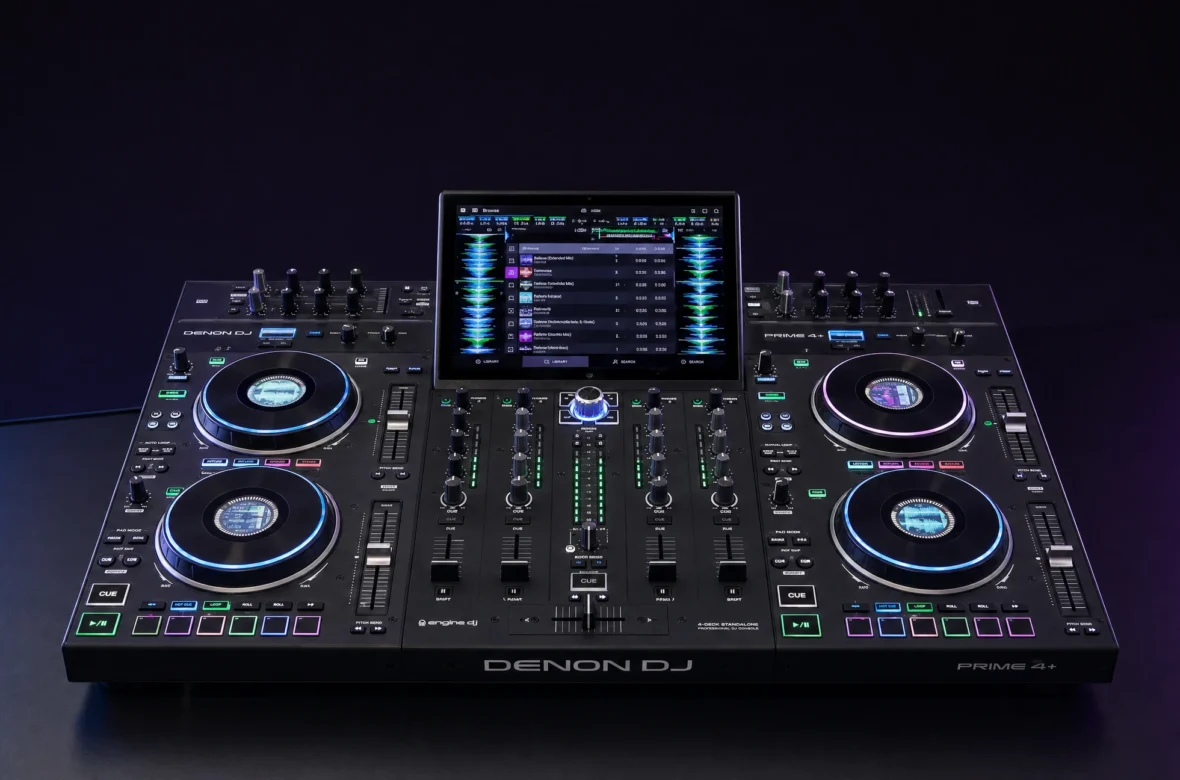
The Denon Prime 4+ is the flagship of Denon’s whole range and, for many working DJs, the most complete standalone system on the market. It’s a refined version of the 2019 Prime 4 that basically invented the true 4-deck standalone category — think of it as a “Prime 4 MK2.” It runs four independent decks with no laptop, has a stunning 10.1″ screen, streams from more services than anything else out there, and was the first standalone to offer onboard Stem separation. If you’ve read my XDJ-XZ guide, this is the unit that does the one big thing the XZ can’t. Here’s an honest overview of why it’s so loved — and the few things to know.
The Denon Prime 4+ is Denon’s flagship 4-deck standalone system (~$2,199) — true independent 4-deck play with no laptop, a gorgeous 10.1″ touchscreen, industry-first onboard Stems, huge streaming support, and pro connectivity (4 USB, SD, internal SATA bay, Zone output). It’s one of the most feature-packed all-in-ones you can buy, and superb value versus club separates. The honest catches: Stems sound cleaner via Serato than the standalone path, and clubs still run Pioneer.
Prime 4+ at a Glance
The key specs and what they mean for you:
| Spec | Prime 4+ | What it means for you |
|---|---|---|
| Type | Flagship 4-deck standalone all-in-one | Full club-style setup, no laptop needed |
| Channels | 4 — true independent standalone | Layer 4 tracks from USB; fixes the XZ’s limit |
| Screen | 10.1″ multi-gesture touchscreen + Touch FX | Class-leading browsing; XY effects pad |
| Jog wheels | 6″ capacitive, RGB rings, HD centre displays | Responsive; artwork/logo on the jog |
| Stems | Industry-first onboard Stem separation | Isolate vocal/melody/bass/drums live |
| Software | Engine OS standalone; Serato DJ Pro / Virtual DJ controller | Laptop-free, or use software |
| Storage / streaming | 4 USB, SD, internal SATA bay, Wi-Fi/Ethernet, huge streaming list | Play from almost anything, anywhere |
| Connectivity | XLR main/booth/Zone, 4 line/phono in, 2 mic, Bluetooth | Pro I/O; second-room Zone output |
| Price | ~$2,199 (check current local price) | Superb value vs club separates |
(Prices vary by region and over time — confirm the current Thailand/local price before buying.)
Why the Prime 4+ Is So Loved
The original Prime 4 was genuinely groundbreaking — in 2019 it was the only true 4-deck standalone, and rivals took years to catch up. The Prime 4+ refines that winning formula rather than reinventing it: a toned-down, more grown-up look, larger jog surfaces, new FX, Bluetooth, and the headline addition of onboard Stems. What makes it special is that it packs a feature set that outguns pro club systems costing three times as much, in one rugged, self-contained box. For a mobile, wedding, or home DJ who plays their own gear, it’s hard to argue with what you get for the money.
What’s Great About the Prime 4+
True 4-Deck Standalone + a Stunning Screen
This is the core appeal. You get four fully independent decks playing from USB, SD, or the internal drive with no computer — the very thing Pioneer’s XDJ-XZ can’t do from USB. The 10.1″ touchscreen is superb: large, bright, and responsive, showing all four waveforms (vertical or horizontal), full library management with a QWERTY search, and doubling as an XY Touch FX pad. It’s one of the best browsing experiences in DJing.
Industry-First Onboard Stems
The Prime 4+ was the first standalone to bring Stem separation to the hardware. You pre-render tracks or playlists in Engine DJ Desktop, export to a drive, and then isolate or remove the vocal, melody, bass, and drums live — including Part Instant Doubles (send just the vocal to another deck to scratch or FX it). It’s genuinely creative, and a real edge over most rivals. One honest note below on how it sounds.
Streaming and Connectivity That Embarrass the Competition
Denon leads the industry on streaming: Apple Music, Amazon Music Unlimited, TIDAL, Beatport, Beatsource, SoundCloud GO+, and Dropbox — over 100 million tracks at your fingertips via Wi-Fi (or hard-wired Ethernet). Storage is equally generous: four USB ports, an SD slot, and an internal 2.5″ SATA bay so your whole library can live inside the unit. Add XLR main/booth outputs, a dedicated Zone output for a second room, four line/phono inputs, two full mic channels, Bluetooth, and an internal recorder, and it’s a true centrepiece a venue can build around. For choosing your software, see rekordbox vs Serato.
What to Watch Out For
- Stems sound better via software. The onboard/standalone Stems are functional but, by many accounts, not as clean as Stems run through Serato or Virtual DJ. If pristine Stems are central to your style, temper expectations for the standalone path.
- Not the club standard. Like all Denon gear, it’s excellent, but clubs overwhelmingly run Pioneer — so the muscle memory and layout won’t match most booths you’ll be booked into.
- Faders feel a touch cheaper. Some owners note the channel faders and sliders feel slightly less premium than Pioneer’s, though this is minor and hasn’t hurt reliability reports.
- It’s big and heavy. A rugged 4-deck all-in-one is not a grab-and-go unit — plan for a proper case and transport.
- Engine DJ prep required. You analyse and organise in Engine DJ Desktop first (it can import rekordbox, Serato, and Traktor libraries), so there’s a workflow to learn — and Stems must be pre-rendered before a gig.
How It Compares
- vs Pioneer XDJ-XZ: The Prime 4+ is cheaper and does what the XZ can’t — true 4-deck standalone from USB — plus onboard Stems and more streaming. The XZ links external CDJs (Pro DJ Link) and matches Pioneer club feel; the Prime 4+ wins on standalone capability and value.
- vs Pioneer OPUS-QUAD: The OPUS is Pioneer’s premium true-4-deck standalone with a gorgeous design at a higher price (~$3,199). The Prime 4+ offers similar core capability plus Stems and bigger streaming for hundreds less — the OPUS wins on looks and Pioneer-ecosystem feel.
- vs Denon SC Live 4: The SC Live 4 is the cheaper 4-deck Denon with built-in speakers but a smaller 7″ screen and less I/O. The Prime 4+ is the flagship: bigger screen, more connectivity, Stems, and pro outputs.
Who the Prime 4+ Is Really For
It’s ideal for the mobile, wedding, or event DJ who wants a do-it-all, laptop-free 4-deck system with the biggest streaming access and creative Stems — and for home DJs who want a flagship centrepiece without club-separates pricing. It’s especially strong for anyone in (or moving into) the Engine DJ ecosystem. Skip it if you specifically need to practise on Pioneer club gear (learn on a Pioneer unit instead), if you want the very cleanest Stems (run them via software), or if portability is a priority (it’s a big unit). If four decks are overkill, look at the 2-deck Prime 2 or the portable Prime GO.
A Note From NaJade
I’ll say it plainly: the Prime 4+ is one of the most impressive pieces of DJ gear you can buy at the price, and if you play your own setup — weddings, events, home, mobile — it can genuinely be the last unit you ever need. As a standalone player myself, I love what Denon does here: four real decks, that beautiful screen, streaming from basically everywhere, all with no laptop. The two honest things I always flag: first, if you dream of playing clubs, remember the booth will be Pioneer, so this is a “play my own gigs” machine more than a “practise for club residencies” one. Second, don’t buy it for the Stems expecting studio-clean results from the standalone path — they’re fun and useful, but the magic is really the whole package, not that one feature. Judge it as the complete, do-everything standalone it is, and it’s superb value. Buy it for how you actually play, prep your library well in Engine DJ, and it’ll serve you brilliantly for years — the room responds to your selection and your read of the crowd, never to the badge on the box.
See the whole lineup in my complete Denon DJ range guide, or weigh the other side in the Pioneer DJ controller guide. Want help choosing your first standalone and learning to mix on it? My DJ lessons run in person in Bangkok or online over Zoom.
Frequently Asked Questions About the Denon Prime 4+
Is the Denon Prime 4+ worth it?
Does the Denon Prime 4+ need a laptop?
What’s the difference between the Prime 4 and Prime 4+?
How good are the Stems on the Denon Prime 4+?
Denon Prime 4+ vs Pioneer XDJ-XZ: which is better?
Do clubs use the Denon Prime 4+?
About the Author
NaJade is a Bangkok-based DJ playing progressive house, melodic EDM, pop, and Thai music across clubs, rooftops, and weddings in Thailand. He teaches beatmatching and mixing to beginners both in person in Bangkok and online over Zoom. When he’s not behind the decks, he’s documenting the journey on YouTube, Instagram, and TikTok.