
By NaJade · DJ in Bangkok · Published September 28, 2026
This guide is part of Denon DJ controllers & standalone systems: the complete range explained.
The Prime 4+ experience in a smaller, cheaper, two-deck box — often called the sweet spot of the range. But one awkward question hangs over it. The honest verdict.
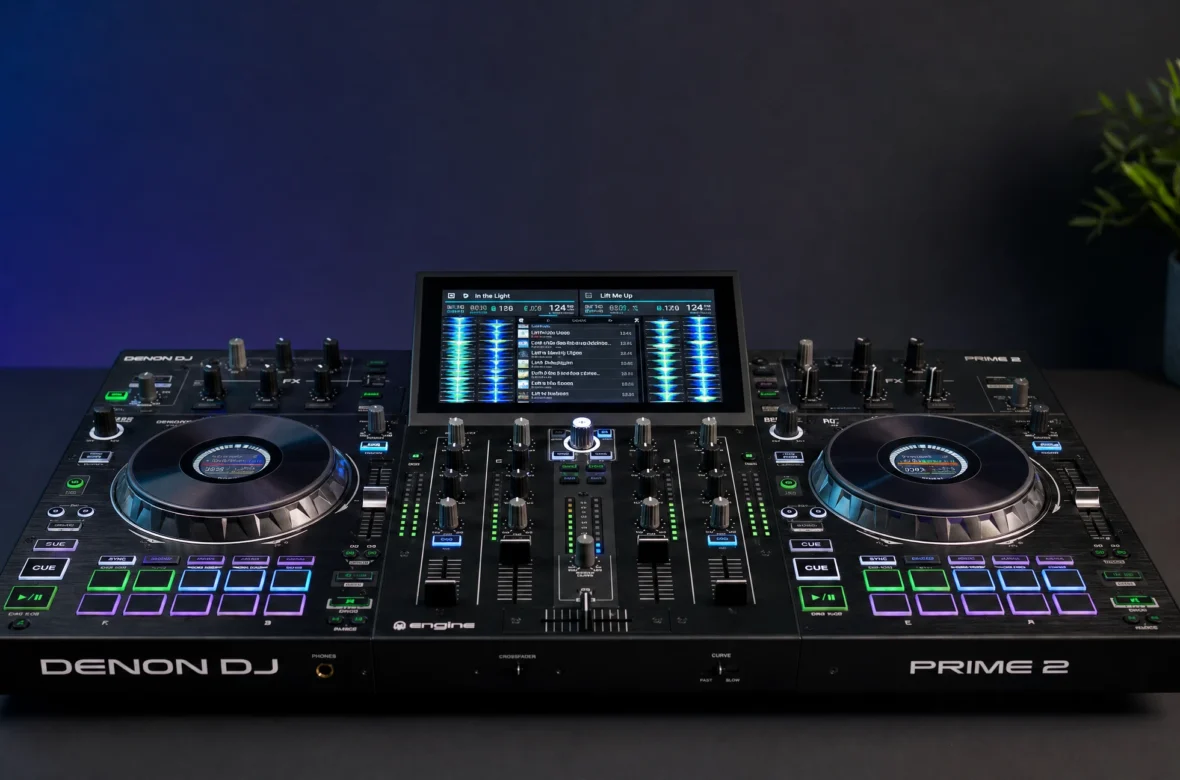
The Denon Prime 2 is the two-deck member of the Prime family — essentially a cut-down Prime 4+ with the same Engine OS brain, the same laptop-free freedom, and most of the same features, in a lighter, more portable, less expensive package. Many reviewers have called it the “sweet spot” of the Denon range, and for the huge number of DJs who genuinely only need two channels, it makes a lot of sense. It’s also the most direct Denon rival to Pioneer’s XDJ-RX3. But there’s one honest question worth asking before you buy. Here’s the full picture.
The Denon Prime 2 is a 2-deck standalone system with a 7″ touchscreen, 6″ capacitive jogs with colour displays, a metal chassis, and the same Engine OS as the flagship — plus streaming, an internal drive bay, and pro I/O. It’s a superb, more portable option for the many DJs who only need two channels. The catch: it isn’t much cheaper than the far more capable 4-deck Prime 4+, so the value maths deserves a hard look.
Prime 2 at a Glance
The key specs and what they mean for you:
| Spec | Prime 2 | What it means for you |
|---|---|---|
| Type | 2-deck standalone all-in-one | Full laptop-free system, smaller footprint |
| Screen | 7″ multi-touch, multi-gesture | Good — but smaller than the Prime 4+’s 10.1″ |
| Jog wheels | 6″ capacitive touch, HD colour centre displays | Artwork/BPM on the jog; solid feel |
| Software | Engine OS standalone; imports rekordbox/Serato/Traktor libraries | Bring your existing prep across; onboard analysis |
| Storage / streaming | 3 USB, SD, internal 2.5″ SATA bay, Wi-Fi + Ethernet | Whole library onboard; TIDAL/Beatport/SoundCloud/Dropbox |
| Mixer | 2ch, 3-band EQ + filter, dual FX, 100mm pitch faders | Full control; long faders help manual beatmatching |
| Connectivity | XLR + RCA master, XLR booth, RCA aux, 2 mic (XLR combo) | Pro I/O; proper dual mics for events |
| Build / weight | Metal chassis · ~15.9 lb | Road-ready but genuinely portable |
| Price | ~$1,399 (check current local price) | Close to the Prime 4+ — the key question |
(Prices vary by region and over time — confirm the current Thailand/local price before buying.)
The Honest Question: Why Not Just Buy the Prime 4+?
Let’s deal with the elephant first, because it’s the single most useful thing I can tell you. The Prime 2 launched at around $1,399 — only a few hundred less than the Prime 4+, which gives you four decks, a much larger 10.1″ screen, more FX, and onboard Stems. Several reviewers have flagged exactly this: for the cut in features, many expected a bigger cut in price. So the real decision isn’t “is the Prime 2 good” (it is) — it’s whether the savings and smaller size are worth losing that much capability. Two situations where the Prime 2 clearly wins: you genuinely only ever play two decks and want the money back, or portability and desk space actually matter to you — it’s meaningfully smaller and lighter at ~15.9 lb. If neither is true, stretch to the Prime 4+.
What’s Great About the Prime 2
The Full Engine OS Experience, Nothing Held Back
This is Denon’s smartest move across the whole range: every Prime unit runs the same Engine OS, and every update lands on all of them. So the Prime 2 gives you the same fast track loading, the same excellent library navigation and on-the-fly playlist building, the same onboard analysis, and the same Wi-Fi streaming as the flagship. It can even import a full rekordbox collection — playlists, hot cues, and loops — directly from a drive and analyse it internally, with no computer at all. If you’re coming from Pioneer, that’s a genuinely painless migration path.
Serious Storage, Streaming, and Pro I/O
For a mid-size unit the connectivity is excellent: three USB ports, an SD slot, and an internal 2.5″ SATA drive bay so a terabyte library can live inside the unit. Add Wi-Fi and wired Ethernet streaming (TIDAL, Beatport LINK, Beatsource LINK, SoundCloud GO+, Dropbox), onboard set recording, balanced XLR and RCA master outs, an XLR booth output, an RCA aux input, and two proper XLR-combo mic channels with EQ and talkover — that last one matters enormously for weddings and events. There’s even StagelinQ for SoundSwitch lighting and Resolume video.
Built Like a Denon, Sized Like a Gigging Unit
Metal chassis, robust faders, 100mm pitch faders (long throw genuinely helps if you beatmatch by ear), 6″ capacitive jogs with HD centre displays showing artwork and track info, and eight responsive pads per deck for hot cues, loops, rolls, and slicing. It’s built for the road but light enough to actually carry — a real advantage over the big Prime 4+.
What to Watch Out For
- The price gap to the Prime 4+ is small. The biggest one. You lose two decks, screen size, FX, and Stems for a modest saving.
- The 7″ screen feels tight. It’s the main way you interface with your library, and reviewers consistently wish it were bigger — especially compared to the Prime 4+’s 10.1″. Interestingly it feels more generous on the smaller Prime GO; here it can feel undersized for the unit.
- Fewer FX than the flagship. The Prime 4+’s four Sweep FX are gone, replaced with basic high/low-pass filter options — a real loss if you love sweeping filter work. There are also no individual FX screens.
- No onboard Stems. Stem separation is a Prime 4+ / SC Live feature; the Prime 2 doesn’t have it.
- Not the club standard. Like all Denon, superb gear — but clubs run Pioneer, so this is a “play my own gigs” machine.
- Engine DJ desktop still trails. The library software has improved a lot, but many still find it less polished than the competition.
How It Compares
- vs Pioneer XDJ-RX3: The head-to-head that matters. The Prime 2 is cheaper and technically outguns the Pioneer on features (internal drive bay, more streaming, onboard analysis, rekordbox import). The RX3 has a much bigger, nicer 10.1″ screen and the Pioneer club ecosystem. Choose the Prime 2 for value and features; the RX3 if you want Pioneer’s feel and screen.
- vs Prime 4+: Two decks and a smaller screen versus four decks, a 10.1″ screen, more FX, and Stems — for not much more money. Take the Prime 2 only if you want the smaller size or genuinely never need four decks.
- vs SC Live 2: The SC Live 2 is cheaper with built-in speakers, but plastic, with less I/O. The Prime 2 is the more professional unit: metal build, internal drive bay, dual mics, booth out.
Who the Prime 2 Is Really For
It’s ideal for the mobile, wedding, bar, or event DJ who plays two decks, wants a laptop-free pro system with strong I/O and dual mics, and values a unit they can actually carry. It’s also a strong home centrepiece if desk space is limited, and an easy landing spot for a rekordbox DJ moving to Denon. Skip it if four decks, a big screen, Stems, or sweep FX matter to you (get the Prime 4+), if you want built-in speakers and a lower price (see the SC Live 2), or if you’re aiming for club residencies where practising on Pioneer would serve you better.
A Note From NaJade
I like the Prime 2 a lot — as a two-deck standalone player myself, I understand its appeal completely. Most of us, most nights, are mixing two tracks; four decks is a luxury plenty of DJs never touch. And the fact that Denon doesn’t cripple the software on its cheaper units is genuinely admirable — you get the full Engine OS brain here. But I’d be doing you a disservice if I didn’t repeat the honest bit: the Prime 4+ is close enough in price that you should look hard at your own wallet and desk before choosing. My advice is simple — if you’re buying this because it’s smaller and you’ll actually feel that portability every weekend, buy it happily; that’s a real reason. If you’re buying it purely to save money, do the maths again, because the flagship might be the better long-term value. And whichever you choose, remember the two-deck thing is a non-issue for how most of us actually play: the room responds to your selection and your read of the crowd, never to how many channels you own.
See the whole lineup in my complete Denon DJ range guide, or weigh the other side in the Pioneer DJ controller guide. Want help choosing your first standalone? My DJ lessons run in person in Bangkok or online over Zoom.
Frequently Asked Questions About the Denon Prime 2
Is the Denon Prime 2 worth it?
What’s the difference between the Denon Prime 2 and Prime 4+?
Does the Denon Prime 2 need a laptop?
Denon Prime 2 vs Pioneer XDJ-RX3: which is better?
Can the Denon Prime 2 read rekordbox libraries?
Does the Denon Prime 2 have Stems?
About the Author
NaJade is a Bangkok-based DJ playing progressive house, melodic EDM, pop, and Thai music across clubs, rooftops, and weddings in Thailand. He teaches beatmatching and mixing to beginners both in person in Bangkok and online over Zoom. When he’s not behind the decks, he’s documenting the journey on YouTube, Instagram, and TikTok.