
By NaJade · DJ in Bangkok · Published September 28, 2026
This guide is part of Denon DJ controllers & standalone systems: the complete range explained.
The cheapest true 4-deck standalone ever made — with speakers built in, so you switch it on and you’re playing. But Denon cut some corners to get here. The honest verdict.
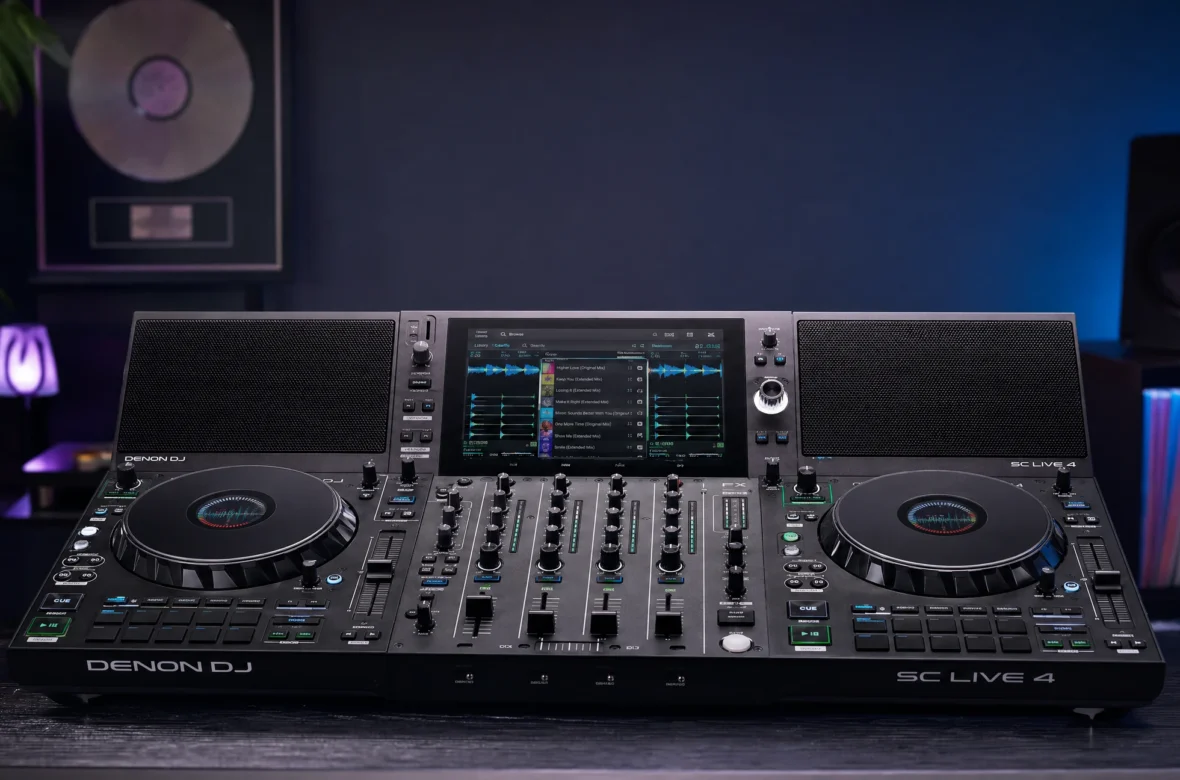
The Denon SC Live 4 is one of the smartest products in DJing right now. It takes the thing that made the Prime 4+ special — true four-deck standalone play — and delivers it at the lowest price any Denon standalone has ever sold for, then adds built-in speakers so you can literally switch it on and mix with nothing else plugged in. Aside from the Prime 4+, it’s one of the only true 4-channel standalones on the market. The trade-off is that it’s plastic instead of metal, has a small screen, and is missing some connections. For the right DJ that’s a brilliant bargain. Here’s the honest picture.
The Denon SC Live 4 is the most affordable true 4-deck standalone system, with built-in speakers, a 7″ touchscreen, Engine OS, standalone Stems, huge streaming (including Apple and Amazon Music), and a Serato DJ Pro licence included. It’s ideal for home, practice, livestreaming, and small gigs. The catches: plastic build, a 7″ screen that’s tight for four decks, and no inputs for turntables or CDJs.
SC Live 4 at a Glance
The key specs and what they mean for you:
| Spec | SC Live 4 | What it means for you |
|---|---|---|
| Type | 4-deck standalone + built-in speakers | Switch on and play — nothing else needed |
| Channels | 4 — true standalone | Cheapest true 4-deck standalone available |
| Screen | 7″ multi-gesture (fixed angle) | Works, but tight for four waveforms |
| Jog wheels | 6″ touch-sensitive, colour LCD centres | BPM/track info on the jog; responsive |
| Stems | Standalone Stems (pre-render in Engine DJ Desktop) | Isolate vocal/melody/bass/drums — one-time licence |
| FX | 4 Sweep FX + 13 BPM FX (17 total) | Club-style FX section on the right |
| Software | Engine OS; Serato DJ Pro licence included; Virtual DJ | Standalone or laptop — your choice |
| Connectivity | 2 USB + SD, Bluetooth, 2 mic, aux, XLR + RCA main, 1/4″ booth | No turntable/CDJ inputs — key limitation |
| Build / price | Plastic · ~$1,299–$1,599 (check local) | Cost-cut to hit the price |
(Prices vary by region and have moved since launch — confirm the current Thailand/local price before buying.)
The Big Deal: 4 Decks, Standalone, at This Price
This is why the SC Live 4 matters. True four-deck standalone play — mixing four tracks at once with no laptop — has historically been the preserve of expensive flagships like the Prime 4+ (Pioneer’s XDJ-XZ can’t even do it from USB). The SC Live 4 brings that capability down to the cheapest Denon standalone price ever, which genuinely lowers the barrier for a lot of DJs. Add the built-in speakers and it’s the fastest setup in DJing: switch on, hit the speaker switch, load one of the built-in demo tracks and you’re playing — no cables, no monitors, no laptop. If you’ve wanted a Prime 4+ but couldn’t justify the price, this is the answer.
What’s Great About the SC Live 4
Built-In Speakers That Actually Work
Borrowed from sister-brand Numark’s Mixstream Pro but sounding noticeably better, the speakers sit at the top of the unit (not under your hands), with their own volume knob and on/off switch. They’re loud and clear enough for practice, content creation, livestreaming, small home parties, and personal monitoring at a gig. Be realistic: they will not serve as monitors in a loud club — but for the intended home/streaming audience they’re genuinely useful, and they make the unit feel instantly playable.
Club-Style Layout and Real FX
This was a first for Denon: the SC Live layout is modelled on club gear, with the FX section moved to the right of the mixer to match the industry-standard arrangement (as on Denon’s own X1800/X1850 club mixers). You get a 3-band full-kill EQ, four knob-controlled Sweep FX (filter, noise, echo, wash), 13 customisable BPM FX, and eight pads per deck for hot cues, loops, rolls, and slicing. It genuinely prepares you for a club-standard rig.
Streaming, Stems, Lighting, and Serato Included
It was the world’s first DJ hardware to support Amazon Music Unlimited, and also streams Apple Music, Beatport, Beatsource, SoundCloud GO+, TIDAL, and Dropbox — over 100 million lossless tracks, so you can play a full set without owning any music. It does standalone Stems (pre-rendered in Engine DJ Desktop; one-time licence). It drives Philips Hue, Nanoleaf, and DMX lights beat-synced from the unit — a real gift for solo livestreamers and mobile DJs. And a Serato DJ Pro licence is included for laptop use, with Virtual DJ also supported.
What to Watch Out For
- No inputs for turntables or CDJs. The most important limitation. The only external inputs are two mics and an aux — you cannot plug in external decks, and can’t route external sources through the EQ or FX. It’s a closed, self-contained system by design.
- Plastic, not metal. Reviewers noted it feels more like Numark gear than Denon Prime gear. It’s fine and lightweight — Pioneer uses plastic too — but it’s a clear departure from the Prime range’s build.
- The 7″ screen is tight for four decks. The single most common criticism: it’s the same size as on 2-deck units but has to show four waveforms and manage a bigger workflow. It’s also fixed-angle, so no tilting.
- Not that much cheaper than Prime units. Depending on current pricing, the gap to a Prime 2/Prime 4+ can be smaller than you’d expect — always compare live prices.
- External power brick. A 12V brick rather than a proper IEC socket, which is annoying on a unit this size.
- Stems cost extra. Standalone Stems require a one-time software licence purchase on top.
- No internal drive bay. Unlike the Prime 2/Prime 4+, there’s no SATA bay for an internal library drive.
How It Compares
- vs Prime 4+: The Prime 4+ is the grown-up version: metal build, 10.1″ screen, internal drive bay, external inputs for turntables/CDJs, more I/O. The SC Live 4 gives you the same 4-deck standalone core plus speakers for less. Choose the SC Live 4 for value and convenience; the Prime 4+ if you need pro build and connectivity.
- vs SC Live 2: The SC Live 2 saves roughly $200 but drops to two decks, fewer pads, and less I/O. If you want four decks, the Live 4 is the reason this line exists.
- vs Pioneer XDJ-RX3: The RX3 has a much bigger, better screen and the Pioneer ecosystem clubs use — but it’s 2-channel and pricier. The SC Live 4 gives you double the decks and speakers for less. It’s an ecosystem choice.
Who the SC Live 4 Is Really For
It’s ideal for the home DJ, livestreamer, or content creator who wants a genuine 4-deck club-style system that’s instantly playable — and for mobile DJs on a budget who need four decks and don’t require external inputs. It’s also the answer for anyone who’s long wanted a Prime 4+ but couldn’t justify the cost. Skip it if you need to connect turntables or CDJs (get the Prime 4+), if you want a big screen for four-deck work, if you need club-level monitoring from the built-in speakers (they won’t manage it), or if you only ever use two decks — where the SC Live 2 or a Prime 2 makes more sense.
A Note From NaJade
I have a lot of time for what this unit represents. Four-deck standalone used to be a luxury; the SC Live 4 made it affordable, and the speakers mean a beginner can be mixing thirty seconds after opening the box — that’s genuinely good for DJing. If you’re a home player, a streamer, or you’re building content, this is arguably the best value in the whole standalone world. Two honest flags from me. First, the no external inputs thing is the one people regret: if there’s any chance you’ll want to plug in turntables, a CDJ, or another player, this closes that door permanently, and the Prime 4+ is the unit you actually want. Second, don’t over-trust the speakers — they’re brilliant for your room and useless in a loud venue, so if you’re gigging, budget for real monitors and a PA anyway. Go in knowing it’s a self-contained home-and-small-gig machine and it’s a joy. And as always, four decks won’t make you better — the crowd responds to your selection and your read of the room, not your channel count.
See the whole lineup in my complete Denon DJ range guide, or the wider DJ gear for beginners series. Want help learning to mix on a standalone? My DJ lessons run in person in Bangkok or online over Zoom.
Frequently Asked Questions About the Denon SC Live 4
Is the Denon SC Live 4 worth it?
Are the SC Live 4’s built-in speakers any good?
Can you connect turntables or CDJs to the SC Live 4?
What’s the difference between the SC Live 4 and Prime 4+?
Does the SC Live 4 have Stems?
Does the SC Live 4 work with Serato?
About the Author
NaJade is a Bangkok-based DJ playing progressive house, melodic EDM, pop, and Thai music across clubs, rooftops, and weddings in Thailand. He teaches beatmatching and mixing to beginners both in person in Bangkok and online over Zoom. When he’s not behind the decks, he’s documenting the journey on YouTube, Instagram, and TikTok.