
By NaJade · DJ in Bangkok · Published September 29, 2026
This guide is part of Denon DJ controllers & standalone systems: the complete range explained.
A full pro DJ system with a four-hour battery that fits in a backpack. Beach, rooftop, park, hotel room — anywhere. There’s genuinely nothing else quite like it. Here’s the honest verdict.
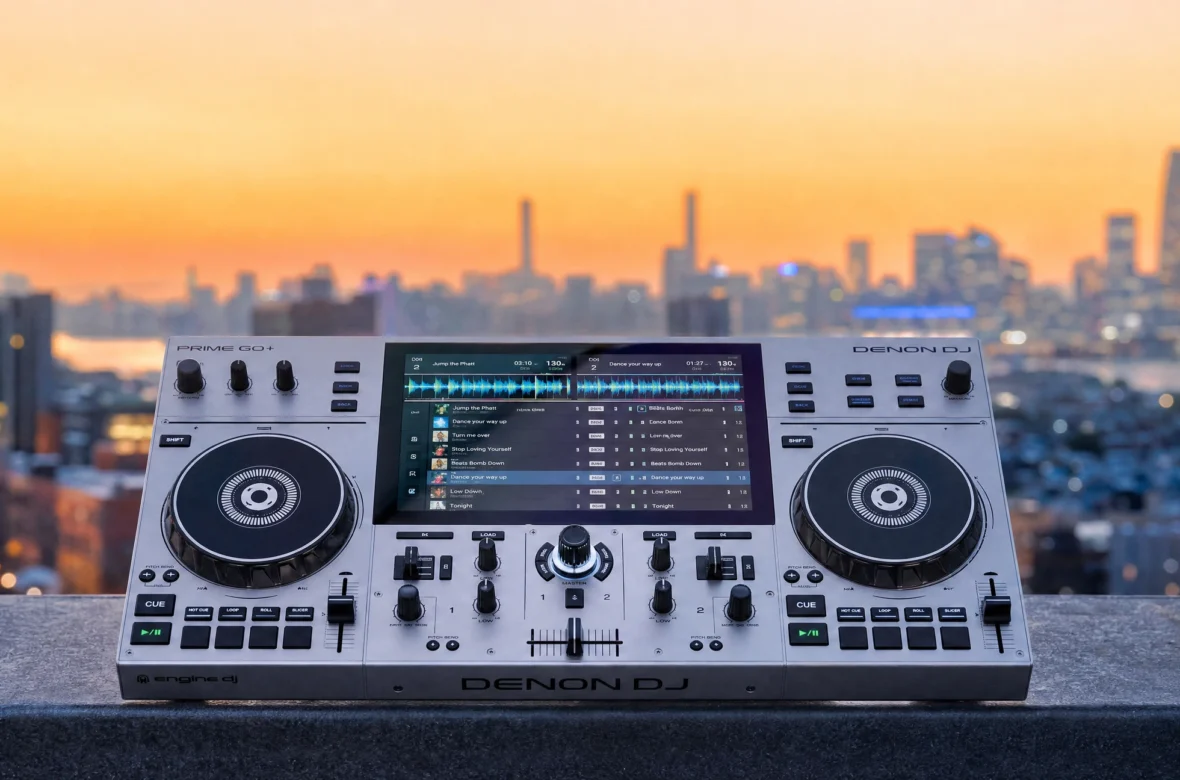
The Denon Prime GO is the one piece in this whole guide that created a category. It’s a complete, standalone, two-deck DJ system — screen, mixer, Engine OS computer and all — with a rechargeable battery that gives you around four hours of play with no mains power at all. Throw it in a backpack, walk to a beach or a rooftop, plug in a speaker, and you have a party. Nothing else at this level does that. The current version is the Prime GO+ (2024), which adds Bluetooth and a longer battery. It’s brilliant — but it’s a luxury item with real compromises. Here’s the honest picture.
The Denon Prime GO+ is a fully standalone 2-deck DJ system with a rechargeable battery giving roughly 4 hours of play with no mains power — the most portable pro system of its kind. It runs the same Engine OS as Denon’s flagships, with a 7″ touchscreen, Wi-Fi streaming, Bluetooth, dual mics, and pro outputs. The catches: small cramped jogs, a fixed screen angle, and at around $999 it’s a lot for a first system.
Prime GO+ at a Glance
The key specs and what they mean for you:
| Spec | Prime GO+ | What it means for you |
|---|---|---|
| Type | Portable 2-deck standalone all-in-one | A complete DJ system in a backpack |
| Battery | Rechargeable lithium-ion, ~4 hours | The headline: play with no mains power |
| Screen | 7″ HD multi-gesture, day mode, fixed angle | Feels generous on a unit this size; glare risk outdoors |
| Jog wheels | Small, touch-capacitive | Fine for blending; cramped for scratching |
| Software | Engine OS — same core as the flagships | No software features cut; imports rekordbox |
| Streaming | Wi-Fi: TIDAL, Amazon Music, Beatport, Beatsource, SoundCloud GO+, Dropbox | Millions of tracks with no drive |
| Connectivity | USB + SD, Bluetooth in/out, 2 mic, aux, master + booth, dual headphone | Surprisingly pro I/O for the size |
| Build / size | Metal construction · ~12″ wide | Rugged and genuinely backpackable |
| Price | ~$999 (check current local price) | Premium for the size — it’s a luxury item |
(Prices vary by region and over time — confirm the current Thailand/local price before buying.)
The Headline: Four Hours, No Power Needed
Everything about the Prime GO flows from the battery. Roughly four hours of untethered play covers the vast majority of DJ sets, and it changes what’s possible: a beach session, a rooftop sunset, a park, a pop-up, a hotel room on tour, prepping a set on a plane or in the back of a car. Living in Bangkok, I can tell you the “play anywhere” thing isn’t a gimmick — rooftops and outdoor spaces are exactly where this shines. DJ TechTools called it the “Mercedes Benz of battery-powered units,” and that’s fair: it’s a genuinely premium, fully-featured system, not a toy with a battery bolted on.
What’s Great About the Prime GO+
No Software Compromises
This is the clever part. Because every Prime unit runs the same Engine OS, the smallest unit in the range loses almost nothing in software: the same fast loading and library navigation, playlist creation on the unit, onboard analysis (including reading rekordbox collections with cues and loops), track preview, and Wi-Fi streaming from TIDAL, Amazon Music, Beatport, Beatsource, SoundCloud GO+, and Dropbox. And because it’s CPU-based, Denon keeps adding features via firmware. Reviewers consistently note the 7″ screen actually feels generous here in a way it doesn’t on the bigger Prime 2.
Pro Connectivity in a Tiny Box
This is what separates it from “entry-level”: two mic inputs, an aux input, separate master and booth outputs, dual headphone ports, USB and SD, plus Bluetooth audio in/out on the GO+. That’s a genuinely professional I/O set — enough to run a real wedding cocktail hour, a bar, or a second room, not just a bedroom.
A Superb Second System
One of its smartest uses: a backup or secondary rig. If you already own Denon gear, the GO shares your Engine library exactly — so it’s a pro-grade backup for big events, a cocktail-hour unit at a wedding, a coffee-shop gig you can carry, or a prep station for your hotel room on the road. Pop it in a flight case and it’d hold a main room at a pinch.
What to Watch Out For
- The jogs are small and cramped. The clearest compromise. They’re fine for blending and cueing, but scratching or intricate work is genuinely limited. Don’t buy this as a scratch unit.
- Fixed screen angle. The screen sits flat and doesn’t tilt, so glare can be a real problem outdoors — ironic given it’s built for outdoor play (the day mode helps).
- The GO+ dropped the Ethernet port. The original had one; the GO+ is Wi-Fi-only (a USB dongle works, but that occupies your USB port). Since streaming leans on venue Wi-Fi, that’s a step backwards for reliability.
- It’s a lot for a first system. At ~$999 it’s excellent value for what it is, but it’s above most first-timers’ budgets — and it’s a luxury item, not a bargain.
- Two channels, compact layout. The EQ layout is cramped by necessity, and you’re limited to two decks.
- No club standard. Like all Denon, clubs run Pioneer — this is a play-your-own-gigs machine.
Prime GO vs Prime GO+: Should You Upgrade?
The GO+ (2024) is a refresh, not a revolution. It adds Bluetooth in/out, a newer, more efficient processor with roughly 25% more battery life, Amazon Music streaming, and a refreshed silver finish — but removes the Ethernet port. If you already own the original Prime GO, that’s not a compelling upgrade unless Bluetooth genuinely matters to you. If you’re buying fresh, the GO+ is the one to get.
Who the Prime GO+ Is Really For
It’s made for the DJ who wants to play anywhere — outdoor sessions, beaches, rooftops, pop-ups, parks — and for the mobile or wedding DJ who needs a serious, pro-connected backup or second-room system. It’s also excellent for anyone tight on space, or who wants to prep sets on the move. Skip it if you’re a scratch DJ (those jogs), if you need four decks or a big screen (Prime 4+), if you want built-in speakers at a lower price (SC Live 2), or if you’re a first-timer who’d rather spend less to learn on.
A Note From NaJade
Of everything in the Denon range, this is the one that makes me smile. Playing a sunset on a rooftop with no cables, no laptop, no mains — that’s a genuinely joyful way to DJ, and Bangkok is full of places where that’s possible. What impresses me most is Denon’s discipline: they didn’t cripple the software to make it small, so you get the real thing in a backpack. Two honest flags, though. First, the jogs: if you’re a scratch or heavy-hands DJ, you will feel cramped, so go touch one before you buy. Second, be clear about why you’re buying it — if it’s genuinely for portability and playing in places power doesn’t reach, it’s worth every baht and there’s nothing else like it. If you’ll actually just sit it on a desk at home forever, a Prime 2 or an SC Live gives you more unit for the money. Buy the freedom, not the novelty — and remember the crowd on that rooftop responds to your selection and your read of the moment, never to the box you carried up there.
See the whole lineup in my complete Denon DJ range guide, or the wider DJ gear for beginners series. Want help getting set up and mixing confidently? My DJ lessons run in person in Bangkok or online over Zoom.
Frequently Asked Questions About the Denon Prime GO
How long does the Denon Prime GO battery last?
Is the Denon Prime GO worth it?
What’s the difference between the Prime GO and Prime GO+?
Can you scratch on the Denon Prime GO?
Does the Denon Prime GO need a laptop?
Is the Denon Prime GO good for beginners?
About the Author
NaJade is a Bangkok-based DJ playing progressive house, melodic EDM, pop, and Thai music across clubs, rooftops, and weddings in Thailand. He teaches beatmatching and mixing to beginners both in person in Bangkok and online over Zoom. When he’s not behind the decks, he’s documenting the journey on YouTube, Instagram, and TikTok.