
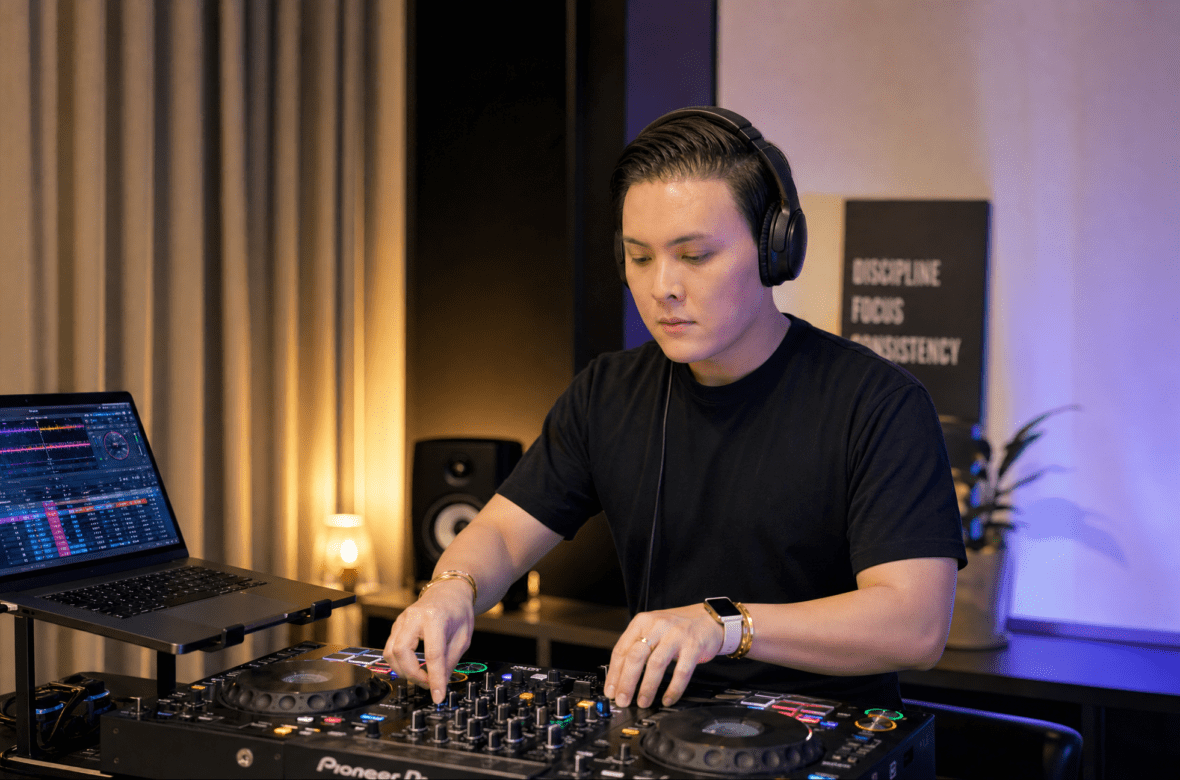
By NaJade · DJ in Bangkok · Published September 29, 2026
Everything you need to go from complete beginner to confident DJ — the full roadmap, in order.
If you’ve ever stood at the back of a club watching the DJ and thought “I want to do that” — this guide is your starting point. Learning to DJ is more achievable than ever in 2026, and you don’t need expensive gear, a music degree, or industry connections to begin. What you need is the right path and the willingness to practice. This is the complete beginner’s roadmap: what to buy, the skills to learn and the order to learn them in, how to perform, and how to actually improve. Each section links to a full deep-dive guide when you’re ready for the detail.
To learn to DJ: start with an entry-level controller and free software, learn to beatmatch by ear, then learn to mix two tracks using EQ and the bass swap, understand phrasing by counting bars, set hot cues to control your tracks, then develop the performance skills — reading a crowd and building sets. Consistent, focused practice ties it all together. Most beginners can play a basic mix within a month and become gig-ready in 6–12 months.
Step 1: Get Your Gear
You can’t learn to DJ without something to learn on — but the good news is you need far less than you think. For almost every beginner, the answer is a two-channel DJ controller connected to a laptop. It’s affordable, compact, and teaches every fundamental skill that transfers to professional club gear later.
Don’t fall into the trap of thinking expensive equipment will make you better — it won’t. A solid entry-level controller is more than enough to become genuinely good. For specific recommendations across budgets, see my full guide to the best DJ controllers for beginners. Your controller will come with free software — usually rekordbox or Serato — and if you’re unsure which to commit to, my rekordbox vs Serato comparison breaks down the choice (short version: use whichever your controller is built for).
Step 2: Learn to Beatmatch
Beatmatching — getting two tracks playing at the same tempo with their beats aligned — is the foundation everything else is built on. Modern software has a “sync” button that does this automatically, and it’s tempting to rely on it entirely. Don’t. Learning to beatmatch by ear trains your timing and musical awareness, and it’s the skill that separates DJs who last from those who plateau.
This is where every beginner should spend their first weeks. My beginner’s guide to beatmatching walks through exactly how to do it step by step.
Step 3: Understand Phrasing (Counting Bars)
Here’s the skill that quietly makes everything sound right: phrasing. Music is built in groups of beats (bars) and groups of bars (phrases) — and mixing on those phrase boundaries is what makes a transition feel musical instead of accidental. You can beatmatch perfectly and still sound off if your phrasing is wrong.
The good news: if you can count to four, you can learn it. My guide to counting bars and phrases shows you how, and why it’s the secret behind clean mixing.
Step 4: Mix Two Songs Together
Now you combine beatmatching and phrasing into the thing that makes you feel like a real DJ: blending two tracks seamlessly. The core move is bringing the new track in during a beats-only section, on a phrase boundary, while managing the low-end so two basslines never clash.
This is the heart of DJing, and it’s worth getting really comfortable with. Full step-by-step walkthrough in my guide to mixing two songs together.
Step 5: Master EQ and the Bass Swap
If your mixes ever sound muddy even when the beats line up, EQ is the fix. The three EQ knobs — low, mid, high — let you carve space so two tracks coexist cleanly. The single most important technique here is the bass swap: cutting one track’s bass as you bring the other’s up, so only one bassline ever drives the floor.
Learning this one skill is the fastest upgrade to how professional you sound. Here’s my full guide to using EQ when DJing.
Step 6: Use Hot Cues to Control Your Tracks
Those colored pads on your controller? They’re hot cues — saved markers that let you jump instantly to any point in a track, like the intro, the drop, or the breakdown. They make your mixing faster and more precise, and they mean you always know exactly where you are in a song.
Setting up a simple, consistent cue system early is a habit that pays off forever. Learn how in my guide to hot cues and how to use them.
Step 7: Learn to Read a Crowd
Everything up to here is technical. This is where DJing becomes an art. Reading a crowd — sensing the room’s energy and responding to it in real time — is what separates someone who plays music from someone who throws a party. You can have flawless technique and still clear a floor if you ignore the room.
It’s a skill you can only truly build live, but knowing what to watch for accelerates it hugely. My guide to reading a crowd as a DJ covers exactly that.
Step 8: Build Sets That Flow
A great set isn’t a pile of great tracks — it’s a journey with a shape: a warm-up, a build, a peak, and a close. Learning to plan an energy curve (and to plan your peak first) turns a random playlist into a performance that takes the room somewhere.
Once you can mix and read a room, this is the next level. Here’s my guide to building a DJ set.
How Long Does It All Take?
A realistic timeline: most beginners can play a basic mix within their first month, mix cleanly within 2–3 months, and become gig-ready within 6–12 months of consistent practice. Becoming genuinely great is a lifetime pursuit — and that’s the appeal. For the full month-by-month breakdown, see how long it takes to learn to DJ.
How to Actually Improve (and Avoid the Traps)
Two things make the difference between beginners who get good fast and those who stall: how they practice, and the mistakes they avoid.
Practice the right way. Short, focused, near-daily sessions beat rare marathons every time. Give each session one goal, record yourself, and review critically. My guide to practicing DJing includes a simple 30-minute daily routine that works.
Avoid the common traps. Relying entirely on sync, opening sets too high, overusing effects, neglecting EQ — these are the avoidable habits that slow most beginners down. Know them in advance with my guide to the common beginner DJ mistakes and how to fix each one.
A Note From NaJade
I started exactly where you are — watching DJs and wondering if I could ever do that, then figuring it out one skill at a time in my bedroom in Bangkok. The path above is the one I actually walked, just without the wasted detours. If there’s one thing I want you to take away, it’s that none of this is talent-gated. It’s a series of learnable skills, stacked in order, built through showing up consistently. Start with a controller and a single track tonight. Make your first messy beatmatch. Everything else grows from there.
And if you’d rather not navigate it all alone, that’s exactly what I do — my DJ lessons take you through this whole journey step by step, in person in Bangkok or online over Zoom anywhere in the world. We start wherever you are and build from there, so you skip the months of bad habits and frustration most self-taught beginners go through.
Frequently Asked Questions About Learning to DJ
How do I start learning to DJ as a complete beginner?
Can I teach myself to DJ?
What do I need to start DJing?
How long does it take to learn to DJ?
What should I learn first when DJing?
Is it hard to learn to DJ?
About the Author
NaJade is a Bangkok-based DJ playing progressive house, melodic EDM, pop, and Thai music across clubs, rooftops, and weddings in Thailand. He teaches beatmatching and mixing to beginners both in person in Bangkok and online over Zoom. When he’s not behind the decks, he’s documenting the journey on YouTube, Instagram, and TikTok.