
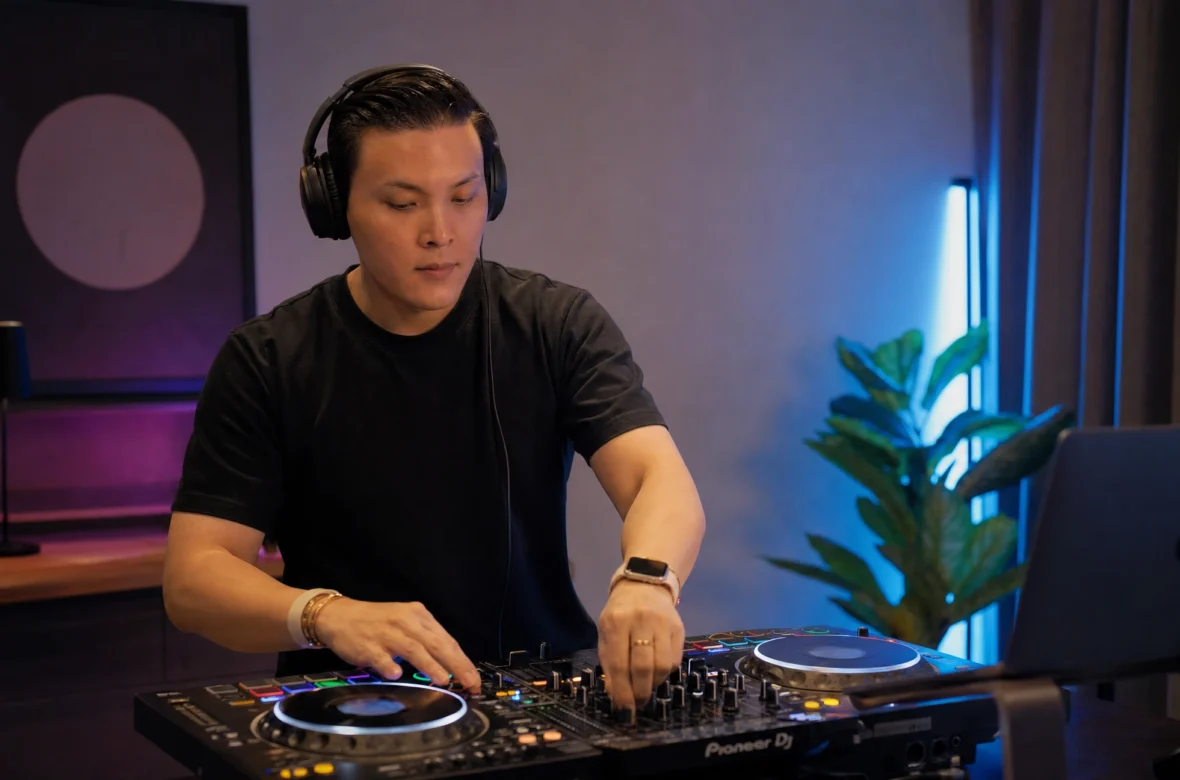
By NaJade · DJ in Bangkok · Published September 28, 2026
The honest answer — from your first mix to your first paid gig, and everything in between.
It’s the question every beginner asks before they start, and the one most guides dodge with a vague “it depends.” So here’s the honest version, from someone who went through it recently. The timeline below is realistic — not the hype you see in “learn to DJ in a weekend” ads, and not the gatekeeping that says it takes years before you’re allowed to enjoy it.
A complete beginner can play a basic 30-minute mix after 4 to 8 practice sessions. Becoming a confident DJ who can play a real gig takes 6 to 12 months of consistent practice. Becoming genuinely great is a lifetime — and that’s the point. The first lesson is enough to know whether you love it.
What “Learning to DJ” Actually Means
Part of why the answer feels slippery is that “learning to DJ” isn’t one skill — it’s a stack of them, learned in layers:
- The mechanics — loading tracks, using the software, beatmatching, basic transitions. Fastest to learn.
- The craft — EQ mixing, phrasing, harmonic mixing, building energy across a set. Takes months.
- The art — reading a crowd, track selection, knowing the exact moment to drop the next song. Takes years, and never really stops developing.
The good news: you don’t need to master all three before you start having fun. You’ll be playing enjoyable mixes long before you’ve “finished” learning — because no one ever finishes.
A Realistic Timeline for Learning to DJ
Month 1: Your First Mix
In your first month of regular practice, you’ll learn how your gear and software work, how to beatmatch, and how to make a basic transition between two tracks. By the end of the month, most people can play a rough but recognizable 30-minute set. It won’t be clean. It’ll be yours, and it’ll feel incredible.
Months 2–3: Cleaner Mixing
Now the fundamentals start to click. You move from “the beats roughly line up” to EQ-based transitions that actually sound smooth, you start hearing phrasing (mixing on the right musical sections, not just any beat), and you can hold a 60-minute set together. This is where it stops feeling like button-pressing and starts feeling like music.
Months 4–6: Finding Your Sound
By now you’re mixing confidently. You learn harmonic mixing (matching keys), more creative transitions, and you start developing taste — a sense of which tracks are yours. Many people play their first sets for friends around here, and some land their first small gig. This is also when a genre identity forms; for me, it was progressive house and melodic EDM.
Months 7–12: Gig-Ready
With consistent practice, by the end of the first year you can confidently play a real venue — a bar, a private party, a warm-up slot. You can recover from mistakes live, read a room well enough to adjust, and structure a set with intention. You’re a working-level DJ. Not a legend yet, but absolutely good enough to be booked.
Year 2 and Beyond: The Real Craft
This is where the art lives — performance presence, reading huge crowds, building a personal style people recognize, and the business side if you want to go pro. There’s no finish line here, and that’s the appeal. The best DJs in the world are still learning. That’s what makes it a craft worth keeping.
What Makes Some People Learn Faster
The timeline above assumes steady, regular practice. A few things speed it up — or slow it down:
- Practice frequency. 20 minutes a day beats a three-hour session once a week. Consistency builds the ear faster than cramming.
- A musical background. If you already play an instrument or have a strong sense of rhythm, beatmatching tends to click sooner.
- Learning by ear vs leaning on sync. Beatmatching manually early on builds the underlying skill that makes everything else faster later.
- Having a teacher. A good teacher cuts months off the timeline by fixing bad habits before they set in and showing you what to focus on.
- The right starting gear. You don’t need expensive equipment, but a proper beginner controller with a real layout teaches better than a toy one.
Can You Learn to DJ Faster With Lessons?
Honestly — yes, usually. Not because lessons hand you a shortcut, but because they remove the wasted time. Left alone, most beginners spend weeks reinforcing small mistakes, getting stuck on the same transition, or not knowing what to practice next. A teacher catches those things immediately. You’ll still put in the hours — there’s no avoiding that — but the hours count for more. According to audio education resources like iZotope’s learning hub, structured, focused practice consistently outperforms unstructured tinkering, and DJing is no exception.
A Note From NaJade
I started in 2025, and I remember exactly how the timeline felt from the inside: the first month was equal parts frustration and magic, and the moment two tracks first locked together I was hooked for good. The thing I’d tell my past self is to stop worrying about how long it takes and just practice tonight. The clock only matters if you’re standing still. Show up consistently and the milestones arrive on their own.
If you want to move through this timeline faster — and skip the months of bad habits I had to unlearn — that’s exactly what my DJ lessons are for, in person in Bangkok or online over Zoom anywhere in the world. We start wherever you are and build from there.
Frequently Asked Questions About Learning to DJ
How long does it take to learn to DJ?
Can you learn to DJ in a weekend?
How often should I practice to learn DJing quickly?
Is it hard to learn to DJ?
How long until I can play my first paid gig?
Do lessons make you learn to DJ faster?
About the Author
NaJade is a Bangkok-based DJ playing progressive house, melodic EDM, pop, and Thai music across clubs, rooftops, and weddings in Thailand. He teaches beatmatching and mixing to beginners both in person in Bangkok and online over Zoom. When he’s not behind the decks, he’s documenting the journey on YouTube, Instagram, and TikTok.