
By NaJade · DJ in Bangkok · Published September 28, 2026
This guide is part of Denon DJ controllers & standalone systems: the complete range explained.
The player that started Denon’s assault on the CDJ — still supported, still capable, and now a serious value pick on the used market. Here’s the honest verdict.
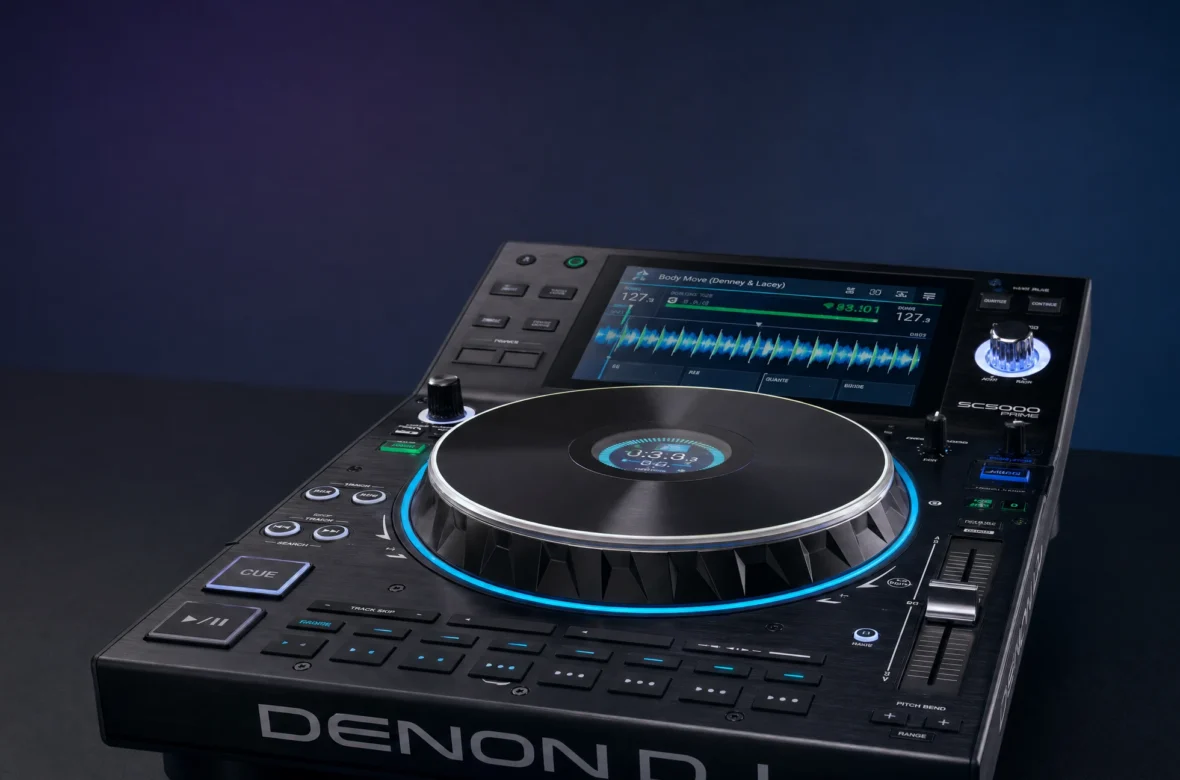
The Denon SC5000 Prime is where the modern Denon story began. Launched in 2017, it was the world’s first DJ media player with onboard track analysis and the dual-layer trick, and it kicked off the “#ChangeYourRider” campaign that put Denon on the map as a genuine CDJ rival. It’s since been superseded by the SC6000, but here’s the important part: Denon confirmed it stays on sale and keeps getting updates. That makes it a smart value pick — new at a lower price, or excellent used. Here’s who should still consider it.
The Denon SC5000 Prime (~$1,099 new, less used) is the original Denon pro media player — a dual-layer CDJ rival with a 7″ touchscreen, onboard analysis, and standalone play. It’s been superseded by the SC6000 but is still sold and updated, making it a strong value pick for a club-style separates rig on a budget. The catches: a smaller 7″ screen, less refined jogs, and no internal drive bay versus the SC6000.
SC5000 at a Glance
The key specs and what they mean for you:
| Spec | SC5000 Prime | What it means for you |
|---|---|---|
| Type | Pro standalone media player (needs a mixer) | The original Denon CDJ rival |
| Screen | 7″ high-definition multi-touch | Good, but smaller than the SC6000’s 10.1″ |
| Dual-layer | Yes — two decks + separate outputs per unit | Play a full set from one player |
| Jog | Capacitive touch, HD centre display | World-first onboard analysis at launch |
| Storage | 3 USB + SD; rear USB for mass storage (no internal SATA bay) | Plenty of media options; no internal drive |
| Software / audio | Engine OS; Serato DJ; 24-bit/96kHz, FLAC/ALAC/WAV | Standalone or software; audiophile output |
| Status | Superseded by SC6000, but still sold & updated | Safe to buy; ongoing firmware support |
| Price | ~$1,099 new (less used) — check local | The value entry to a Denon separates rig |
(Prices vary by region and over time — confirm the current Thailand/local and used-market price before buying, and budget for two players plus a mixer.)
Why the SC5000 Still Makes Sense
The SC5000 was genuinely groundbreaking — the first player to analyse tracks onboard and offer dual-layer playback, and the deck that forced Pioneer to pay attention (some SC5000 ideas later showed up in the CDJ-3000). It’s no longer the flagship, but its core is still excellent, and crucially Denon kept it on sale and kept updating it rather than abandoning it. That means you can build a real, modern, standalone club-style rig around SC5000s for meaningfully less than SC6000s — new or, even better, used. For a budget-conscious DJ who wants dual-layer power and standalone play, it’s one of the best value routes into the Prime ecosystem.
What’s Great About the SC5000
The Same Dual-Layer Superpower
The SC5000 has the same headline trick as the SC6000: two independent layers with separate outputs, so one player behaves like two decks. You can mix an entire set from a single SC5000, or build four decks from two players — a big cost saving on a home or mobile rig, and something Pioneer CDJs still don’t offer.
Familiar Layout, Pro Feel
If you know CDJs, the SC5000 is instantly familiar — a raised platter, a decent screen, USB/SD up front (tucked where the CD slot would be, protecting media from accidental knocks), eight pads for hot cues, loops, slicing, and roll, plus pitch-bend buttons (a nice touch many players dropped). It’s built to pro standards for club use, with 24-bit/96kHz audio and support for FLAC, ALAC, and WAV. Denon’s keylock, in particular, has been praised as best-in-class.
Still Supported, Still Growing
This is what makes it a safe buy: rather than discontinue it, Denon kept the SC5000 in the lineup and continued issuing firmware updates, so it benefits from the maturing Engine OS. It reads rekordbox libraries, runs Serato DJ, and pairs over LAN with Denon mixers — so a used SC5000 rig isn’t a dead end, it’s a living part of the ecosystem.
What to Watch Out For
- Smaller 7″ screen. The clearest step down from the SC6000’s 10.1″ — still usable, but library work and waveforms have less room.
- Less refined jogs. The SC6000 improved jog feel and tension smoothness; the SC5000’s are good but a generation behind.
- No internal SATA drive bay. You can attach mass storage via rear USB, but there’s no internal drive slot like the SC6000’s.
- Not the club standard. Like all Denon, clubs run Pioneer — this is an own-rig deck.
- You still need two plus a mixer, and it’s a heavy pro unit to transport.
- Buy used carefully. As with any second-hand pro gear, check jog tension, screen, and pad response before purchase.
How It Compares
- vs SC6000: The SC6000 is the upgrade — bigger 10.1″ screen, better jogs, an internal drive bay, refined design. The SC5000 has the same dual-layer core for less. Choose the SC5000 to save money; the SC6000 for the nicer screen and drive bay.
- vs SC6000M: The M adds a motorized platter for scratching. The SC5000 has a static jog. Only relevant if you scratch.
- vs Pioneer CDJ-3000 / older CDJs: The SC5000 undercuts current CDJs dramatically and adds dual-layer play, but isn’t the club standard. Against older used CDJ-2000NXS2s it’s a feature-rich, cheaper alternative for an own-rig build.
Who the SC5000 Is Really For
It’s ideal for the budget-conscious DJ who wants a real, dual-layer, standalone club-style separates rig and is happy with a 7″ screen — especially anyone shopping the used market for value. It’s also a sensible pick to pair with an X1850 for a capable, affordable setup. Skip it if you want the biggest screen and an internal drive bay (get the SC6000), if you scratch (SC6000M), if you need club-standard Pioneer gear, or if you’d rather have an all-in-one like the Prime 4+.
A Note From NaJade
There’s something I really respect about the SC5000: Denon didn’t kill it when the SC6000 arrived — they kept selling it and kept updating it, which means a used pair today is a genuinely smart, living buy rather than orphaned gear. If your budget is tight and you want into the dual-layer, standalone world, this is arguably the best-value door there is. Be clear-eyed about the trade: the 7″ screen and older jogs are a real step down from the SC6000, and you’ll feel that most in library work. But the music comes out identically, and the dual-layer trick still saves you money on decks. My advice: if you can find a well-cared-for used pair and an X1850, you’ll have a serious rig for a fraction of new-flagship money. Buy it for the value and the standalone freedom — and remember, as always, a great set comes from your selection and your read of the room, not from the year your player was released.
See the whole lineup in my complete Denon DJ range guide, or the wider DJ gear for beginners series. Want help building a first club-style rig? My DJ lessons run in person in Bangkok or online over Zoom.
Frequently Asked Questions About the Denon SC5000
Is the Denon SC5000 still worth buying?
What’s the difference between the SC5000 and SC6000?
Is the Denon SC5000 discontinued?
Does the SC5000 have dual-layer playback?
Does the SC5000 need a mixer?
Can the SC5000 read rekordbox and run Serato?
About the Author
NaJade is a Bangkok-based DJ playing progressive house, melodic EDM, pop, and Thai music across clubs, rooftops, and weddings in Thailand. He teaches beatmatching and mixing to beginners both in person in Bangkok and online over Zoom. When he’s not behind the decks, he’s documenting the journey on YouTube, Instagram, and TikTok.