
By NaJade · DJ in Bangkok · Published October 26, 2026
This guide is part of how to learn to DJ: the complete guide.
People hear the music, but they remember the room. Lighting is what turns a function hall into a party.
If you’re starting to play weddings, birthdays, school events or small bars that don’t have a lighting rig, your own lights can do as much for the atmosphere as your track selection. The good news: a simple, effective setup costs less than a decent controller, and you don’t need to be a lighting engineer to run it. This guide covers what to buy first, how to set it up safely, and when it’s worth moving to DMX control.
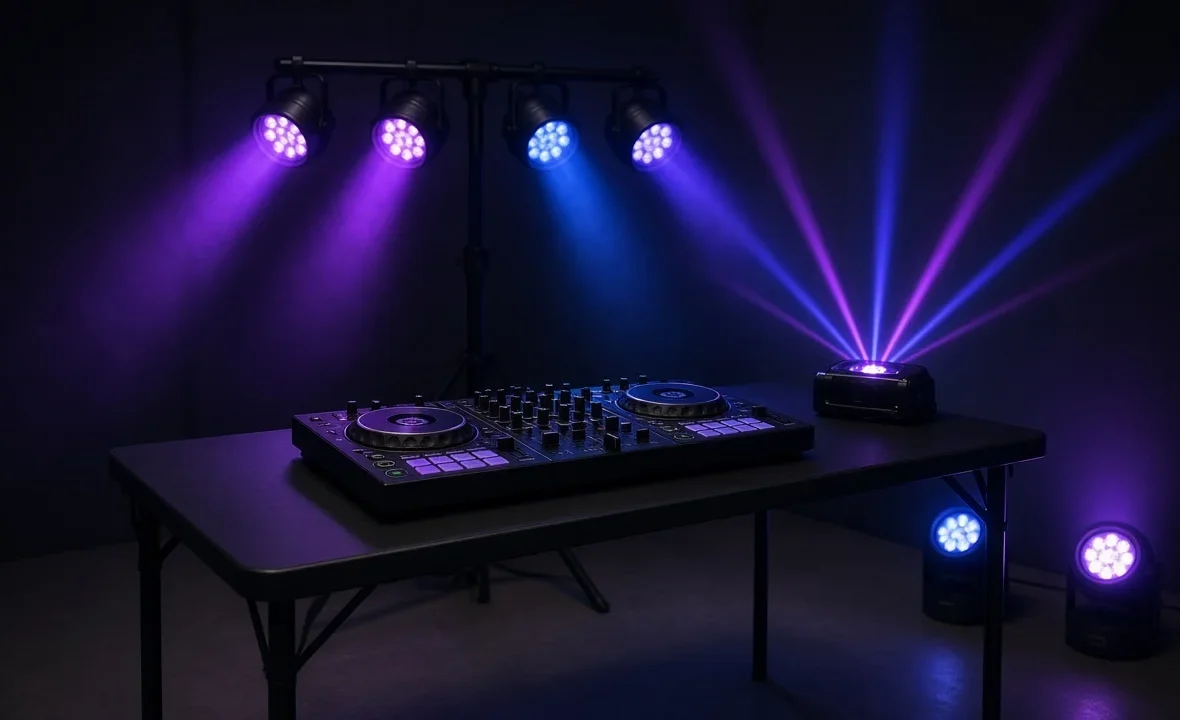
Start small: two LED wash or par lights on a stand to light the dance floor, one effect light for movement, and a few battery uplighters for the room. Run everything in sound-active or auto mode at first. Once you’re comfortable, add a DMX interface and software such as SoundSwitch to sync lights to your tracks.
The Four Types of DJ Lights
| Type | What it does | Beginner priority |
|---|---|---|
| Wash / par lights | Flood the dance floor with even colour | Essential — buy these first |
| Effect lights | Moving beams, derby or gobo patterns for energy | High — one good unit is enough |
| Uplighting | Colours walls and pillars to change the whole room | High for weddings and events |
| Moving heads, lasers, haze | Club-style beams and atmosphere | Later — check venue rules first |
Almost all modern DJ lights are LED, which means they run cool, draw little power and can be plugged into ordinary sockets. That makes them far easier to manage than the old halogen cans — especially in hot venues.
A Simple Starter Setup
- A lighting bar or two par lights on a T-bar stand. Place them either side of the booth, angled at the floor rather than into people’s eyes.
- One effect light. A compact derby, moonflower or beam effect adds movement when the floor fills up.
- Four to eight battery uplighters. Wireless, rechargeable units let you colour a room in minutes without running cables across the floor.
- Optional: a small haze machine. Haze makes beams visible, but many venues and hotels ban it because of smoke detectors. Always ask first.
For the rest of the kit that goes in the car, see our mobile DJ equipment guide and how to become a mobile DJ.
How to Control Your Lights
There are three common ways to run a beginner rig, from simplest to most flexible:
- Sound-active or auto mode. Each light has a built-in microphone or program. It’s free, instant and good enough for most small parties.
- Foot controller or remote. Many lighting bars include a footswitch or wireless remote to change scenes, trigger strobes or black out between songs.
- DMX control. DMX512 is the industry-standard protocol for lighting. Each fixture gets an address, and a controller or software tells it exactly what to do. DMX512 explained (Wikipedia).
DMX software can now sync lights to the music in your DJ software. SoundSwitch, for example, works with Engine DJ, Serato and others, and AlphaTheta added official SoundSwitch support in rekordbox 7.2.19 for Creative and Professional plan users. You’ll need a separate SoundSwitch licence and a DMX interface. See our rekordbox plans and prices guide for what each plan includes.
Setting Up Safely
| Check | Why it matters |
|---|---|
| Use a sturdy stand and safety cables | A falling light at a wedding is a disaster waiting to happen |
| Tape down every cable | Trip hazards near the booth and dance floor |
| Don’t overload one circuit | Lights, speakers and decks on one extension can trip the power |
| Keep strobes brief | Strobe can trigger photosensitive epilepsy — use it sparingly |
| Ask about haze and lasers | Many venues ban them; some lasers need safety approvals |
Good cabling makes all of this easier — our guides to DJ cables and setting up a PA system cover power and signal runs.
Using Lights Well on the Night
- Match the moment. Warm, static colours for dinner and speeches; movement and colour changes when dancing starts.
- Less is more. Constant flashing gets tiring. Save the big effects for peaks and drops.
- Light the people, not the DJ. Guests should look good in photos — avoid harsh green on faces.
- Use blackouts. A second of darkness before a drop is one of the most powerful tricks you have.
A Note From NaJade
My first wedding gig in Bangkok, I brought great speakers and zero lights. The music was fine, but the hall felt like a conference room until the venue staff dimmed the lights for me. The next week I bought two par lights and a set of uplighters, and the difference in the room — and in how the couple talked about the night — was huge. You don’t need a club rig; you need the room to feel different from normal. Start simple, learn what each light does, and only buy more when you know exactly what’s missing.
Related: how to DJ a wedding, the mobile DJ equipment guide, choosing a DJ flight case, and the home DJ setup guide.
Frequently Asked Questions
What DJ lights should a beginner buy first?
Do I need DMX to run DJ lights?
What is DMX lighting?
Can rekordbox control DJ lights?
How much does a basic DJ lighting setup cost?
Are haze machines allowed at venues?
About the Author
NaJade is a Bangkok-based DJ playing progressive house, melodic EDM, pop, and Thai music across clubs, rooftops, and weddings in Thailand. He teaches beatmatching and mixing to beginners both in person in Bangkok and online over Zoom. When he’s not behind the decks, he’s documenting the journey on YouTube, Instagram, and TikTok.