
By NaJade · DJ in Bangkok · Published October 20, 2026
This guide is part of how to learn to DJ: the complete guide.
Everything you need to turn up at a venue with no sound system and leave with a room full of people dancing. What to buy, in what order, and what you can skip.
Club DJing and mobile DJing are different jobs. In a club, the sound system, the booth and the engineer already exist and you bring a USB. At a wedding, a corporate party or a private event, you are the sound system — and the gear decisions you make determine whether the night works. Here’s the complete kit, ordered by what to buy first.
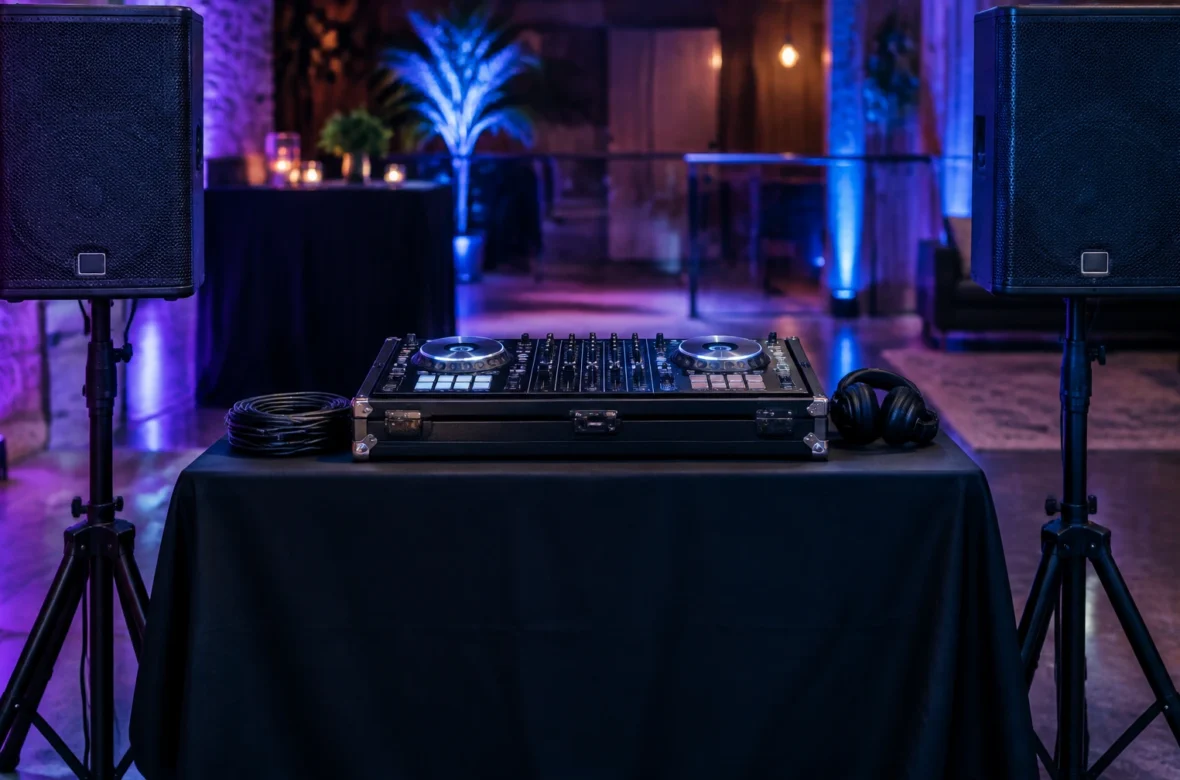
A working mobile rig is two powered speakers on stands, a controller or player setup, a mixer or all-in-one, a microphone, and the cables to connect it all. Buy speakers first and buy them good — everything else can be upgraded later, but the speakers are what the audience actually hears. Add a sub when the rooms get bigger, and lights last.
Buy in This Order
| Priority | Item | Why |
|---|---|---|
| 1 | Two powered speakers | What the room hears. Don’t compromise here |
| 2 | Speaker stands | Speakers on the floor sound dreadful |
| 3 | Controller or all-in-one | Your actual instrument |
| 4 | Cables and spares | The thing that ends gigs |
| 5 | Microphone | Non-negotiable for events |
| 6 | Subwoofer | Once rooms get bigger |
| 7 | Lighting | Last. Nobody books you for lights |
| 8 | Transport and cases | Protects everything above |
Speakers
Powered (active) speakers have the amplifier built in, so you plug them straight into the mixer and into the wall. For mobile work this is almost always the right choice — passive speakers need a separate amp, which is another box, more cables and more to go wrong.
- A pair of 12-inch powered speakers handles most private events and small venues.
- 15-inch gives more low end for larger rooms, at more weight to carry.
- Always buy two. One speaker is a PA for a speech, not for music.
- Check the weight before you buy. You’ll be carrying these up stairs, alone, at 1am.
Stands — Not Optional
This is the cheapest meaningful upgrade in mobile DJing and the one beginners skip. Main speakers should go on stands, raised a little above the ears of the audience. On the floor, the sound is absorbed by bodies in the first two metres and the people at the back hear almost nothing.
Subwoofers are the exception — those go on the floor, because low frequencies are non-directional and the floor coupling helps.
The DJ Setup
An all-in-one unit is the pragmatic mobile choice — one box, no laptop required, and it uses the same USB workflow as club gear, which means your preparation transfers. See the XDJ-RX3 review and Pioneer DJ controllers.
A laptop and controller is cheaper and more flexible but adds a failure point, and a laptop on a wobbling table at a wedding is a genuine risk. Whichever you choose, bring a backup playback source — even a phone with a cable will save a night.
Cables, and Why They Matter More Than You Think
- Two long speaker cables (XLR for powered speakers), longer than you think you need.
- RCA cables to connect your playback device to the mixer.
- Extension leads and a power strip. Venues never have a socket where you need one.
- Spares of everything. Cables fail more than any other component.
- Gaffer tape for taping down anything a guest could trip over. This is a safety issue, not a tidiness one.
More on the full gig bag in what to bring to a DJ gig.
Microphone and Lights
A wired dynamic microphone is the reliable default; wireless is more convenient and more to go wrong. Either way, for events you need one — see using a microphone as a DJ.
Lighting comes last for a reason: no one has ever rebooked a DJ because of the lights, and plenty have been not-rebooked because of the sound. When you do buy, two simple wash or effect units on stands do more than a pile of cheap gadgets.
A Note From NaJade
The mistake I see constantly is people spending on the visible things. A nicer controller, more lights, a fancy facade — all of it in front of speakers that can’t fill the room. The audience never sees your controller. They only ever hear your speakers. If your budget is tight, buy good speakers and a cheap controller rather than the reverse; you can mix a great night on entry-level decks through a proper PA, and you cannot save a night on brilliant decks through bad speakers. The other thing I’d push: buy stands before you buy anything else optional. They cost almost nothing and they’re the difference between the back of the room hearing music and hearing mush. It’s the highest return per baht in this entire list.
Related: how to set up a PA system, what to bring to a DJ gig, how to DJ a wedding, and how much should a DJ charge.
Frequently Asked Questions
What equipment does a mobile DJ need?
Should mobile DJs use powered or passive speakers?
Do I need speaker stands?
What size speakers do mobile DJs need?
What cables does a mobile DJ need?
Where should I spend my budget as a mobile DJ?
About the Author
NaJade is a Bangkok-based DJ playing progressive house, melodic EDM, pop, and Thai music across clubs, rooftops, and weddings in Thailand. He teaches beatmatching and mixing to beginners both in person in Bangkok and online over Zoom. When he’s not behind the decks, he’s documenting the journey on YouTube, Instagram, and TikTok.