
By NaJade · DJ in Bangkok · Published September 29, 2026
This guide is part of DJ headphones explained: the complete guide.
Pioneer’s cheapest DJ headphone ever — with the same drivers as a model twice its price. The smartest first purchase in DJing? Here’s the honest verdict.
The Pioneer DJ HDJ-CUE1 is the answer to a question beginners ask constantly: “do I really have to spend $150+ on headphones before I’ve mixed a single track?” At roughly $69 it’s easily the most affordable headphone Pioneer DJ has ever made — and the clever part is where they didn’t cut: it uses the same drivers as the HDJ-X5, a headphone nearly twice its price. Corners were cut in accessories and refinement instead, which is exactly the right trade for a first pair. There’s even a customisation ecosystem of coloured pads and cables. Here’s the full picture.
The Pioneer HDJ-CUE1 (~$69) is the best-value entry into real DJ headphones — the same drivers as the twice-the-price HDJ-X5, a compact closed-back design that folds into its own headband, a detachable hybrid cable, and $30 colour accessory packs for customisation. A Bluetooth version exists for casual listening. The catches: no case, no 1/4-inch adapter in the box, and build refinement matches the price.
HDJ-CUE1 at a Glance
| Spec | HDJ-CUE1 | What it means for you |
|---|---|---|
| Type | Closed-back, compact over-ear | Between on-ear and full over-ear size |
| Drivers | Same as the HDJ-X5 | Real DJ sound at half the X5’s price |
| Price | ~$69 (BT version ~$119) | Pioneer’s cheapest DJ headphone ever |
| Cable | Detachable coiled/straight hybrid | The first wear part is replaceable |
| Folding | Folds into its own headband | Pocketable despite no case |
| Customisation | ~$30 accessory packs, 6 colours | Pads + cable swaps; make them yours |
| In the box | No case, no 1/4″ adapter | Budget for a $5 adapter for mixers |
| Swivel | Rotating ear cups | One-ear monitoring works properly |
(Prices vary — check current pricing on the official Pioneer DJ site. The HDJ-CUE1BT adds Bluetooth for casual listening — you still mix wired.)
Where They Cut Corners — and Where They Didn’t
Budget gear lives or dies on which corners get cut, and the CUE1’s choices are smart. Not cut: the drivers (borrowed from the HDJ-X5), the closed-back isolation, the rotating cups for one-ear monitoring, and — genuinely rare at this price — a detachable cable, which is the component most likely to die first on any DJ headphone. Cut: the carry case (it folds into its own headband instead), the 1/4-inch adapter (buy one for a few dollars — you’ll need it for most mixers), premium materials (moulded plastic and faux leather), and some long-term durability confidence. For a first headphone, that’s precisely the right distribution of compromise: the sound and the DJ function survive; the luxuries go.
What’s Great About the HDJ-CUE1
Real DJ Sound for Beginner Money
Because the drivers come from the HDJ-X5, the CUE1 sounds like a DJ headphone, not a toy: punchy, present bass for beatmatching, clear mids, crisp highs. Reviewers consistently land on the same verdict — it sounds far better than the price suggests, and it does the actual job (hearing a kick drum clearly against a live room) without excuses. For learning to beatmatch, there is nothing meaningful a flagship does that this doesn’t.
Light, Foldable, and Actually Practical
It’s lightweight and comfortable across a session, the cups rotate for one-ear cueing, and the whole thing folds into its own headband to stuff into a bag or big pocket — a genuinely clever answer to the missing case. The hybrid coiled/straight cable is the same style the expensive models use, and being detachable, it’s replaceable the day it frays.
The Colour Customisation Trick
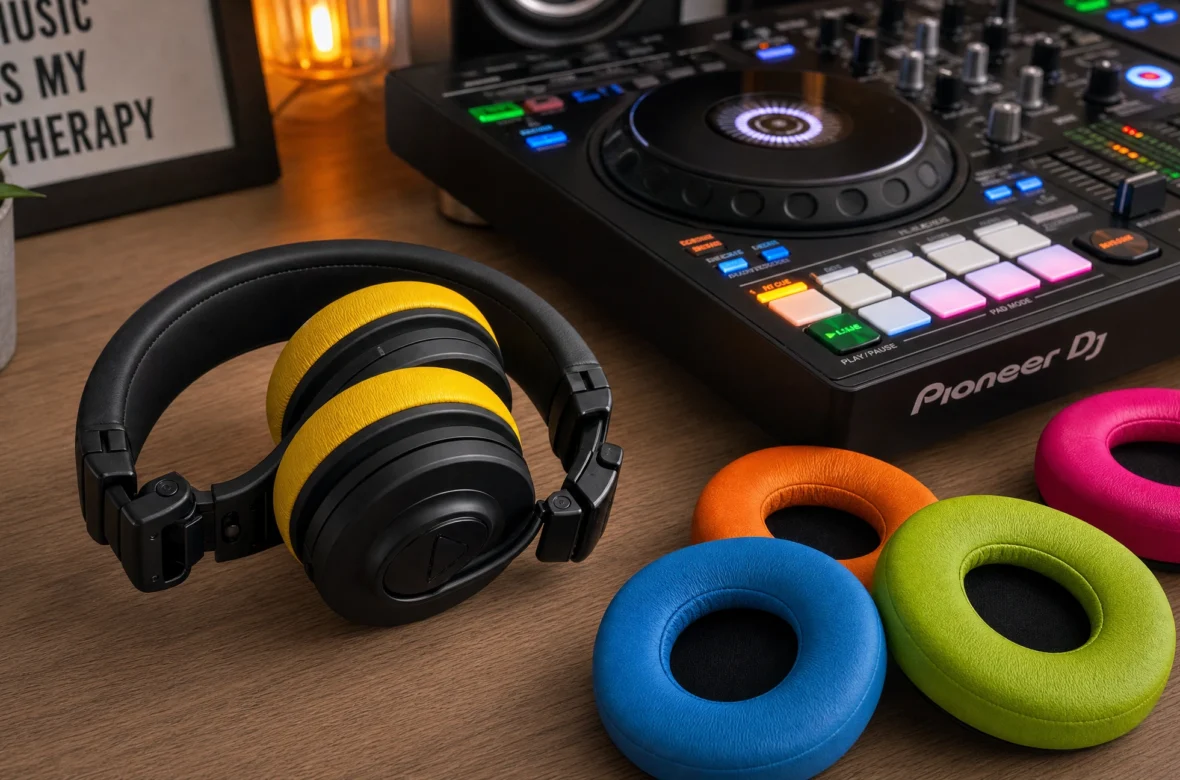
A ~$30 accessory pack (pads + cable) in six bright colours lets you re-skin the CUE1 — a small thing that beginners genuinely enjoy, and a cheap refresh when the original pads wear out. It also means the wear parts have an official replacement path, which most budget headphones simply don’t. The HDJ-CUE1BT variant adds Bluetooth for phone listening and practice browsing; you’ll still plug in the cable to actually mix, since Bluetooth latency makes beatmatching impossible.
What to Watch Out For
- No 1/4-inch adapter in the box. The classic gotcha: most mixers use the big jack, the CUE1 ships mini-jack only. Order a cheap adapter with the headphones.
- No case. The headband fold helps, but unprotected in a gig bag is how budget headphones die. A cheap pouch is a wise $10.
- Durability is the honest question mark. Moulded plastic at $69 won’t survive abuse like an HD 25 or X10 — treat it gently and it’ll serve; throw it around and it won’t.
- Isolation is decent, not exceptional. Fine for practice and small gigs; in a seriously loud booth the HD 25 class pulls clearly ahead.
- The BT version isn’t for mixing. Bluetooth is for the commute; wired is for the decks. Don’t pay the premium expecting wireless DJing.
- You may outgrow it — which is the plan. It’s a first headphone, and a good one, not a forever headphone.
Who the HDJ-CUE1 Is Really For
It’s the right first headphone for beginners who want real DJ monitoring without a $150 commitment, for anyone learning on a starter controller, for a cheap backup pair in a working DJ’s bag, and for young DJs who’ll love the colour customisation. Skip it if you’re already gigging in loud rooms regularly (go straight to the HD 25), if long-term durability matters more than price, or if you want one premium pair for everything (HDJ-X10 or ATH-M50x).
A Note From NaJade
I genuinely like recommending the CUE1, because it removes the worst excuse in beginner DJing — “I’ll start once I’ve bought proper gear.” Sixty-nine dollars buys you the same drivers as a headphone twice the price, and every fundamental skill — beatmatching, phrasing, EQing — is learned exactly as well on these as on my most expensive pair. The trick with budget gear is knowing what you bought: treat it as the capable, slightly fragile tool it is, buy the $5 adapter and a $10 pouch on day one, and let it carry you through your first year. When you’re gigging in loud rooms and the isolation starts to feel thin, that’s your genuine signal to step up to an HD 25 — and the CUE1 graduates to being the backup pair in your bag, which every working DJ needs anyway. Nothing about it is wasted money. Start now, start cheap, and spend the savings on music — the crowd responds to your selection, not your receipt.
Compare all the options in my complete DJ headphones guide, or pair it with hardware from the beginner controller guide. Want help learning the fundamentals properly? My DJ lessons run in person in Bangkok or online over Zoom.
Frequently Asked Questions About the HDJ-CUE1
Is the Pioneer HDJ-CUE1 good for beginners?
What’s the catch with the HDJ-CUE1’s low price?
Does the HDJ-CUE1 come with a 1/4-inch adapter?
What are the HDJ-CUE1 colour accessory packs?
Should I buy the HDJ-CUE1 or HDJ-CUE1BT?
HDJ-CUE1 vs Sennheiser HD 25: should I just save up?
About the Author
NaJade is a Bangkok-based DJ playing progressive house, melodic EDM, pop, and Thai music across clubs, rooftops, and weddings in Thailand. He teaches beatmatching and mixing to beginners both in person in Bangkok and online over Zoom. When he’s not behind the decks, he’s documenting the journey on YouTube, Instagram, and TikTok.