
By NaJade · DJ in Bangkok · Published September 29, 2026
This guide is part of Denon DJ controllers & standalone systems: the complete range explained.
The 4-channel club mixer built to anchor an SC-player rig — Denon’s answer to the Pioneer DJM, with more features for less money. Here’s the honest verdict.
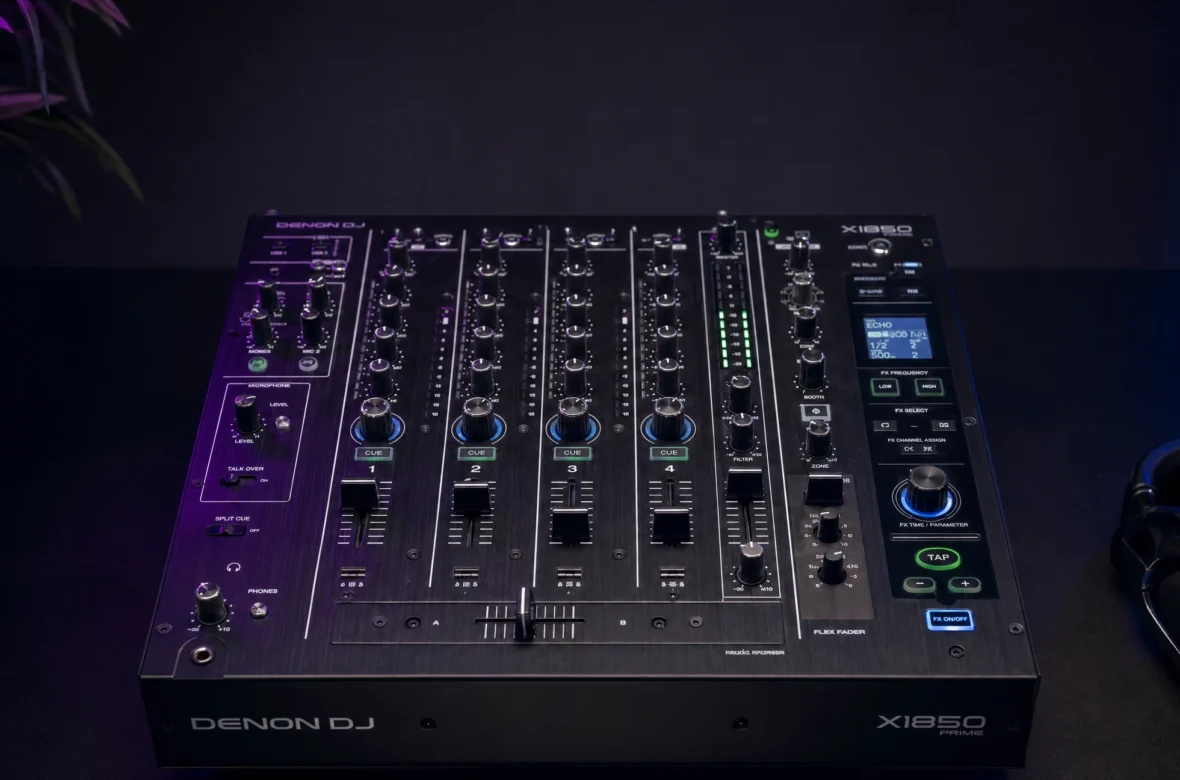
The Denon X1850 Prime is the mixer at the heart of a Denon separates setup. It’s a rugged, all-metal, 4-channel club mixer designed to pair with SC6000, SC6000M, and SC5000 players over a built-in LAN hub — Denon’s direct rival to Pioneer’s industry-standard DJM. Like the rest of the range, it packs in more features per dollar than the Pioneer equivalent. If you’re building a Denon club-style rig, this is the hub everything plugs into. Here’s the full picture.
The Denon X1850 Prime (~$1,099 / £1,099) is a rugged 4-channel club mixer — Denon’s DJM rival — with a built-in 5-port LAN hub to connect up to four SC media players, 16 BPM FX, Sweep FX, dual 24-bit/96kHz USB soundcards, and multi-assignable analog/digital inputs. It’s superb value for a Denon separates rig. The catches: clubs run Pioneer DJMs, and some owners report fader and post-firmware reliability issues.
X1850 at a Glance
The key specs and what they mean for you:
| Spec | X1850 Prime | What it means for you |
|---|---|---|
| Type | 4-channel club mixer (all-metal) | The hub of a Denon separates rig |
| LAN hub | Built-in 5-port hub for up to 4 SC players | Link tempo, transfer files, StagelinQ |
| FX | 16 BPM FX + Sweep FX + Filter, FX Quantize, Touchstrip | Beat-grid-accurate effects, more than a DJM |
| EQ | 3-band with Normal + Isolation modes | Full-kill EQ and expressive isolator work |
| Soundcards | Dual 24-bit/96kHz USB audio interfaces | Two DJs / laptops; seamless B2B hand-offs |
| Inputs | Multi-assignable phono/line/digital/DVS per channel | Plug in anything; DVS-ready |
| Fader | Tension-adjustable Flex-Fader crossfader | Tune the crossfader to your style |
| Price | ~$1,099 / £1,099 (check local) | Strong value vs a flagship DJM |
(Prices vary by region and over time — confirm the current Thailand/local price before buying.)
Why the X1850 Is the Rig’s Backbone
In a separates setup, the mixer is the piece everything connects to, and the X1850 is built for exactly that. Its standout is the built-in 5-port LAN hub: plug in up to four SC media players and they share tempo (BPM sync), transfer music files fast, and carry StagelinQ audio-visual data for lighting and video — all through the mixer, no extra hub needed. Pair it with two SC6000s and you have a complete, self-contained club-style rig that rivals a Pioneer CDJ-and-DJM booth for considerably less money. It’s the natural centrepiece of the Denon separates story.
What’s Great About the X1850
More FX Than the Rivals
The effects section is genuinely generous: 16 Pro-Club BPM FX plus dedicated per-channel Sweep FX and a Lo/Hi-pass filter, with a Time-Division Touchstrip and — a standout feature — FX Quantize, which locks effect parameters to the Engine beat grid so your effects stay perfectly in time. That’s more effects flexibility than you get on the comparable Pioneer mixer, and it’s beat-accurate. The 3-band EQ also switches between normal and full-isolation modes for expressive, harmonic mixing.
Dual Soundcards and Flexible I/O
The X1850 has two independent 24-bit/96kHz USB soundcards, so two DJs can connect laptops at once for seamless back-to-back sets and clean hand-offs. Every channel is multi-assignable — flip between phono, line, digital USB, and DVS with a knob — plus there’s a send/return, MIDI out with clock and song-position for syncing drum machines, and pro-grade audio throughout. It’s an extremely flexible hub for any kind of gig.
Built Like a Tank
Rugged all-metal construction, a high-visibility EQ section, smooth channel faders with positive tension, and a tension-adjustable Flex-Fader crossfader you can tune to your mixing style. It’s a serious, road-ready club mixer built to take a beating on the main stage.
What to Watch Out For
- Not the club standard. The big one. Clubs run Pioneer DJM mixers, so the X1850 is for your own rig, not the booth you’ll be booked into.
- Fader reliability reports. Some owners report channel faders developing issues over time, and note the faders can be awkward to replace due to the build — a known niggle worth budgeting for.
- Post-firmware glitches reported. A minority mention reboots or glitches after certain firmware updates — usually resolved, but worth knowing.
- The crossfader isn’t a Magvel. The Flex-Fader is good and adjustable, but scratch DJs used to Pioneer’s Magvel (or an Innofader) may want to upgrade it.
- Heavy (~20 lb) and, like all separates, it’s one more piece to transport and power.
- It only makes sense with SC players (or DVS/laptops). On its own it’s just a mixer — the magic is the LAN hub feeding SC decks.
How It Compares
- vs Pioneer DJM (900NXS2 / A9): The DJM is the club standard you’ll find in booths; the X1850 undercuts it and offers more BPM FX plus FX Quantize and dual soundcards. Choose the DJM for club familiarity; the X1850 for value and features on your own rig.
- vs the older X1800: The X1850 is the refresh — higher-visibility EQs, added FX Quantize, improved MIDI (clock/song-position). If choosing new, the X1850 is the one; a used X1800 is a budget alternative.
- vs an all-in-one (Prime 4+): The Prime 4+ has a mixer built in, so you don’t need the X1850. The X1850 only makes sense if you’re building a modular SC-player rig.
Who the X1850 Is Really For
It’s for the DJ building a Denon separates rig around SC media players who wants a feature-rich, great-value club mixer as the hub — especially anyone who’ll use the LAN hub, dual soundcards for B2B, or DVS. It’s also a solid standalone 4-channel mixer for a mixed setup with turntables and laptops. Skip it if you want club-standard Pioneer gear, if you’re buying an all-in-one like the Prime 4+ (which has its own mixer), or if you don’t need four channels or the SC-player integration.
A Note From NaJade
If you’re going the Denon separates route, the X1850 is the obvious anchor, and it’s a lot of mixer for the money — the FX section genuinely outguns the comparable Pioneer, FX Quantize is a lovely creative tool, and the LAN hub makes wiring an SC rig painless. I really rate it as the centre of a home or mobile club-style setup. Two honest flags. First, the faders: enough owners have mentioned channel-fader wear and fiddly replacement that I’d factor it into your long-term thinking, and scratch DJs will probably want to swap the crossfader. Second — same as every Denon piece — clubs run DJMs, so buy this to build your own rig, not to prepare for the booth. If those things fit your plan, two SC players and an X1850 give you a seriously capable setup for well under Pioneer money. As always, the mixer’s a tool; the mix is you.
See the whole lineup in my complete Denon DJ range guide, or weigh the other side in the Pioneer DJ controller guide. Want help dialling in a club-style rig? My DJ lessons run in person in Bangkok or online over Zoom.
Frequently Asked Questions About the Denon X1850
Is the Denon X1850 a good mixer?
What is the LAN hub on the X1850 for?
Denon X1850 vs Pioneer DJM: which should I buy?
What’s the difference between the X1850 and X1800?
Can two DJs use the X1850 at once?
Do I need SC players to use the X1850?
About the Author
NaJade is a Bangkok-based DJ playing progressive house, melodic EDM, pop, and Thai music across clubs, rooftops, and weddings in Thailand. He teaches beatmatching and mixing to beginners both in person in Bangkok and online over Zoom. When he’s not behind the decks, he’s documenting the journey on YouTube, Instagram, and TikTok.