
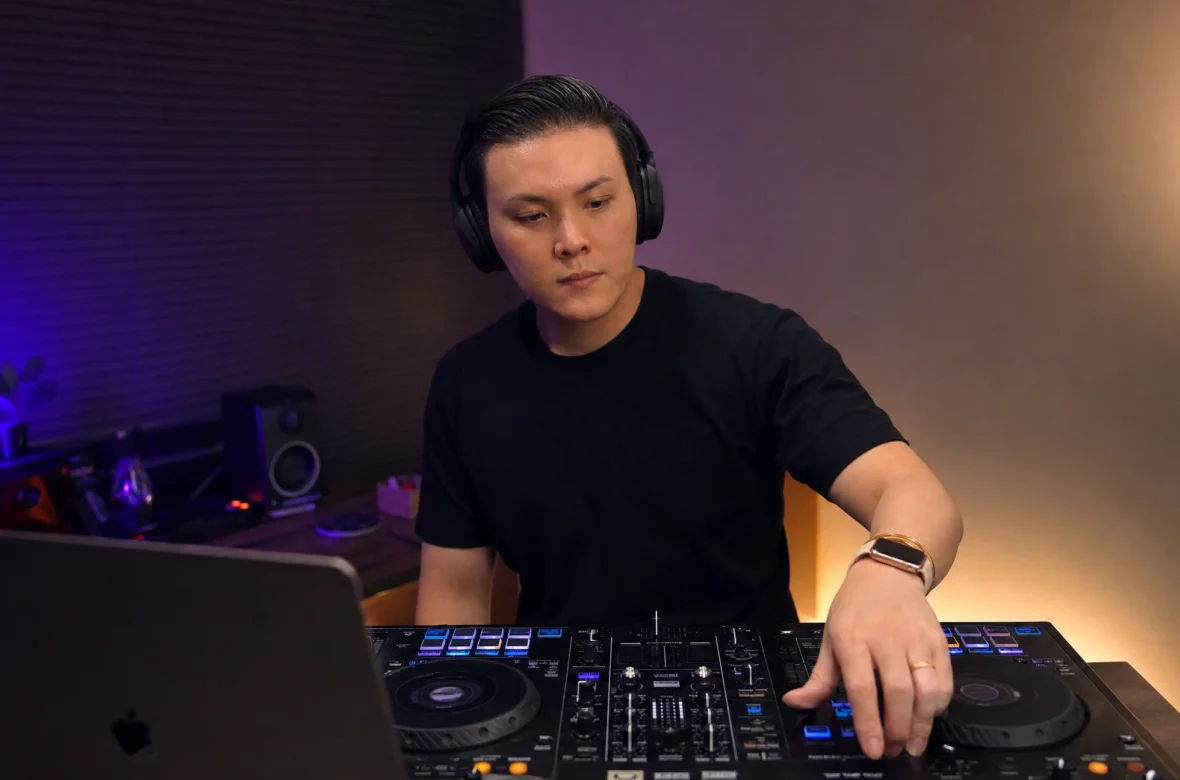
By NaJade · DJ in Bangkok · Published September 29, 2026
Every DJ has made these. The ones who improve fastest are the ones who stop making them early.
Most beginners don’t struggle because they lack talent. They struggle because they pick up the same handful of avoidable habits early on — and then repeat them without knowing why their mixes sound off. The good news: every one of these is fixable once you know what to look for. Here are the eight I see most often, and exactly how to fix each.
The most common beginner DJ mistakes are relying entirely on the sync button, skipping the fundamentals, opening a set too high, overusing effects, ignoring the crowd, neglecting EQ, not preparing or organizing music, and chasing better gear instead of better skills. Each one is fixable with focused practice on the right habit. Let’s go through them.
1. Relying Entirely on the Sync Button
Sync isn’t evil — plenty of pros use it. The mistake is relying on it entirely so you never learn what’s happening underneath. When you lean only on sync, you’re stuck the moment a beat grid is wrong or two tracks drift, and you never build the timing instinct that makes everything else easier.
The fix: Learn to beatmatch by ear. Even if you use sync later, understanding manual beatmatching trains your timing and musical awareness, and saves you when the technology fails — which happens more than you’d think.
2. Skipping the Fundamentals
Rushing past beatmatching, phrasing, and clean EQ to get to the “fun” stuff is the fastest way to plateau. When you don’t understand how tempo, phrasing, and rhythm work together, your mixes sound rushed or messy even when they’re technically in sync. Strong fundamentals are what separate DJs who last from those who fade out quickly.
The fix: Slow down and build the base. Get genuinely comfortable with counting phrases and clean transitions before chasing advanced tricks.
3. Opening Too High
Excited to impress, beginners often drop their biggest banger first — and then have nowhere to go for the rest of the set but harder and faster, until the room burns out long before the real peak.
The fix: Open at around 60–70% of your peak energy. Build gradually and save your biggest moments for when anticipation is highest. This is the heart of building a set as a journey rather than a constant peak.
4. Overusing Effects
The effects section is the first thing many new DJs reach for — twisting every knob and triggering echoes like they’re remixing a remix. But constant effects distract from the music. As one veteran instructor puts it, if a track sounded better with constant effects, the producer would have made it that way.
The fix: Treat effects like icing on a cake — get the cake right first (clean phrasing, tight EQ, smooth transitions), then add effects with intention. An echo-out at the end of a phrase or a filter sweep before a drop, used sparingly, does far more than constant noise. Club Ready DJ School makes this point well: your job is to enhance the song, not rewrite it.
5. Ignoring the Crowd
Beginners often get so locked into their headphones and their planned set that they forget to look up. But a technically perfect mix means nothing if it empties the floor. Playing your own taste at a room that isn’t feeling it — and not adjusting — is one of the most common ways to lose a crowd.
The fix: Look up, watch the room, and adapt. Reading the crowd and being willing to change direction is what turns a good mixer into a real DJ.
6. Neglecting EQ
If your mixes sound muddy even when the beats are matched, this is almost always why. Leaving both tracks’ basslines up when they play together creates a cluttered, muddy low-end — the hallmark of an amateur mix.
The fix: Learn the bass swap and basic EQ mixing. Keeping only one bassline driving the floor at a time is the single biggest upgrade to how clean you sound.
7. Not Preparing or Organizing Your Music
Throwing random songs into a folder and hoping for the best leads to awkward fumbling mid-set, tracks that don’t blend, and energy that’s all over the place. “Winging it” rarely ends well.
The fix: Organize your library — tag tracks by BPM, key, and energy, and set hot cues on intros and outros so you always know where you are in a track. Preparation is what lets you perform confidently and adapt on the fly.
8. Chasing Better Gear Instead of Better Skills
It’s tempting to think a more expensive controller will make you better overnight. In reality, upgrading too early just masks gaps in your fundamentals instead of fixing them. As working pros with decades of experience point out, the skills matter far more than the equipment.
The fix: Master the setup you already have. Core skills — beatmatching, EQ, phrasing, transitions — transfer to any gear and make a far bigger difference than the equipment itself. A solid beginner controller is more than enough to become genuinely good.
A Note From NaJade
I made nearly every one of these. I relied on sync too long, I overused effects because they felt cool, and I definitely opened sets too hot. None of them meant I wasn’t cut out for it — they’re just the normal potholes everyone hits. The DJs who get good fast aren’t the ones who avoid mistakes; they’re the ones who notice a mistake, understand why it’s happening, and fix that one thing. Pick the mistake on this list that stings the most right now, fix just that this week, and you’ll hear the difference immediately.
One of the biggest advantages of having a teacher is that they catch these habits before they set in — which is exactly what we do in my DJ lessons, in person in Bangkok or online over Zoom. Months of self-taught frustration can often be fixed in a single session once someone shows you what to look for.
Frequently Asked Questions About Beginner DJ Mistakes
What is the most common mistake beginner DJs make?
Is it bad to use the sync button?
Why do my DJ mixes sound muddy?
How many effects should a DJ use?
Do I need better gear to be a better DJ?
How do I stop making beginner mistakes faster?
About the Author
NaJade is a Bangkok-based DJ playing progressive house, melodic EDM, pop, and Thai music across clubs, rooftops, and weddings in Thailand. He teaches beatmatching and mixing to beginners both in person in Bangkok and online over Zoom. When he’s not behind the decks, he’s documenting the journey on YouTube, Instagram, and TikTok.