
By NaJade · DJ in Bangkok · Published September 28, 2026
This guide is part of studio monitors for DJs: the complete guide.
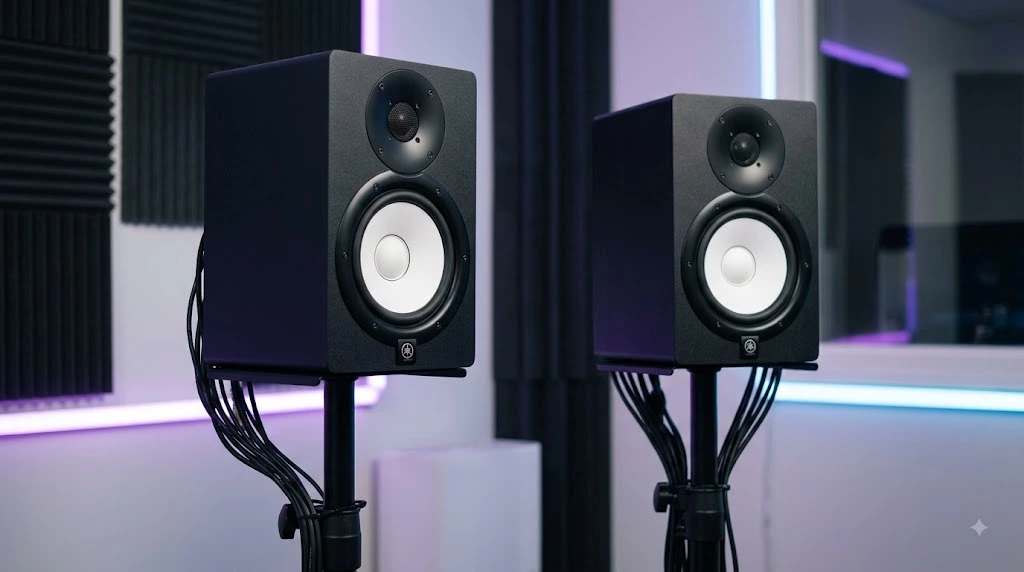
The white-coned monitor that refuses to flatter you — descended from the most famous reference speaker ever made. Brutal, honest, and exactly what a mix needs. Here’s the verdict.
The Yamaha HS5 carries a heavier lineage than anything else at its price. Those white cones are a deliberate nod to the Yamaha NS10 — a speaker that engineers famously described as unforgiving, and that became the industry’s reference precisely because it made bad mixes sound bad. The HS5 inherits that philosophy: it is flat, bright, and cheerfully unflattering. It will not make your tracks sound better than they are, which is uncomfortable for about a week and then becomes the most useful tool on your desk. For anyone producing as well as DJing, this is the more responsible buy.
The Yamaha HS5 (~$400 a pair) is the honest reference: a flat, bright, deliberately unflattering 5-inch nearfield descended from the legendary NS10, with a low-resonance enclosure and Room Control and High Trim switches for placement compensation. It reveals flaws rather than smoothing them, which is exactly what mixing needs. The catches: it’s rear-ported so it needs space off the wall, and it’s an unforgiving listen for pleasure.
Yamaha HS5 at a Glance
| Spec | Yamaha HS5 | What it means for you |
|---|---|---|
| Type | Active 5-inch nearfield monitor | Sweet spot for bedrooms and small rooms |
| Lineage | Descended from the Yamaha NS10 | The industry’s classic unforgiving reference |
| Sound | Flat, bright, uncoloured | Reveals flaws; mixes translate elsewhere |
| Drivers | White-cone woofer + updated tweeter | Improved resolution over the old HS50m |
| Enclosure | Low-resonance, rear-ported | Minimal cabinet colouration; needs wall space |
| Controls | Room Control and High Trim switches | Basic placement compensation |
| Inputs | Balanced XLR and TRS | Connects to any mixer or interface |
| Price | ~$400 a pair | Often sold as singles — check listings |
(Confirm current pricing and whether a listing is one speaker or a pair on the official Yamaha site or with your dealer.)
Why “Unflattering” Is the Selling Point
This is counter-intuitive enough to be worth stating plainly. A speaker that makes everything sound great is useless for making decisions, because you can’t hear what needs fixing. The NS10 became legendary for the opposite reason: it was harsh in the midrange, and engineers learned that if a mix held up on an NS10, it held up anywhere.
The HS5 continues that thinking. Out of the box on its flat setting it reproduces music with essentially no colouration — no bass lift, no treble sweetening. Muddy low mids sound muddy. A harsh vocal sounds harsh. That’s not a fault; that’s the instrument working. The payoff is translation: mixes made on an HS5 tend to hold together on club systems, in cars, on phones, and through laptop speakers, because you weren’t being lied to while you made them.
What’s Great About the HS5
Detail You Can Actually Work With
The HS5’s updated transducers and slightly larger tweeter over the old HS50m deliver noticeably improved frequency response and resolution, and reviewers consistently find it brighter and more revealing up top than a KRK Rokit. In practice you hear the reverb tail, the hi-hat detail, the small timing errors — the things that separate a mix that works from one that nearly works. For DJ prep it also means you can hear whether two tracks genuinely sit together rather than assuming they do.
A Cabinet That Gets Out of the Way
Yamaha engineered the enclosure for low resonance, which matters more than it sounds: a cabinet that vibrates adds its own character to everything you hear, and cheap monitors often do exactly that. Minimising it is a large part of why the HS5 stays neutral. The build feels solid and purposeful rather than styled, which is entirely in keeping with the philosophy.
The Right Size for a Real Room
Five inches is the sweet spot and the HS5 sits in it well — compact enough for a tight desk setup, but capable of filling a small-to-medium room with genuine fidelity rather than sounding thin like smaller monitors do. Room Control and High Trim switches on the back give you basic compensation for placement, which you should set after positioning the speakers properly rather than instead of it.
What to Watch Out For
- It’s rear-ported, so it needs space. Push an HS5 against a wall and the bass builds up and misleads you. Pull it a few inches out minimum. If your desk must be against a wall, the front-ported KRK Rokit is more forgiving.
- Not a fun listen. Flat and bright is the correct choice for working and a slightly joyless one for enjoying music. Many owners keep something else for pleasure listening.
- Limited low-end extension. Physics: a 5-inch driver only goes so low. If you need to hear deep sub content, you’ll want a larger pair or a subwoofer — and a room that can handle either.
- Less room-correction than the G5 Rokit. Two switches versus DSP voicing modes and an app. If your room is genuinely bad, the KRK has more tools to compensate.
- Often sold as singles. Check listings carefully — “HS5” frequently means one speaker.
- Stands and cables extra. Balanced XLR or TRS cables and proper stands are essential and not included; budget for them.
Who the HS5 Is Really For
It’s the right monitor for DJs who produce, for anyone making tracks they intend to release, and for anyone who wants one honest reference that never flatters them. It suits a room where you can pull the speakers off the wall, and it rewards good placement more than most. Skip it if your desk is jammed against a wall or your room is untreated and problematic (the front-ported, DSP-equipped KRK Rokit 5 G5 is the pragmatic choice), if you want an enjoyable listen as well as a reference, or if you need deep sub extension. Read the placement section of my studio monitors guide before buying either.
A Note From NaJade
The HS5 is the monitor I’d tell you to buy if you’re serious about making music, and the one I’d warn you about if you just want your practice sessions to sound exciting. It’s genuinely unkind. The first week you’ll think you’ve bought the wrong speakers, because tracks you loved suddenly sound thin and your own edits sound amateur — and then you realise that’s information, not a defect, and you start fixing things you couldn’t previously hear. That’s the whole value proposition. My practical caution is the rear port: this speaker needs to breathe, and if your only option is a desk shoved against a wall, be honest with yourself and buy the Rokit instead — a compromised HS5 is worse than a well-placed alternative. Whichever you land on, get the tweeters to ear height and pull them off the wall. Placement is free and it beats every upgrade you could buy.
Compare it directly with the KRK Rokit 5, or read the full studio monitors for DJs guide for setup and placement. Want help building a practice space that actually teaches you something? My DJ lessons run in person in Bangkok or online over Zoom.
Frequently Asked Questions About the Yamaha HS5
Is the Yamaha HS5 good for DJs?
Why are Yamaha HS5 monitors so flat?
Yamaha HS5 vs KRK Rokit 5: which is better?
Does the Yamaha HS5 need to be away from the wall?
Is the HS5 big enough, or should I get the HS7?
What cables do I need for the Yamaha HS5?
About the Author
NaJade is a Bangkok-based DJ playing progressive house, melodic EDM, pop, and Thai music across clubs, rooftops, and weddings in Thailand. He teaches beatmatching and mixing to beginners both in person in Bangkok and online over Zoom. When he’s not behind the decks, he’s documenting the journey on YouTube, Instagram, and TikTok.