
By NaJade · DJ in Bangkok · Published September 28, 2026
This guide is part of studio monitors for DJs: the complete guide.
The yellow-coned monitors you’ve seen in a thousand bedroom studios — now with DSP that fixes the room you’re actually mixing in. Here’s the honest verdict.
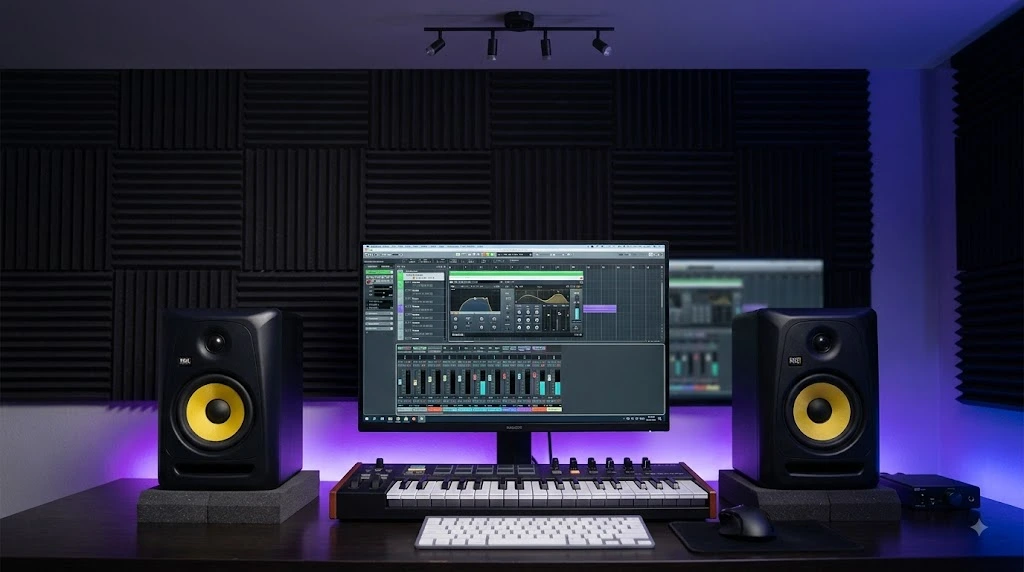
The KRK Rokit 5 is the most recognisable studio monitor on earth. You’ll find those yellow Kevlar cones in the smallest bedroom setups, in pawn shops, and sitting in professional studios beside monitors costing ten times as much — used there as a sanity check, because engineers know what a mix sounds like on a Rokit. The current G5 generation is the most interesting version yet, because it addresses the thing that actually ruins home mixing: the room. Three voicing modes, 25 EQ combinations, and a room-correction app mean the speaker can adapt to a bedroom with parallel walls and no treatment. For a DJ, that’s a bigger deal than any driver spec.
The KRK Rokit 5 G5 (~$400 a pair) is the most popular budget studio monitor for a reason: a 5-inch Kevlar woofer, front porting for punch, up to 55W of bi-amped Class-D power, and — the real story — DSP with three voicing modes, 25 EQ combinations and a room-correction app. It’s fuller and more flattering than a Yamaha HS5, which makes it fun for EDM and less reliable as a pure reference.
KRK Rokit 5 G5 at a Glance
| Spec | Rokit 5 G5 | What it means for you |
|---|---|---|
| Type | Active 5-inch nearfield monitor | Right size for a bedroom or small room |
| Drivers | 5″ woven Kevlar woofer + 1″ Kevlar tweeter | Matched materials; consistent character |
| Amplification | Bi-amped, up to 55W Class-D | Accurate transients without straining |
| Porting | Front-firing | More forgiving close to a wall than rear-ported |
| DSP | 3 voicing modes (Mix, Create, Focus) + 25 EQ combos | Tune the speaker to your actual room |
| App | KRK room-correction app | Measures your space and suggests settings |
| Character | Fuller low end, crisp top — engaging | Great for electronic music; flatters slightly |
| Price | ~$400 a pair (G4 often discounted) | Check whether listings are single or pair |
(Prices and generations overlap in stock — confirm on the official KRK site, and check whether a listing is for one speaker or two.)
The DSP Is the Reason to Buy the G5
Here’s the thing nobody tells beginners: your room is doing more damage to your mixes than your speakers are. Parallel bedroom walls create standing waves, a desk reflects sound back at you, and corners exaggerate bass by up to 10dB. Most budget monitors ignore this and leave you fighting it.
The G5 addresses it directly. Three voicing modes — Mix, Create and Focus — change the speaker’s character for the task at hand, and 25 EQ combinations let you compensate for placement problems you can’t fix physically. The companion app helps you measure the room and pick settings. It won’t turn a bad room into a good one, but it meaningfully narrows the gap, and for a DJ mixing in a condo bedroom in Bangkok that’s genuinely the most valuable feature on the spec sheet.
What’s Great About the Rokit 5
A Low End That Reflects a Club
The Rokit’s voicing is fuller and more engaging than a flat reference — more low-end presence, a crisp top end, and front porting that delivers punch. Purists call that a colouration, and technically they’re right. But for a DJ auditioning progressive house and EDM, hearing the low end with weight is closer to how the track will land on a club system than a clinical flat response is. It makes practising enjoyable, which matters more than audiophiles admit — you practise more when it sounds good.
Everywhere, Which Means Something
Ubiquity is an underrated feature. Because Rokits are in so many rooms, engineers and producers have a shared reference for what a mix sounds like on them — and if you send a track to someone, there’s a decent chance they’re hearing it on the same speakers. Support, replacement parts, second-hand availability, and a mountain of setup advice all follow from that scale.
Practical Details Done Right
Bi-amped Class-D amplification up to 55W means the drivers aren’t overworked at realistic volumes, giving cleaner transient response. The front-firing port is a real practical advantage over rear-ported rivals if your desk is against a wall, which in most bedrooms it is. A high-density Iso-foam pad is included to decouple the speaker from the desk surface — a small thing that audibly tightens the low end, and one many manufacturers make you buy separately.
What to Watch Out For
- It flatters your music. The honest criticism: the response isn’t flat, with lift at both ends, which makes critical mixing and mastering harder. If your mixes need to translate everywhere, the Yamaha HS5 is the safer reference.
- Less high-end detail than the HS5. Reviewers consistently find the Yamaha brighter and more revealing up top. You lose some air and fullness in the treble.
- DSP is not room treatment. The modes help, but no EQ fixes a standing wave. Placement and a couple of absorption panels still matter more.
- Generations overlap confusingly. G4 and G5 stock sits side by side at different prices. The G5’s DSP and app are the meaningful upgrade — know which you’re buying.
- Single vs pair pricing catches people out. Listings vary. Confirm before you order or you’ll receive one speaker.
- Stands or pads are still needed. The included Iso-foam helps, but tweeters at ear height matters more — budget for stands.
Who the Rokit 5 Is Really For
It’s the right pick for DJs and electronic producers mixing in an untreated bedroom, where the DSP earns its keep and the fuller low end reflects club playback. It’s also excellent as a second reference pair for professionals, and a sensible first monitor for anyone learning. Skip it if you need a genuinely flat reference for critical mixing and mastering (Yamaha HS5), if your room is large enough to need 7-inch drivers, or if your budget is truly tight — a cheaper pair placed properly beats these placed badly. Start with my studio monitors guide for placement.
A Note From NaJade
I’ll say something slightly unfashionable: for a DJ rather than a mastering engineer, the Rokit’s “flaw” is close to a feature. Yes, it flatters the low end. But I’m not mastering — I’m learning how a blend feels, whether a transition holds, and whether a track has the weight to carry a room at midnight. A monitor that shows me bass with presence is telling me something useful about a club, and the DSP means I can compensate for a Bangkok condo bedroom that was never designed for this. That said, if you’re producing tracks you intend to release, buy the HS5 instead and let it be unkind to you — that’s the whole point of a reference. And whichever you choose, spend the extra on stands before you spend it on bigger speakers. Getting the tweeters to ear height changed more for me than any upgrade in driver size ever did.
Compare it directly with the Yamaha HS5, or read the full studio monitors for DJs guide for placement and setup. Want help building a practice space that teaches you something? My DJ lessons run in person in Bangkok or online over Zoom.
Frequently Asked Questions About the KRK Rokit 5
Are KRK Rokit 5 monitors good for DJs?
KRK Rokit 5 vs Yamaha HS5: which should I buy?
What do the Rokit G5’s voicing modes do?
What’s the difference between the Rokit G4 and G5?
Should I buy 5-inch or 8-inch Rokits?
Do I need stands for KRK Rokits?
About the Author
NaJade is a Bangkok-based DJ playing progressive house, melodic EDM, pop, and Thai music across clubs, rooftops, and weddings in Thailand. He teaches beatmatching and mixing to beginners both in person in Bangkok and online over Zoom. When he’s not behind the decks, he’s documenting the journey on YouTube, Instagram, and TikTok.