
By NaJade · DJ in Bangkok · Published November 10, 2026
This guide is part of EDM genres explained.
A single chord, an endless echo, and a kick drum you feel more than hear. That’s the whole trick — and it’s harder than it sounds.
Dub techno is one of electronic music’s quietest revolutions. It takes the steady, hypnotic pulse of techno and runs it through the studio techniques of Jamaican dub — heavy delay, deep reverb, sound that drifts in and out of focus. The result is music that works equally well at 5am on a big system and on headphones on a long train ride. If melodic techno is about the climax, dub techno is about the space between the notes.
Dub techno is a techno subgenre that blends Detroit techno’s minimal 4/4 pulse with Jamaican dub’s echo-heavy production. Born in Berlin in the early 1990s through Basic Channel, it typically runs around 110–125 BPM, built on soft chord stabs soaked in delay and reverb over deep, rolling sub-bass.
What Dub Techno Sounds Like
| Element | Typical in dub techno |
|---|---|
| Tempo | Roughly 110–125 BPM, often slower than mainstream techno |
| Rhythm | Steady 4/4 kick, minimal percussion, lots of space |
| Harmony | One or two chord stabs, repeated and slowly filtered |
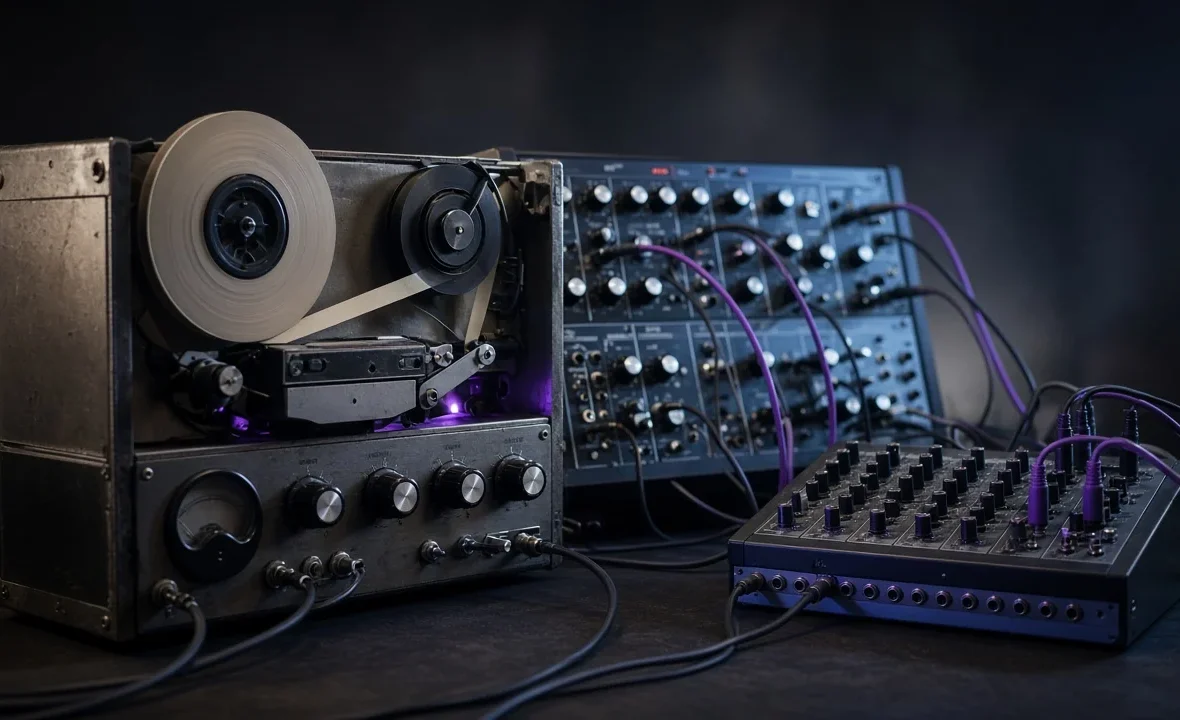
| Effects | Tape-style delay, long reverb, filter sweeps — the mixing desk as an instrument |
| Bass | Deep, round, repetitive sub-bass |
| Texture | Hiss, crackle and haze; vocals are rare |
The key idea is movement through effects rather than through new parts. A track might use the same chord for seven minutes, but the delay feedback, filter cutoff and reverb size keep changing, so it never feels static. Like Jamaican dub, producers often release several versions of the same track. For the wider family tree, see what is techno and what is minimal techno.
Where Dub Techno Came From
The story starts in Berlin. Mark Ernestus opened the Hard Wax record shop in 1989, and in 1993 he and Moritz von Oswald formed Basic Channel. They took the raw, anonymous sound of Detroit techno and filtered it through the dub of King Tubby and Lee “Scratch” Perry. They even set up their own mastering studio, Dubplates & Mastering, to get the low end exactly right.
- Basic Channel: the founding releases, including “Phylyps Trak” (1993) and “Quadrant Dub” (1994).
- Maurizio: another von Oswald and Ernestus alias, whose M-Series collection is a cornerstone.
- Chain Reaction (1995–2003): their label that introduced Monolake, Porter Ricks, Vladislav Delay and Fluxion.
- Rhythm & Sound: the pair’s project with reggae vocalists, pushing the dub side even further.
The name “dub techno” only became common in the 2000s, long after the sound was established. Wikipedia’s dub techno entry covers the history in more detail.
Key Artists and Records to Start With
| Artist | Start with | Why |
|---|---|---|
| Basic Channel | BCD compilation | The blueprint |
| Monolake | “Cyan” (Chain Reaction) | Precise, crystalline sound design |
| Porter Ricks | Biokinetics | Submerged, aquatic textures |
| Deepchord / Echospace | Echospace’s “Aequinoxium” | The hazy 2000s revival |
| Vladislav Delay | “Huone” | Abstract and experimental |
| Yagya | Rigning | Melodic and gentle, a great entry point |
Fact Magazine’s list of the 25 best dub techno tracks is a good rabbit hole once you’ve heard the basics. Shinichi Atobe, Quantec and the early Modern Love releases of Andy Stott are also worth seeking out.
How to DJ Dub Techno
Dub techno rewards patience. The tracks are long and gradual, and the best mixes feel like one continuous piece rather than a series of transitions.
- Blend long. One to three minutes or more is normal. Let the delays of two tracks overlap until you can’t tell where one ends.
- Swap the bass carefully. Keep the low EQ cut on the incoming track, then swap on a phrase. Two dub basslines together get muddy fast. See how to use EQ when DJing.
- Ride the filters and highs. Small moves on filter and high EQ shape the reverb wash without killing the groove.
- Use effects sparingly. The tracks are already full of delay. A touch of extra echo on an outro can work; stacking more usually doesn’t. More in how to use DJ effects.
- Mind the room. It suits warm-ups, afterhours and listening-focused spaces more than peak time.
Dub Techno vs Related Genres
Compared with deep house, dub techno is less soulful and less vocal, with a straighter, more mechanical groove. Compared with melodic techno, it avoids big builds and lead melodies, focusing on texture and repetition. It shares DNA with minimal techno and ambient, and it often turns up in the kind of rooms covered in listening bars in Bangkok.
A Note From NaJade
Most of my gigs are progressive and melodic, so dub techno isn’t what I play to a full Bangkok dancefloor. But it’s what I listen to on the way home at 4am, when the city’s quiet and the taxi’s gliding down an empty expressway. It taught me more about patience than any genre I actually play. Listening to how Basic Channel can hold one chord for eight minutes and keep you hooked changed how I think about breakdowns and long blends. If you play any form of house or techno, spend a week with this music. You’ll come back with more space in your mixing.
Related: what is techno, minimal techno, deep house, and EDM genres explained.
Frequently Asked Questions
What is dub techno?
Who invented dub techno?
What BPM is dub techno?
What is the difference between dub techno and minimal techno?
Is dub techno good for DJing in clubs?
Where should I start listening to dub techno?
About the Author
NaJade is a Bangkok-based DJ playing progressive house, melodic EDM, pop, and Thai music across clubs, rooftops, and weddings in Thailand. He teaches beatmatching and mixing to beginners both in person in Bangkok and online over Zoom. When he’s not behind the decks, he’s documenting the journey on YouTube, Instagram, and TikTok.