
By NaJade · DJ in Bangkok · Published October 20, 2026
This guide is part of DJ turntables: the complete guide.
Most of the crackle you blame on your turntable is just dust sitting in the grooves.
Records played in DJ booths live a hard life: smoke, sweat, spilled drinks, humid air and dusty bags. A dirty record sounds noisy, wears your stylus faster and can even skip. The good news is that cleaning vinyl properly is cheap, quick and mostly about avoiding a few common mistakes. Here’s the routine I use, from a quick brush before every play to a full wet clean for second-hand finds.
To clean a vinyl record, brush it with a carbon-fibre brush before every play to lift surface dust. For deeper dirt, wet-clean it with distilled water and a dedicated record-cleaning fluid, wiping along the grooves with a microfibre pad, then dry it fully before sleeving. Never use tap water, household cleaners or paper towels.
What You Need
| Tool | What it’s for | When to use it |
|---|---|---|
| Carbon-fibre brush | Lifts dust and discharges static | Before every play |
| Stylus brush | Cleans fluff off the needle | Every few records |
| Distilled water | Mineral-free base for wet cleaning | Every wet clean |
| Record-cleaning fluid | Breaks down grease and fingerprints | Dirty or second-hand records |
| Microfibre pads or cloths | Wiping and drying without lint | Every wet clean |
| Label protector or cleaning clamp | Keeps the paper label dry | Every wet clean |
| Record-cleaning machine (optional) | Vacuum or ultrasonic deep clean | Big or very dirty collections |
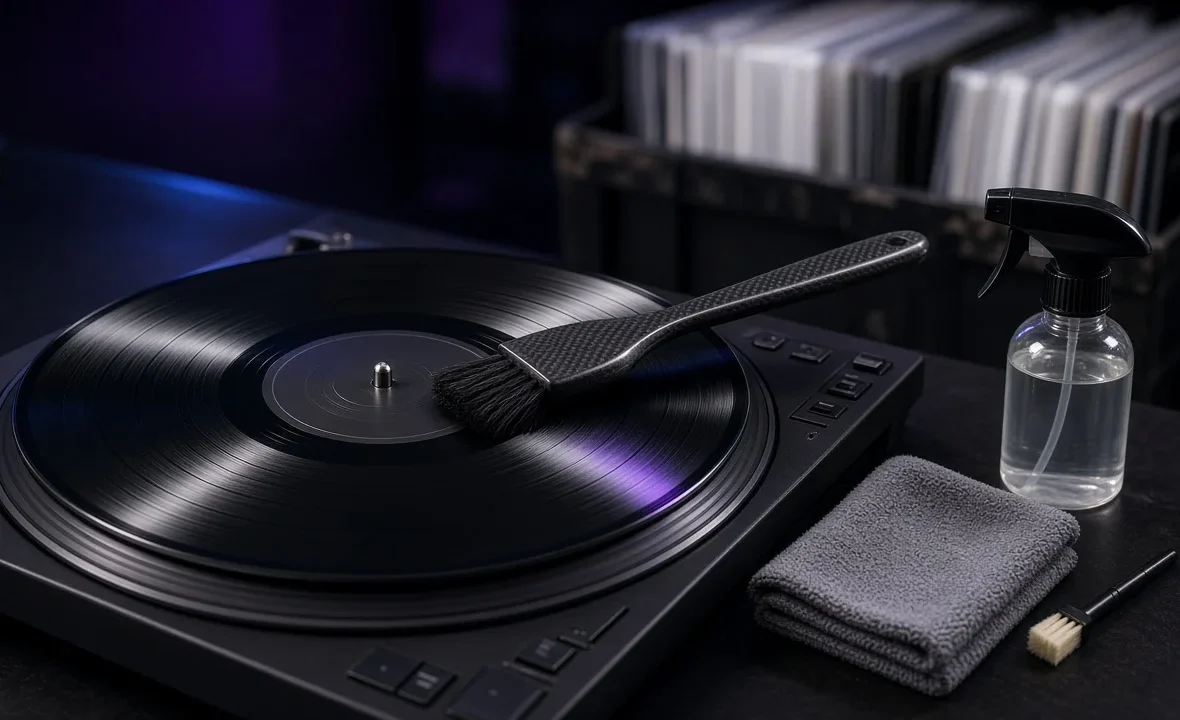
You don’t need expensive gear to start. A brush, distilled water, a proper fluid and two clean microfibre cloths will handle most records.
Dry Cleaning: Before Every Play
- Handle the record by its edges and label only. Fingerprints leave oils that trap dust.
- Put it on the platter and let it spin.
- Rest the carbon-fibre brush lightly on the surface for two or three rotations, following the grooves.
- Slowly angle the brush off the record toward the edge, collecting the dust into a line, and lift it away.
- Clean the brush by tapping or wiping it, so you’re not putting dust back on the next record.
This takes ten seconds and makes a real difference. Also brush your stylus from back to front — never side to side — every few records. Stylus care is covered in the DJ cartridges guide.
Wet Cleaning: For Dirty and Second-Hand Records
- Protect the label with a label protector, a cleaning clamp, or by working carefully around it.
- Apply a small amount of fluid — a dedicated record-cleaning solution, or distilled water with a few drops of a vinyl-safe surfactant.
- Wipe along the grooves in a circular motion with a soft microfibre pad or brush, never straight across.
- Rinse with plain distilled water if your fluid’s instructions say to, so no residue is left behind.
- Dry completely with a clean microfibre cloth, again following the grooves, then air-dry upright in a rack for a few minutes.
- Use a fresh inner sleeve. Putting a clean record back into a dusty old paper sleeve undoes the work.
Record-cleaning machines speed this up. Vacuum machines suck the fluid and dirt out of the grooves; ultrasonic cleaners use vibrations in a water bath to shake grime loose. They’re worth it if you buy a lot of used vinyl, but not essential for a small crate.
What Never to Use
| Avoid | Why |
|---|---|
| Tap water | Minerals dry into the grooves and add noise |
| Household cleaners and dish soap | Can leave residue or contain additives that harm the vinyl |
| Strong alcohol mixes | Can damage some records; never use alcohol on old shellac 78s |
| Paper towels and tissues | Shed fibres and can scratch |
| Wiping across the grooves | Pushes dirt sideways and can cause fine scratches |
| Glue or wood-glue “peel” hacks | Risky, messy and easy to get wrong |
Archives take a cautious approach too. The Library of Congress guide to caring for records recommends handling discs only by the edge and label, and the NEDCC’s audiovisual care guide is a good deeper read.
Storing Vinyl in a Hot, Humid City
Clean records stay clean only if you store them properly, and Bangkok’s heat and humidity make this matter even more.
- Store records upright, never stacked flat, and don’t pack the shelf so tightly that sleeves bend.
- Use anti-static inner sleeves and keep outer sleeves on records you play often.
- Keep them out of direct sun and away from heat. A record left in a hot car or on a sunny windowsill can warp in an afternoon.
- Control humidity. Archives aim for roughly 35–40% relative humidity at home. In Bangkok, that usually means an air-conditioned room or a dehumidifier, which also helps prevent mould on sleeves.
- Clean your gig crate. Bags collect dust and spilled drinks. Wipe it out regularly, and brush records when you get home from a gig.
If you’re building a vinyl setup, start with the DJ turntables guide, the Technics SL-1200 review, and how to DJ with vinyl.
A Note From NaJade
The first second-hand record I bought in Bangkok sounded like it was being played in the rain. I almost threw it out. Instead I did a proper wet clean with distilled water and a cheap fluid, dried it, put it in a new sleeve — and most of the noise was simply gone. That’s when I realised how much bad sound is just dirt. Now my routine is boring and consistent: brush before every play, brush the stylus regularly, wet-clean anything used before it goes near my turntables, and keep the crate in an air-conditioned room. Humidity is the quiet enemy here. Look after your records and they’ll outlast every controller you ever own.
Related: DJ turntables, DJ cartridges, timecode vinyl and DVS, and where to buy music as a DJ.
Frequently Asked Questions
What is the best way to clean vinyl records?
Can I clean vinyl records with tap water?
Is it safe to clean records with alcohol?
How often should I clean my vinyl records?
Do record-cleaning machines work?
How should I store vinyl records in a humid climate?
About the Author
NaJade is a Bangkok-based DJ playing progressive house, melodic EDM, pop, and Thai music across clubs, rooftops, and weddings in Thailand. He teaches beatmatching and mixing to beginners both in person in Bangkok and online over Zoom. When he’s not behind the decks, he’s documenting the journey on YouTube, Instagram, and TikTok.