
By NaJade · DJ in Bangkok · Published October 20, 2026
This guide is part of how to learn to DJ: the complete guide.
No sync, no waveforms, no screens. Why vinyl still teaches you more about mixing than anything else, and how to actually do it.
Vinyl is no longer how most DJs work, and it doesn’t need to be. But it remains the clearest way to learn what beatmatching actually is, because you cannot see the beats — you can only hear them. There’s no waveform to line up and no sync button to fall back on. Every correction is made with your hands and your ears, which is why DJs who learned on vinyl tend to have an ear that transfers to everything else.
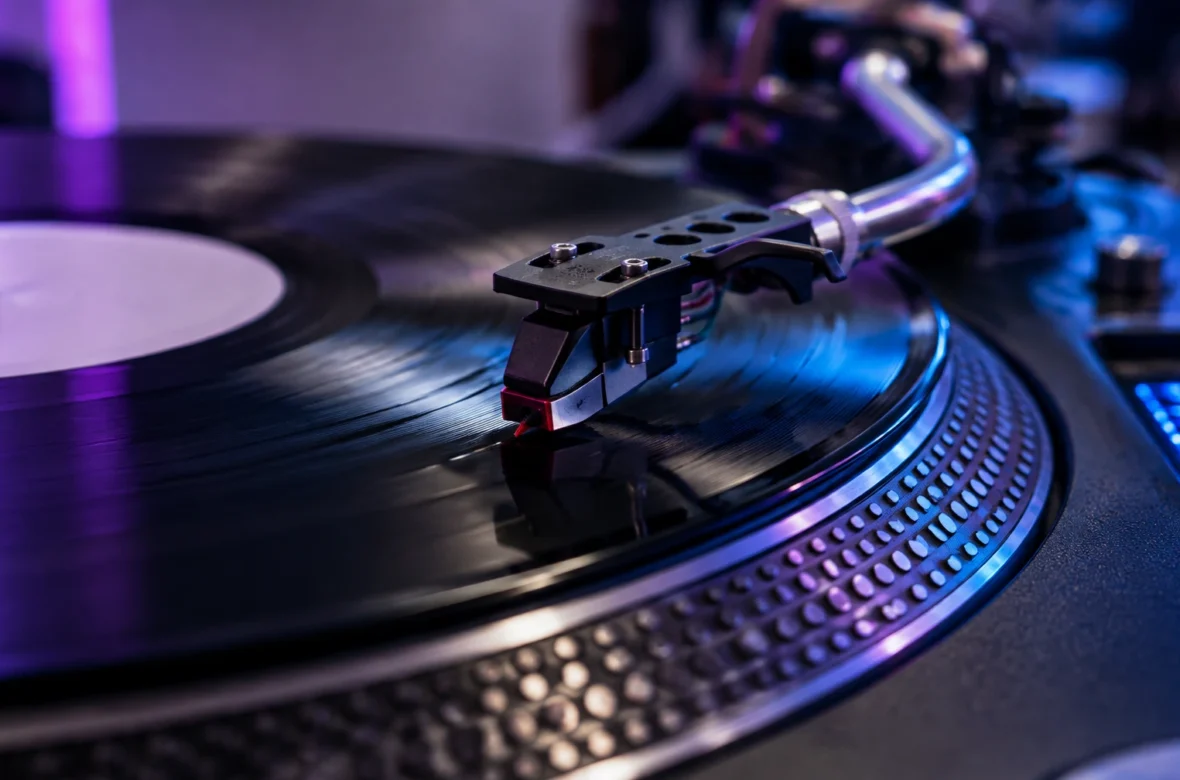
Vinyl mixing has three physical controls: the pitch fader sets the tempo, the platter edge nudges a record forward or back, and the fader or crossfader brings it into the mix. You cue a record by finding the first beat with the platter stopped, then release it in time. Everything else is listening — and there is no undo.
The Setup
The classic configuration is two turntables either side of a mixer. Turntables output a very low phono-level signal, so they connect to the mixer’s dedicated phono inputs — not line inputs — and the mixer’s grounding wire should be attached. Get this wrong and you’ll have either no sound or a loud hum.
- Set the platter speed correctly. Most 12-inch dance records play at 33 RPM; many 7-inch singles play at 45. Playing a record at the wrong speed is the first mistake every beginner makes.
- Balance the tonearm and set the tracking weight per the cartridge’s specification. Too light and the needle skips; too heavy and you wear records out.
- Isolate the decks from vibration. Turntables and loud bass in the same room is a feedback problem waiting to happen.
More on the hardware in the DJ turntables guide.
Cueing a Record
- Drop the needle just before the first beat you want.
- Hold the record still with your fingers on the vinyl while the platter continues turning underneath — the slipmat lets it slide.
- Rock the record back and forth to find the exact start of the beat. You’ll hear it as a short burst.
- Hold it at that point, ready.
- Release on the beat of the track that’s already playing, giving a very slight forward push so it reaches full speed instantly.
That release is the whole technique, and it takes a few hundred repetitions before it stops feeling like luck.
Beatmatching by Hand
| Problem | Fix |
|---|---|
| New track drifting ahead | Lower the pitch fader slightly |
| New track drifting behind | Raise the pitch fader slightly |
| Slightly out of alignment, tempo right | Nudge: brush the platter edge to slow, or push the spindle to speed up briefly |
| Badly out | Re-cue and start again. Don’t fight it |
The loop is always the same: listen in headphones, identify which track is ahead, correct, listen again. The pitch fader is for sustained tempo differences; the nudge is for alignment. Confusing the two is the most common beginner error — see how to beatmatch.
What Vinyl Teaches You
- Your ear. With nothing to look at, you develop genuine rhythmic hearing rather than pattern-matching shapes on a screen.
- Phrasing. You can’t see the structure coming, so you learn to count — see counting bars and phrases.
- Preparation. A crate holds maybe sixty records. You think much harder about what goes in it.
- Commitment. No undo, no reload, no sync. Every mix is a decision you live with.
- Why sync fails. Once you’ve matched tempo by hand, you understand exactly what a beat grid is doing — see should DJs use sync.
A Note From NaJade
I’m a digital DJ. I play progressive house off a USB, I use sync when it helps, and I’m not going to pretend otherwise. But I’d still tell anyone serious to spend a few hours on turntables at some point, because it makes a thing audible that stays invisible on a screen. When you’ve spent an afternoon nudging a platter trying to hold two records together, you stop thinking of beatmatching as an operation and start hearing it as a relationship between two tempos. That hearing is what tells you a beat grid is wrong before anything visibly drifts. There’s no purism in this for me — vinyl isn’t better and I’m not going back. It’s just the most efficient way I know to build an ear, and the ear is the part that doesn’t become obsolete when the gear changes.
Related: the DJ turntables guide, how to beatmatch, should DJs use sync, and how to scratch for beginners.
Frequently Asked Questions
How do you DJ with vinyl?
What speed do DJ records play at?
How do you beatmatch on vinyl?
Do turntables connect to line inputs?
Is it worth learning to DJ on vinyl?
What is a slipmat for?
About the Author
NaJade is a Bangkok-based DJ playing progressive house, melodic EDM, pop, and Thai music across clubs, rooftops, and weddings in Thailand. He teaches beatmatching and mixing to beginners both in person in Bangkok and online over Zoom. When he’s not behind the decks, he’s documenting the journey on YouTube, Instagram, and TikTok.