
By NaJade · DJ in Bangkok · Published September 29, 2026
This guide is part of how to learn to DJ: the complete guide.
Talent gets you your first gig. Etiquette gets you your tenth. The unwritten rules of the booth, clean changeovers, and the conduct that actually gets you rebooked.
Nobody teaches this and everybody is judged on it. The DJ booth is a shared professional workspace, not a VIP hangout, and how you behave in it — toward the gear, the other DJs, the venue staff and the crowd — does as much to build or wreck a career as your mixing does. DJing is a small world and reputation travels faster than any mix: promoters talk to each other, residents talk to bookers, and the sound engineer you were rude to remembers. Here’s the code of conduct nobody writes down.
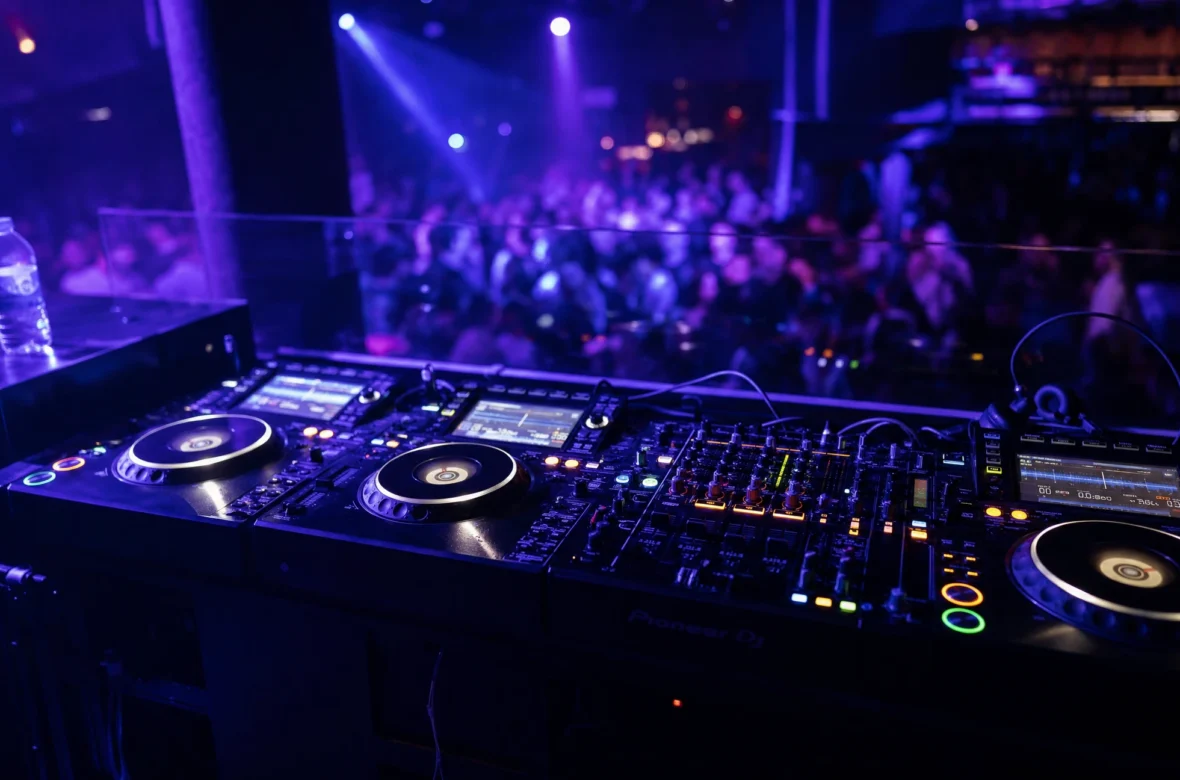
The booth is not a cloakroom, a phone-charging station or a photo opportunity. Keep all drinks away from the gear — a spill on a CDJ can end the night and many venues will bill the DJ for the repair. Don’t lean on the equipment, don’t cut the outgoing DJ off, and never touch the master. Talent gets you your first gig; etiquette gets you your tenth.
The Rules, Ranked by Consequence
| Don’t | What it actually costs you |
|---|---|
| Put a drink near the gear | A repair bill — many venues bill the DJ |
| Touch the master output | The sound engineer decides they dislike you |
| Fill the booth with friends | You can’t reach the mixer; the music stops |
| Cut the outgoing DJ off | A reputation that reaches promoters |
| Arrive at your start time | You play blind, with no read on the room |
| Leave the moment you finish | You’re seen as someone taking, not building |
| Scroll your phone mid-set | The room learns how much you care |
| Badmouth another DJ | It travels, and it reflects on you |
The Cardinal Rules
1. Drinks away from the gear
The one that costs actual money. A spilled drink on a CDJ or mixer can end the night instantly and leave you with a repair bill, because many venues will bill the DJ for the damage. Use a separate surface or shelf, prefer a bottle with a screw cap over an open glass, and never set a drink on top of the players or the mixer. Not for a second, not while you’re reaching for something.
2. The booth is not a social space
It is not a cloakroom, not a phone-charging station, not a photo opportunity. The techno DJ Kyle Geiger once described a night where the booth was so crowded he couldn’t turn around, and a drunk guest stashing a jacket in a cubby by his feet ended up blocking him from reaching the mixer — bringing the music to a complete stop.
If you’re bringing guests, ask the DJ who’s playing first, keep it to one or two, and brief them before you walk in. If you’re the guest, assume you’re in someone’s workplace, because you are.
3. Mind your physical space
Don’t lean on the gear, don’t rest your weight on the booth, and don’t elbow the person trying to mix. Booths are small and the equipment isn’t furniture. A clean, uncluttered booth is the mark of someone who’s done this before.
4. Never touch the master
The master output belongs to the venue and the sound engineer. If the room needs more volume, that’s their decision. If you need more for yourself, use the booth monitor — that’s exactly what it’s for. Reaching for the master is the single fastest way to have an engineer decide they don’t like you. More in gain staging for DJs.
The Changeover
This is where most DJs quietly reveal how professional they are, and it takes about four minutes.
- Arrive early enough to watch. Turning up at your start time means you have no idea what the room is doing. Fifteen minutes of watching tells you more than any brief.
- Load in without getting in the way. Plug your USB in, get your headphones sorted, and stay out of the outgoing DJ’s space while they finish.
- Let them finish their track. Don’t hover, don’t gesture at the clock, don’t cut them off. Their last record is theirs.
- Match their energy on your first track, then take the room where you want it. Arriving 6dB louder or twenty BPM faster is a way to be remembered badly.
- Say thank you. To the DJ, to the engineer, to the promoter. It costs nothing and people notice.
- Don’t overstay. When your slot ends, hand over cleanly and get out of the booth. The next DJ has the same needs you did.
The People Around You
- The sound engineer is your most useful ally. Introduce yourself, ask how they want things, and raise problems as questions rather than complaints. “Something sounds like it’s clipping downstream, could you take a look?” beats twisting knobs.
- Security and bar staff remember everyone. They also talk to management, which is the same conversation that decides whether you’re rebooked.
- Support the other DJs. Watch some of their set, say something specific about it, and don’t disappear the second you finish. Scenes are built by people who show up for each other.
- Handle requests gracefully even when the answer is no. How you decline is remembered longer than what you played.
- Don’t badmouth other DJs. It always travels, and it says more about you than them.
- Get off your phone. A DJ visibly scrolling mid-set tells a room exactly how much they care.
A Note From NaJade
I’d put it as bluntly as I first heard it: talent gets you your first gig, etiquette gets you your tenth. I’ve watched genuinely better DJs than me stop getting booked at venues I still play, and it was never about the mixing — it was showing up late, filling the booth with friends, being short with a sound engineer, or leaving the moment their set finished. None of that is dramatic. It just quietly accumulates into a reputation, and in a scene this small, the reputation arrives at the promoter’s ear before you do. The flip side is genuinely encouraging: being easy to work with is a competitive advantage, and it’s one you can adopt today regardless of how good your transitions are. Turn up early, look after the gear, thank the engineer, and stay for the next DJ. That’s most of it.
Related: what to bring to a DJ gig, gain staging for DJs, how to get DJ gigs, and the B2B DJing guide.
Frequently Asked Questions
What is DJ booth etiquette?
Can you bring friends into the DJ booth?
Why can’t you put drinks near DJ equipment?
How should DJs handle a changeover?
Should a DJ touch the master volume?
Does behaviour really affect whether a DJ gets rebooked?
About the Author
NaJade is a Bangkok-based DJ playing progressive house, melodic EDM, pop, and Thai music across clubs, rooftops, and weddings in Thailand. He teaches beatmatching and mixing to beginners both in person in Bangkok and online over Zoom. When he’s not behind the decks, he’s documenting the journey on YouTube, Instagram, and TikTok.