
By NaJade · DJ in Bangkok · Published July 13, 2026
This guide is part of Pioneer DJ controllers: the complete range explained.
Pioneer’s flagship laptop controller: real-time Stems, club-grade jogs, DMX lighting, and both rekordbox and Serato in one. Is it the do-it-all deck — and where does it stumble? The honest verdict.
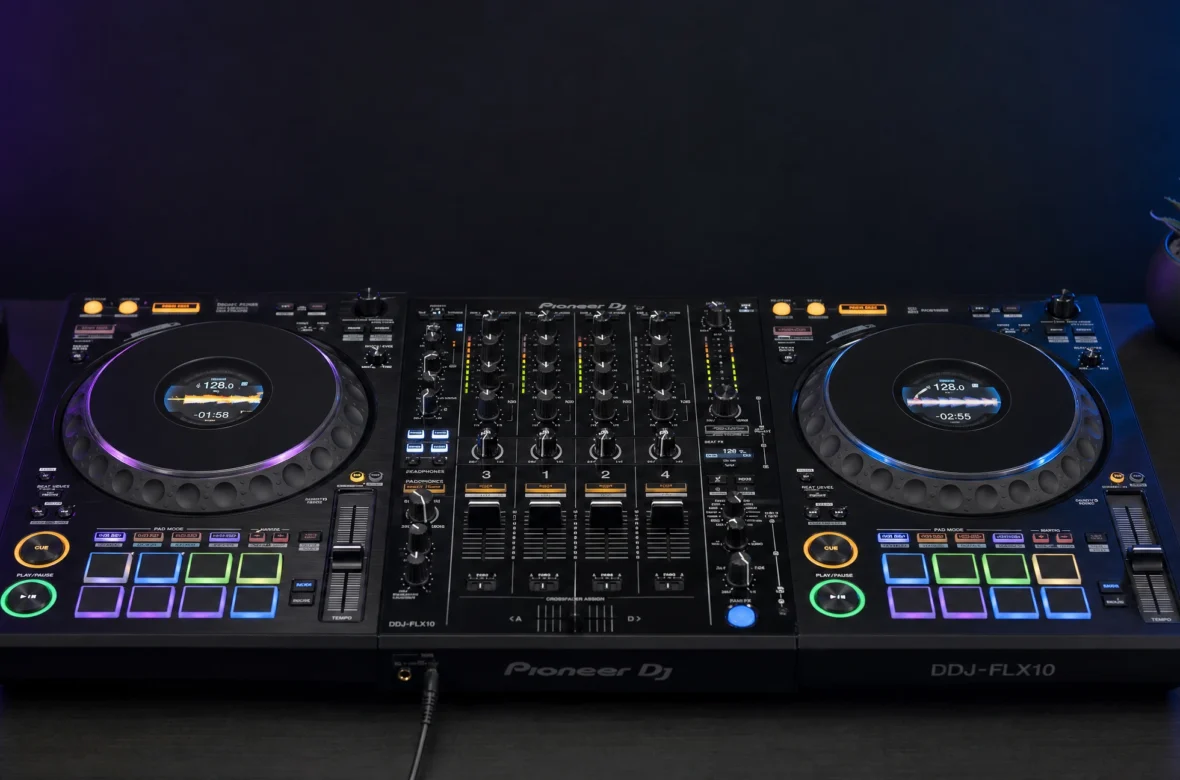
The DDJ-FLX10 is the top of Pioneer’s controller range — the flagship performance unit that replaced the beloved DDJ-1000 and DDJ-1000SRT and rolled them into one. It keeps everything that made the DDJ-1000 special (club-standard layout, full-size jogs, hardware effects) and adds the headline feature of this era: real-time Stems, letting you pull apart the vocals, drums, and instruments of any track live. Throw in dual rekordbox/Serato support, pro connectivity, and even DMX lighting control, and it’s arguably the most complete laptop controller money can buy. It’s also expensive and not flawless. Here’s an honest overview.
The DDJ-FLX10 is Pioneer’s flagship 4-channel laptop controller, replacing the DDJ-1000. Its headline feature is real-time Stems (Track Separation) for live mashups, alongside club-grade CDJ-style jogs with on-jog displays, dual rekordbox/Serato support, pro XLR/mic connectivity, and unique DMX lighting output. It’s the most complete controller in the range — but Stems sound cleaner on Serato than rekordbox, and at ~$1,599 it’s serious money.
DDJ-FLX10 at a Glance
The key specs and what they mean for you:
| Spec | DDJ-FLX10 | What it means for you |
|---|---|---|
| Channels | 4 | Full club-style multi-deck performance |
| Software | rekordbox + Serato DJ Pro (free), +VirtualDJ/djay | Both major platforms in one unit; incl. Pitch ‘n Time |
| Headline feature | Real-time Stems (Track Separation) | Split vocals/drums/inst live for mashups |
| Jog wheels | Full-size CDJ-2000NXS2-grade, 4-mode on-jog displays | Club feel; waveforms, artwork, or your logo |
| Jog rings | First-ever multicolour rings | Colour-coded to show which stems are playing |
| Crossfader | Improved 4-sensor Magvel | Precise; scratch-capable |
| Connectivity | XLR + RCA master, booth, 2 mic, dual USB-C | Full pro I/O; external sources supported |
| DMX output | Yes (rekordbox Lighting) | Run lights from the controller — solo shows |
| Price | ~$1,599 / £1,400 (check current local price) | Flagship money; sits below full CDJ setups |
(Prices vary by region and over time — confirm the current Thailand/local price before buying.)
The Headline Feature: Real-Time Stems
Stems (Pioneer calls it “Track Separation”) is the reason the FLX10 exists. It splits any standard track into three parts — vocals, drums, and instruments — in real time, with dedicated colour-coded buttons to mute or isolate each. That unlocks genuine creativity: Part Iso (adjust or mute a part), FX Part Select (apply effects to just the vocal, say), and Part Instant Doubles (send an isolated part to another deck for live mashups) — all with no track prep. The multicolour jog rings even show you which stems are active at a glance. The honest caveat every buyer should know: Stems currently sound cleaner on Serato DJ Pro (and VirtualDJ) than on rekordbox, where some users report artefacts or stutter and it can be RAM-hungry. If Stems is your main reason to buy, plan to run it on Serato. For help choosing, see rekordbox vs Serato.
What’s Great About the FLX10
Genuinely Club-Grade Feel
The full-size mechanical jog wheels are on par with the CDJ-2000NXS2, with manual tension adjustment and four on-jog display modes (deck info, zoomed waveform, artwork, or your own logo). The layout mirrors a CDJ-and-DJM club setup closely enough that moving to club gear is painless — the pads sit under the jogs rather than above, the one small departure from a true CDJ. Everything feels premium: heavy knobs, solid faders, high-res jog screens.
Both Platforms, Pro Effects, Pro I/O
It unlocks both rekordbox and Serato DJ Pro free (with a Serato Pitch ‘n Time voucher included), so you’re not locked in like you were with the DDJ-1000 vs 1000SRT. Pioneer’s full Beat FX and Sound Color FX suite is on board (with a new Stretch effect and extra Color FX like Space reverb), and the connectivity is properly professional: XLR and RCA master, booth output, two balanced mic inputs, external source support, and dual USB-C for smooth back-to-backs.
Unique Extras: DMX Lighting & Mix Point Link
The FLX10 is, to our knowledge, the only DJ controller with a built-in DMX output — plug lights straight in and drive them from rekordbox Lighting, making genuine one-person light shows possible without a separate interface. Mix Point Link (rekordbox) can also auto-trigger your next track at a preset point, freeing your hands for effects and Stems work. These are real differentiators for mobile and event DJs.
What to Watch Out For
- Stems favour Serato. On rekordbox, separation can sound less clean and may stutter on lower-RAM machines. Plan your software around this if Stems matters.
- Reports of live glitches. Some users have hit occasional audio dropouts or button quirks (often Stems-related in Serato) mid-performance — keep firmware updated and test before gigs.
- It’s a laptop controller, not standalone. Like the DDJ-1000, it always needs a computer for the decks. Want laptop-free? Look at the XDJ-XZ or OPUS-QUAD.
- Plastic chassis + power brick. Solid overall, but the body is plastic and it uses an external 12V brick (no bus power).
- Overkill for beginners. At ~$1,599 it’s far more controller (and money) than a new DJ needs — start on a DDJ-FLX4.
- DMX lighting is rekordbox-only. That headline lighting feature doesn’t work in Serato.
How It Compares in the Range
- vs DDJ-1000: The FLX10 is the direct successor — it adds Stems, dual software, better jog displays, improved Magvel, DMX, and Mix Point Link. If you don’t need Stems or dual-software and can find a DDJ-1000 cheaper, the older unit is still great value; otherwise the FLX10 is the upgrade.
- vs DDJ-GRV6: The GRV6 is the cheaper mid-range 4-channel pick. The FLX10 is better built, more capable, and more future-proof — but costs roughly double.
- vs standalone (OPUS-QUAD / XDJ-XZ): If you’d rather ditch the laptop, a standalone at a similar price is a different path — no Stems-on-laptop workflow, but full independence.
Who the FLX10 Is Really For
It’s the right controller for the serious performing or open-format DJ who wants a do-it-all flagship laptop setup: real-time Stems for creative mashups, club-grade feel that transfers to CDJs, both software platforms, and pro connectivity — plus DMX lighting if you run solo shows. It’s especially strong for Serato-based remix DJs (where Stems shine) and rekordbox DJs who want lighting integration. Skip it if you want laptop-free standalone play (get an XDJ-XZ or OPUS-QUAD), if you’re a beginner (start on the FLX4), or if you’re a dedicated turntablist (the DDJ-REV7 is built for you).
A Note From NaJade
The FLX10 is a stunning piece of kit, and if you’re a working performance DJ it can genuinely be the only controller you need for years. What I love is that it doesn’t chase gimmicks — Stems, DMX, and dual-software are real, useful, professional tools. But let me give you the honest working-DJ take. First, be clear-eyed about the Stems-on-rekordbox situation: if that feature is your dream, lean Serato, or at least test it on your own laptop before you commit, because a stutter mid-set is the last thing you want. Second, don’t buy this as a status symbol — I’ve watched people stretch to a flagship when a DDJ-1000 or GRV6 would have done everything they actually do, and the extra money would’ve been better spent on music, monitors, or lessons. And third, if any part of you wants to play without a laptop, seriously weigh a standalone at this price instead. But if you want the most capable laptop controller Pioneer makes, and you’ll actually use Stems and the pro features, the FLX10 earns its flagship badge. Buy it for the tools you’ll really use — and remember the crowd feels your track selection and timing long before they notice your gear.
Compare it with the rest of the lineup in my complete Pioneer DJ controller guide, or the wider DJ gear for beginners series. Want to get the most from a flagship — or figure out if you even need one? My DJ lessons run in person in Bangkok or online over Zoom.
Frequently Asked Questions About the DDJ-FLX10
Is the DDJ-FLX10 worth it?
What is Track Separation (Stems) on the DDJ-FLX10?
Does the DDJ-FLX10 work with rekordbox and Serato?
Can the DDJ-FLX10 be used without a laptop?
What’s the difference between the DDJ-FLX10 and DDJ-1000?
Is the DDJ-FLX10 good for beginners?
About the Author
NaJade is a Bangkok-based DJ playing progressive house, melodic EDM, pop, and Thai music across clubs, rooftops, and weddings in Thailand. He teaches beatmatching and mixing to beginners both in person in Bangkok and online over Zoom. When he’s not behind the decks, he’s documenting the journey on YouTube, Instagram, and TikTok.