
By NaJade · DJ in Bangkok · Published September 29, 2026
The one piece of gear that outlives every controller you’ll ever own — and the one most DJs understand least. Here’s the whole landscape, explained plainly.
If you’re building a separates setup — media players or turntables rather than an all-in-one — the mixer is the decision that matters most. It’s the piece everything plugs into, the thing your hands live on all night, and the component most likely to still be in your booth in a decade. It’s also where the sound quality of your whole rig is decided. This guide maps the mixers worth knowing: the Pioneer DJM club standards, Allen & Heath’s Xone series, and the battle mixers built for scratching — with honest notes on who each is genuinely for. If you’re using a controller or standalone unit, you already have a mixer built in; this is for everyone building a rig from parts.
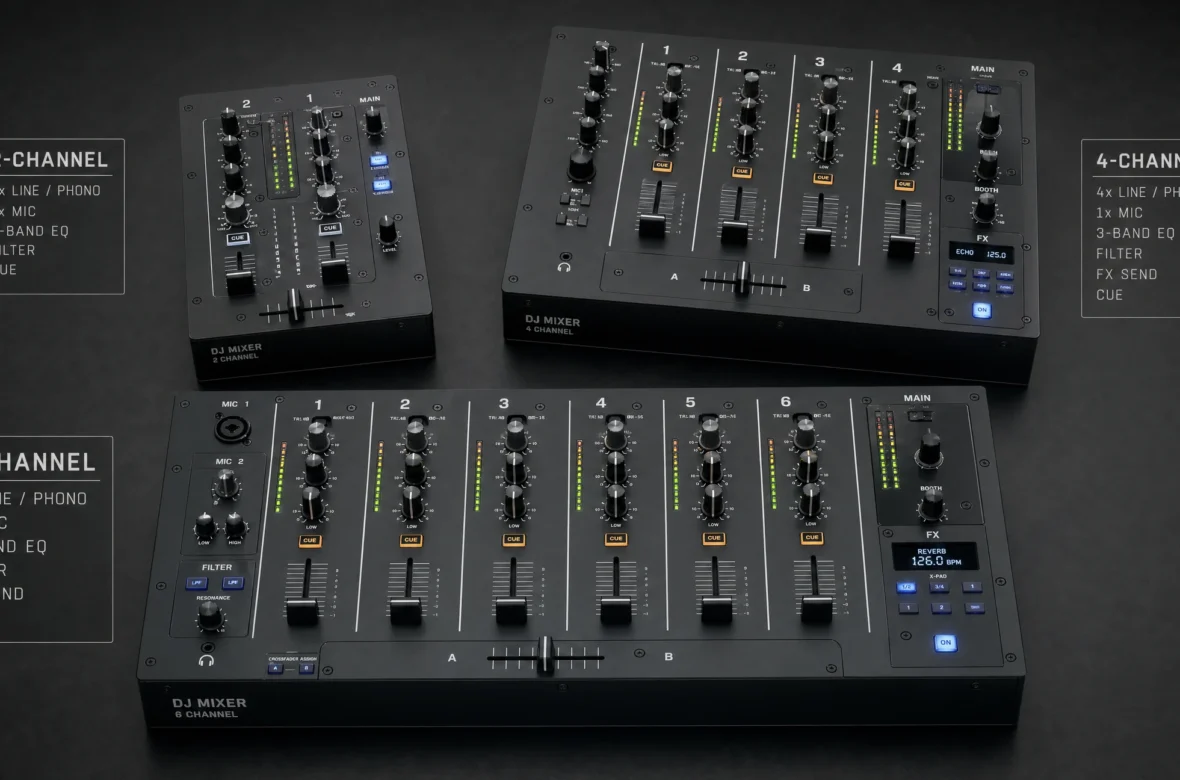
DJ mixers split into three families: club-standard 4-channel mixers (the Pioneer DJM-A9, the outgoing DJM-900NXS2, and Denon’s X1850), performance and audiophile mixers with deeper routing (the 6-channel DJM-V10 and Allen & Heath’s Xone:96 and Xone:92), and 2-channel battle mixers built for scratching (the DJM-S11 and Rane’s Seventy-Two). Pick by the gigs you play, not the spec sheet — and remember most DJs don’t need a separate mixer at all.
First: Do You Even Need a Separate Mixer?
Let’s start here, because it saves a lot of people a lot of money. If you use a DJ controller or an all-in-one standalone system like a Denon Prime 4+ or Pioneer XDJ, you already have a mixer built in — buying a separate one adds nothing. You need a standalone mixer only when your decks are separate boxes: CDJs, SC6000s, or turntables. That’s the whole rule. If you’re not building from separates, skip this guide and read the beginner controller guide instead.
The Three Families of DJ Mixer
- Club-standard 4-channel mixers — the workhorses installed in booths worldwide. Four channels, Beat FX, networked to your players. The DJM-A9, the outgoing DJM-900NXS2, and Denon’s X1850.
- Performance and audiophile mixers — more channels, deeper routing, better converters, aimed at DJs with complex setups or high sonic standards. The 6-channel DJM-V10 and Allen & Heath’s Xone:96 and Xone:92.
- Battle mixers — 2-channel units built for scratching, with a premium crossfader front and centre. The DJM-S11 and Rane’s Seventy-Two.
The Range at a Glance
Here’s the landscape in one table. Prices move constantly — treat these as ballparks.
| Mixer | Channels | Type | Rough price | Best for |
|---|---|---|---|---|
| DJM-A9 | 4 | Club standard | ~$2,699 | The current booth standard |
| DJM-900NXS2 | 4 | Club standard (discontinued) | Used — varies | Best value club mixer |
| DJM-V10 | 6 | Performance / audiophile | ~$3,400+ | Complex routing, sound quality |
| DJM-750MK2 | 4 | Club-style, affordable | Mid-range | Home and small-venue rigs |
| DJM-S11 | 2 | Battle mixer | Premium | Scratch DJs, Serato |
| Xone:96 | 6 | Analogue / audiophile | Premium | Analogue warmth, filters |
| Xone:92 | 6 | Analogue classic | Mid-premium | Legendary VCF filters |
| Rane Seventy-Two | 2 | Battle mixer | Premium | Turntablism, Serato |
| Denon X1850 | 4 | Club style | ~$1,099 | Denon SC-player rigs |
Club-Standard Mixers: The DJM Line
DJM-A9 — the current standard
Released in 2023 and now the mixer you’re most likely to meet in a professional booth, replacing the discontinued 900NXS2. It brings 32-bit converters, noticeably better sound, a third-generation Magvel crossfader, and expanded mic and effects sections. Full DJM-A9 guide.
DJM-900NXS2 — the value king
The industry standard for nearly a decade and still installed in thousands of venues. Now discontinued, which makes it the smartest used buy in DJing — near-identical workflow to the A9 for far less. Full DJM-900NXS2 guide.
DJM-750MK2 — the affordable club layout
Four channels with a familiar Pioneer layout at a far lower price — the sensible choice for a home or small-venue rig where a flagship makes no sense. Full DJM-750MK2 guide.
Performance and Audiophile Mixers
DJM-V10 — six channels, deep routing
Pioneer’s answer to Allen & Heath: six channels, 4-band EQ, separate high- and low-pass filters, send FX per channel, and the best converters Pioneer makes. Built for DJs whose routing needs outgrew a 900NXS2. Full DJM-V10 guide.
Xone:96 and Xone:92 — the analogue alternative
Allen & Heath’s Xone mixers are the choice of house and techno DJs who want analogue warmth and the legendary VCF filters. The Xone:92 is a modern classic; the Xone:96 is its updated successor with dual soundcards. Full Xone:96 and Xone:92 guides.
Battle Mixers for Scratching
If you scratch, everything changes: you want two channels, a premium crossfader with adjustable tension and cut-in, and pads for cues and Stems. The Pioneer DJM-S11 and Rane Seventy-Two are the two units turntablists actually argue about — both Serato-focused, both built around fader feel above all else. Channel count is irrelevant here; fader quality is everything.
What Actually Matters When Choosing
- How many decks are you plugging in? Two players means a 2- or 4-channel mixer is plenty. Four players or extra gear (samplers, drum machines) pushes you toward four or six channels.
- Do you scratch? If yes, a battle mixer, and the crossfader is the whole decision. If no, ignore that family entirely.
- Which ecosystem are your players in? Denon SC players pair naturally with the X1850 and its LAN hub; Pioneer CDJs with a DJM over Pro DJ Link.
- Do you need a soundcard? Most club mixers include one for DVS or laptop use; dual soundcards make back-to-back hand-offs seamless.
- Are you playing clubs, or building at home? Practising on what you’ll meet in the booth has real value — but only if you’ll actually be in those booths.
A Note From NaJade
Two honest things about mixers. First, most people reading this don’t need one — if you’re on a controller or a standalone unit, the mixer is already in the box, and the money is better spent on music, speakers, or lessons. Second, if you are building from separates, the mixer is the one piece worth stretching for, because it outlasts everything else. Controllers get replaced every few years; a good mixer sits in your booth for a decade and quietly defines how your whole rig sounds. That’s also why the discontinued 900NXS2 is such a smart used buy right now — clubs are switching to the A9 and offloading perfectly good mixers. Whatever you land on, spend your practice time on your ears rather than your EQ knobs: the crowd responds to your selection and your timing, and the finest mixer in the world won’t rescue the wrong record.
This guide is part of my wider DJ gear for beginners series — see also the Pioneer and Denon range guides, and the DJ software guide. Want help building or learning a club-style rig? My DJ lessons run in person in Bangkok or online over Zoom.
Frequently Asked Questions About DJ Mixers
Do I need a separate DJ mixer?
Which DJ mixer do clubs use?
How many channels do I need on a DJ mixer?
What is a battle mixer?
Is an expensive DJ mixer worth it?
Should I buy a used DJM-900NXS2?
About the Author
NaJade is a Bangkok-based DJ playing progressive house, melodic EDM, pop, and Thai music across clubs, rooftops, and weddings in Thailand. He teaches beatmatching and mixing to beginners both in person in Bangkok and online over Zoom. When he’s not behind the decks, he’s documenting the journey on YouTube, Instagram, and TikTok.