
By NaJade · DJ in Bangkok · Published September 29, 2026
This guide is part of DJ mixers explained: the complete guide.
The analogue alternative to Pioneer — big, warm, filter-driven sound and the mixer house and techno DJs choose on purpose. Here’s the honest verdict.
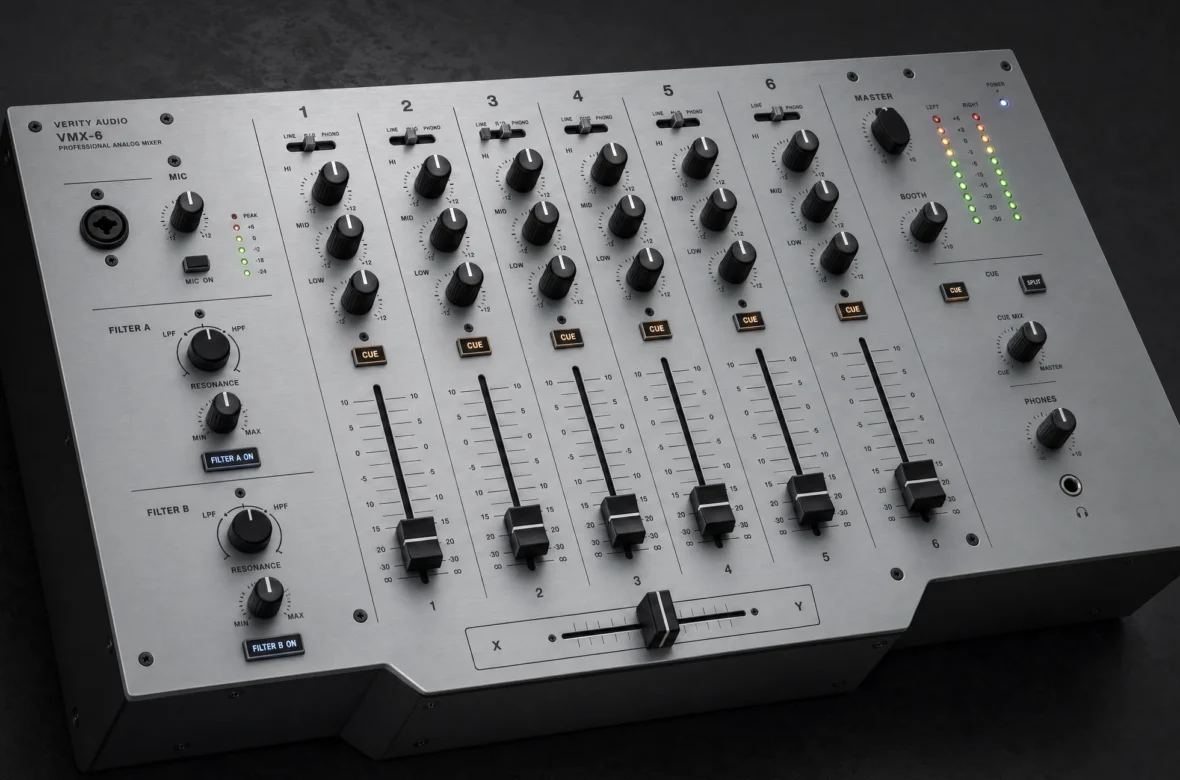
The Allen & Heath Xone:96 exists for DJs who don’t want a DJM. It’s an uncompromising analogue mixer built around the legendary Xone:VCF filters, a precision 4-band EQ, and the huge, dimensional sound the Xone name is known for — with modern digital connectivity bolted on rather than baked through. It’s the long-awaited successor to the Xone:92, a genuine club classic, and it’s the mixer you’ll find in techno and house booths where the crowd came for the sound system. It also can’t do several things a DJM can. Here’s the full picture.
The Allen & Heath Xone:96 (~$1,725–2,499) is a 6-channel analogue DJ mixer — the successor to the classic Xone:92 — built around dual Xone:VCF filters with CRUNCH harmonic distortion, a precision 4-band EQ, and a dual 32-bit/96kHz soundcard with Traktor Scratch certification. It’s the house and techno DJ’s choice for analogue warmth and filter work. The catch: almost no built-in beat effects, unlike a DJM.
Xone:96 at a Glance
The key specs and what they mean for you:
| Spec | Xone:96 | What it means for you |
|---|---|---|
| Type | 6-channel analogue club mixer | 4 stereo channels + 2 stereo returns |
| Sound | Analogue engine, upgraded phono preamps | Big, warm, dimensional — the Xone signature |
| Filters | Dual Xone:VCF (LP/BP/HP) with resonance + CRUNCH | The reason people buy this mixer |
| EQ | 4-band on channels 1–4; 3-band parametric on returns | Fine tonal control; isolator on low/high |
| Soundcard | Dual 32-bit, 24 channels @ 96kHz, two USB | Two laptops; Traktor Scratch certified |
| Faders | Replaceable 60mm VCA channel faders; innoFADER Mini crossfader | Long throw; user-serviceable |
| Routing | 2 stereo sends, 4 stereo returns, master insert | Pedals, synths, drum machines all welcome |
| Built-in FX | Essentially none beyond the filters | The main trade-off versus a DJM |
(Prices vary widely by retailer and region — confirm current local pricing before buying.)
Why DJs Choose Xone Over Pioneer
This isn’t a value decision — it’s a sonic one. Xone mixers have a reputation among sound engineers at major clubs for being outstanding on large systems: the analogue engine delivers a bigger, more three-dimensional low end and a sense of space that many DJs simply prefer to the cleaner, more clinical digital sound of a DJM. Add the VCF filters, which are genuinely musical instruments rather than utility knobs, and you get a mixer that shapes sound rather than just passing it through. That’s why it’s the default in a lot of techno and house rooms, and why Pioneer built the DJM-V10 partly to answer it.
What’s Great About the Xone:96
The VCF Filters — and CRUNCH
The dual Xone:VCF filters (low-pass, band-pass, high-pass, each with resonance) are the heart of the mixer and nothing else quite matches them for musicality. The :96 improves on the :92 in two ways that matter: the filters now switch silently — the :92’s audible pop when engaging a filter is gone — and the old LFOs are replaced by CRUNCH, a harmonic distortion circuit that adds analogue grit to the filter effect. For long, evolving techno and progressive blends, that combination is genuinely creative territory.
Connect Absolutely Everything
Six channels covers four turntable/line inputs plus two fully-featured stereo return channels with their own 3-band parametric EQ. Add two stereo sends, four stereo returns, a master insert, and two independent USB soundcards (24 channels at 96kHz), and you can run laptops, turntables, CDJs, pedals, synths, and drum machines all at once. Two independent headphone circuits make back-to-backs clean. It’s built to be the hub of a hybrid rig.
Serviceable, Long-Life Build
The 60mm VCA channel faders are unusually long — they take adjusting to, but the extra travel gives finer control — and crucially they’re user-replaceable, as is the innoFADER Mini crossfader. On a mixer you plan to own for a decade, that’s a meaningful practical advantage over units where a worn fader means a service visit. The phono preamps were also upgraded over the :92, which noticeably improves vinyl playback.
What to Watch Out For
- Almost no built-in effects. The big one. Beyond the filters there’s essentially nothing — no Beat FX suite like a DJM. Xone mixers were never strong here, and you’ll want an external effects unit if you rely on echoes and delays.
- Not the club standard. You’ll find these in some house and techno venues, but most booths run Pioneer — so it’s a chosen-sound mixer rather than a familiar one.
- It’s large. Noticeably bigger than the Xone:92 — wider, taller, deeper — so check booth space and flight cases.
- The cue system has a quirk: some users report a volume dip at the centre when blending between cue and master, which takes getting used to.
- Traktor-leaning. Traktor Scratch certification out of the box is great if you use Traktor; Serato and rekordbox users should verify their DVS setup.
- The long faders divide opinion. Some love the control, others find the throw unfamiliar coming from a DJM.
Who the Xone:96 Is Really For
It’s for house, techno, and electronic DJs who prioritise analogue sound and filter-driven mixing over effects suites; for hybrid performers plugging in synths, drum machines, and pedals; for vinyl DJs who’ll appreciate the upgraded phono stage; and for venues wanting a mixer that flatters a big sound system. Skip it if you want club-standard familiarity (DJM-A9), if you rely on built-in Beat FX, if you scratch (DJM-S11), or if budget matters — the Xone:92 delivers much of the same magic for less.
A Note From NaJade
The Xone:96 is the mixer I’d point a progressive house or techno DJ toward if they told me sound quality was their priority above everything else. Those filters are the closest a mixer gets to being an instrument — you can ride a VCF through a sixteen-bar build and it feels like playing, not adjusting. But I want to be clear about the trade, because it’s a real one: you’re giving up the effects suite that DJMs make so easy, and you’re stepping outside the layout you’ll meet in most booths. If you love echoes and delays on tap, or you want your home rig to mirror club gear, a DJM is the more sensible buy. If you want the biggest, warmest sound and filters you’ll actually perform with, this is a beautiful, long-lived choice. As ever, the room responds to your selection and your timing — the mixer just decides how good it feels getting there.
Compare the whole range in my complete DJ mixer guide, or see the players that pair with it in the Pioneer and Denon range guides. Want help building a hybrid rig? My DJ lessons run in person in Bangkok or online over Zoom.
Frequently Asked Questions About the Xone:96
Is the Xone:96 better than a Pioneer DJM?
What’s the difference between the Xone:96 and Xone:92?
Does the Xone:96 have built-in effects?
What are Xone:VCF filters?
Is the Xone:96 good for vinyl DJs?
Do clubs use the Xone:96?
About the Author
NaJade is a Bangkok-based DJ playing progressive house, melodic EDM, pop, and Thai music across clubs, rooftops, and weddings in Thailand. He teaches beatmatching and mixing to beginners both in person in Bangkok and online over Zoom. When he’s not behind the decks, he’s documenting the journey on YouTube, Instagram, and TikTok.