
By NaJade · DJ in Bangkok · Published October 19, 2026
This guide is part of EDM genres explained: the complete guide.
Some house music is built for the peak. Organic house is built for the hour before it — when the sun is going down and nobody wants to be shouted at yet.
If you’ve ever heard a set on a rooftop or a beach where the kick drum felt soft, the percussion sounded like real hands on real wood, and a flute or an oud drifted over the top, you’ve probably heard organic house. It is one of the fastest-growing corners of melodic dance music, and it sits very close to the progressive and melodic sounds I play in Bangkok. Here’s what defines it, where it came from, and how to use it in a set.
Organic house is a slow, deep strand of house music built on hand percussion, acoustic instruments and world-music melodies, usually around 110–122 BPM. Beatport gave it its own genre — Organic House / Downtempo — in 2020. Think warm, earthy and hypnotic rather than loud and euphoric.
What Organic House Sounds Like
The name is a description of the texture, not a rule book. Most organic house tracks share a handful of ingredients:
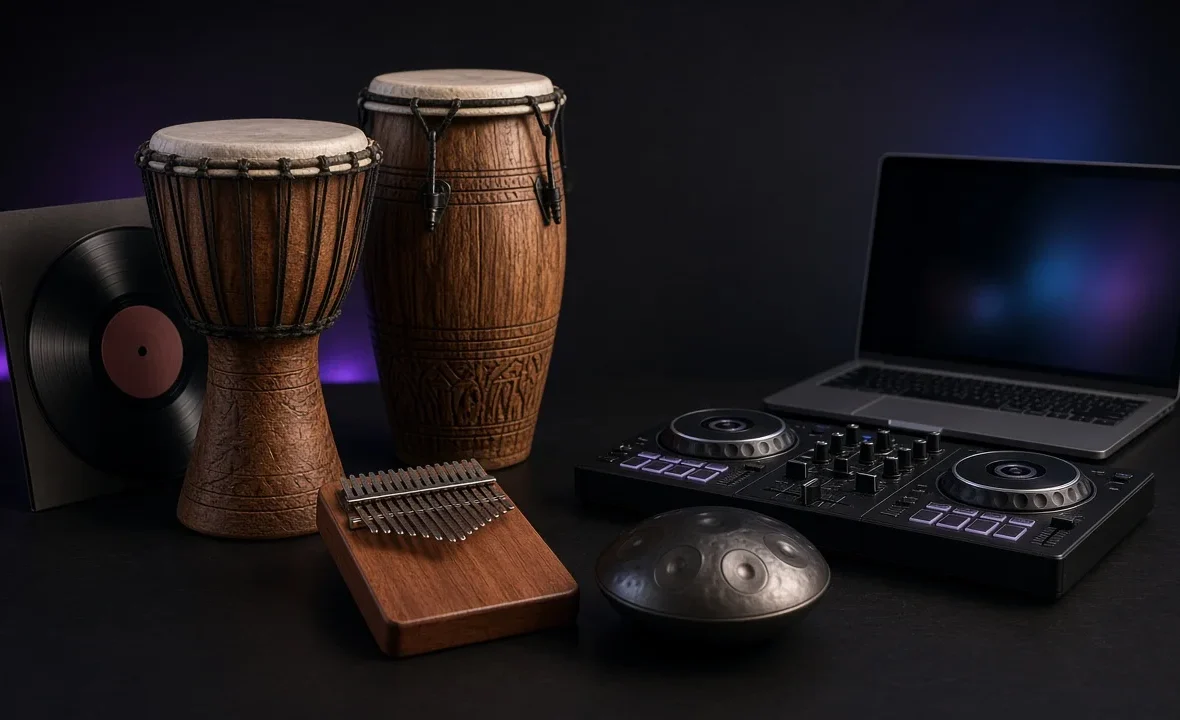
- Hand percussion. Congas, bongos, djembes, shakers and wooden clicks carry the groove as much as the kick does.
- A softer kick and rounded bass. The low end is warm and rolling rather than punchy and distorted.
- Acoustic and world instruments. Guitars, ouds, kalimbas, flutes, handpans and chanted or wordless vocals, often with a Middle Eastern, North African or Latin flavour.
- Space. Long reverbs, field recordings — birds, water, wind — and arrangements that take their time.
- Slower tempos. Typically 110–122 BPM, with downtempo tracks dropping well below that.
The mood is hypnotic and warm. There are builds, but rarely big drops — the energy rises through layering and percussion rather than a snare roll and a wall of synths.
Where Organic House Came From
Organic house grew out of deep house, downtempo and the “desert” and daytime party scenes of the 2010s. DJs playing long open-air sets — sunrise sessions, boutique festivals, beach bars from Tulum to Ibiza — wanted music that worked before and after the peak. Labels and parties built around that daytime feeling, such as Lee Burridge’s All Day I Dream and Damian Lazarus’s Crosstown Rebels and Day Zero events, helped shape the sound.
For years, these tracks were scattered across deep house, melodic house, electronica and afro house charts. In June 2020 Beatport launched a dedicated Organic House / Downtempo genre, describing a trend towards deeper, more meditative and sometimes slower house music. That gave the sound a name DJs and record shops could actually search for. The Wikipedia entry on organic house is a useful overview of its roots.
Organic House vs Similar Genres
The borders are blurry, and plenty of tracks sit across two genres. This is how I separate them when I’m organising a crate.
| Genre | Typical BPM | How it differs |
|---|---|---|
| Organic house | 110–122 | Acoustic textures, hand percussion, world melodies, soft kick |
| Afro house | 118–124 | Rooted in South African house; stronger, drier drums and chanted vocals |
| Melodic house | 118–124 | Synth-led melodies and arpeggios rather than acoustic instruments |
| Progressive house | 120–126 | Longer builds, layered synths and a clearer peak-time arc |
| Deep house | 118–124 | Jazzy chords and soulful vocals; less world-music flavour |
If a track has a conga loop, a desert-guitar riff and a kick you feel more than hear, it’s probably organic. For the neighbours, see what afro house is, what progressive house is and the broader map of house music subgenres.
Artists and Labels to Start With
A good way to learn the sound is to follow a few artists and labels and dig back through their catalogues:
- Artists: Damian Lazarus, Bedouin, Sabo, Lee Burridge, Blond:ish, Satori, Lost Desert, Hraach, Jean Vayat and Monolink’s more acoustic material.
- Labels and parties: All Day I Dream, Crosstown Rebels, Sol Selectas, Bedouin’s Human By Default and Beatport’s Organic House / Downtempo chart.
Lost Desert, Hraach and Jean Vayat were among the first names to top Beatport’s new chart when it launched — a decent snapshot of what the genre meant at the start. For where to actually buy tracks, see where to buy music as a DJ.
How to Mix Organic House
Organic house is forgiving in some ways and unforgiving in others. Long intros and outros make blends easy; dense percussion makes sloppy beatmatching very obvious.
- Blend long. 32 or 64 bars is normal. Let the percussion of two tracks weave together rather than cutting between them.
- Watch the percussion, not just the kick. Two busy conga loops on top of each other turn to mush. Use the mid EQ to give one track room.
- Mix in key. The melodies are exposed and sustained, so clashes are obvious. Harmonic mixing matters more here than in most genres.
- Use it as a ramp. Organic house is perfect for warm-ups: start around 112 BPM and lift a few BPM per half hour into melodic or progressive house. More on that in how to play a warm-up set.
- Go easy on effects. A filter and a touch of reverb are plenty. Heavy echo-outs fight the natural space already in the tracks.
A Note From NaJade
I came to organic house through rooftop gigs in Bangkok. The early slot, 6pm, the sky still orange, people arriving in twos and threes — my usual progressive tracks felt too pushy. A friend handed me a USB of slower, percussive records and the room changed: people stayed at the bar longer, then drifted to the floor on their own. I still don’t play organic house all night. For me it’s the opening chapter — the part of the story where you earn the trust you’ll spend later. If you mostly play melodic or progressive house, a small organic folder is one of the best things you can add to your bag.
Related: what melodic techno is, what progressive house is, EDM genres explained and listening bars in Bangkok. Production deep-dive: Native Instruments on organic house.
Frequently Asked Questions
What is organic house music?
What BPM is organic house?
What is the difference between organic house and afro house?
When did organic house become a genre?
Who are the best organic house artists?
Is organic house good for beginner DJs?
About the Author
NaJade is a Bangkok-based DJ playing progressive house, melodic EDM, pop, and Thai music across clubs, rooftops, and weddings in Thailand. He teaches beatmatching and mixing to beginners both in person in Bangkok and online over Zoom. When he’s not behind the decks, he’s documenting the journey on YouTube, Instagram, and TikTok.