
By NaJade · DJ in Bangkok · Published November 11, 2026
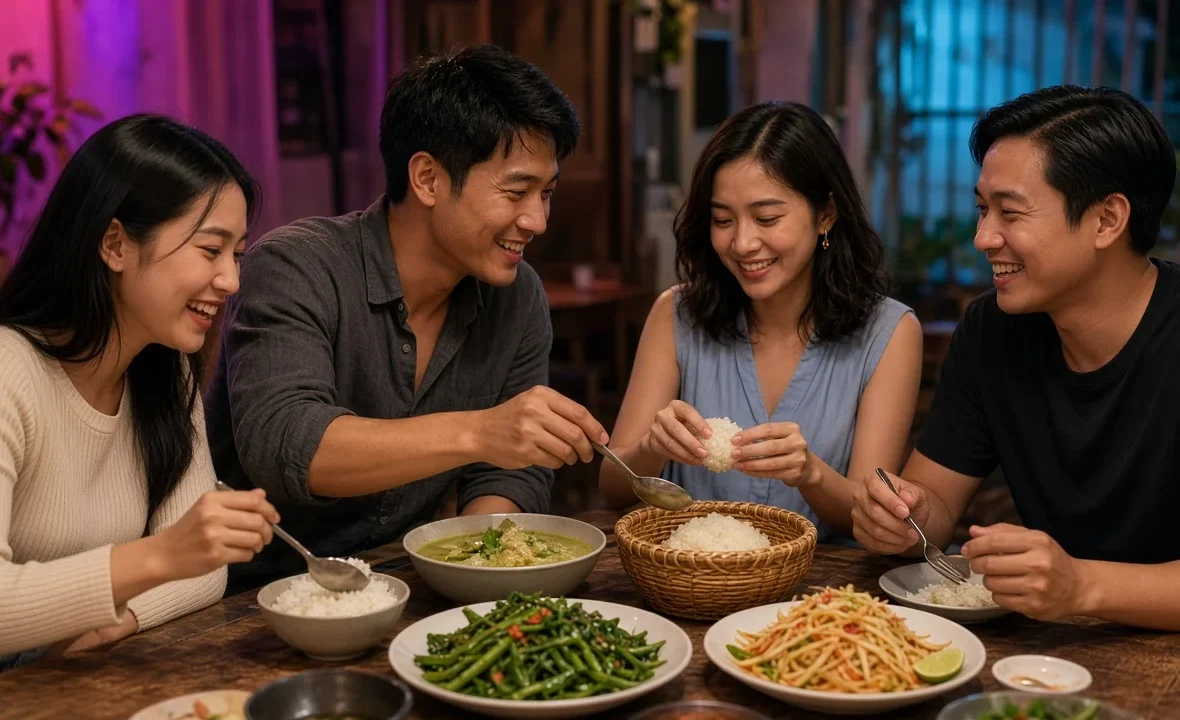
Thai table manners are relaxed but have a few clear rules: eat with a spoon in your right hand and use the fork in your left only to push food onto the spoon — the fork does not go in your mouth. Dishes are shared, so take a little at a time onto your own rice. Use chopsticks for noodle soups, your fingers for sticky rice, and let the host or eldest person lead.
I eat out in Bangkok most days — street stalls before gigs, long family dinners on Sundays, late-night noodles after a set. Visitors are usually nervous about getting it wrong, but Thai people are forgiving at the table. Nobody expects you to be perfect. Knowing the basics, though, makes meals smoother and earns you a lot of warm smiles.
Spoon in the right hand, fork in the left to push food onto it. Rice on your own plate, shared dishes in the middle, a spoonful at a time. Chopsticks for noodle soup, fingers for sticky rice. Don’t take the last bite without offering it, and expect the host or eldest to pay.
Spoon and Fork: The Core Rule
The single biggest surprise for visitors is that Thai food is eaten with a spoon, not a fork. Hold the spoon in your right hand; it does the work of carrying food to your mouth. The fork stays in your left hand and acts like a pusher, sliding rice and curry onto the spoon. Putting the fork in your mouth is not offensive, but it marks you as a newcomer.
Knives are rare because Thai cooks cut everything into bite-sized pieces before it reaches the table. If something is too big, press it with the side of your spoon to cut it.
| Utensil | When it is used | Tip |
|---|---|---|
| Spoon | Almost every rice dish, curries, soups | Right hand — this is your main tool |
| Fork | Pushing food onto the spoon | Left hand — keep it out of your mouth |
| Chopsticks | Noodle soups and Chinese-style noodle dishes | Usually offered with a soup spoon |
| Hands | Sticky rice and northeastern (Isan) food | Right hand, roll a small ball |
| Serving spoon | Taking food from shared dishes | Called chon klang — use it if one is provided |
How Sharing Works
A Thai meal is not “one plate each”. Everyone gets their own plate of steamed rice, and the dishes — a curry, a stir-fry, a soup, a salad — go in the middle for the table. The rhythm is simple:
- Take a spoonful or two at a time onto your rice, eat it, then take more. Piling your plate high looks greedy.
- Use the serving spoon where there is one. Many restaurants now provide them by default.
- Try a bit of everything. Thai meals are balanced across sour, sweet, salty and spicy; the dishes are meant to be eaten together.
- Offer the last piece to others before taking it. Leaving a little in the shared dish is common.
- Pace with the table. Wait until food is served and the host invites people to start.
If you are new to the heat levels, read how spicy Thai food really is before ordering. Wikipedia’s overview of Thai cuisine is also a good primer on how a shared meal is built.
Noodles, Sticky Rice and Condiments
Noodle soups come with chopsticks and a spoon. Lift noodles with the chopsticks onto the spoon, then sip. Slurping is fine at a noodle stall. Never stand your chopsticks upright in a bowl — like in much of Asia, it is associated with offerings to the dead.
Sticky rice, the staple of northern and northeastern Thailand, is eaten by hand. Pinch off a small amount with your right hand, roll it into a ball and use it to scoop up som tam or grilled chicken. Wash your hands first.
Most noodle shops have a condiment caddy — fish sauce with chillies, dried chilli flakes, sugar and chilli vinegar. Thais season their own bowls, so adjusting your food is completely normal, not an insult to the cook. Taste first, then add a little at a time. More street-level detail is in my Bangkok street food guide.
Small Things That Make a Good Impression
- Don’t lick your fingers or blow your nose at the table. Excuse yourself instead.
- Finish your rice. Wasting rice is frowned upon in a culture where it is the centre of every meal.
- Say thank you. Khop khun khrap (men) or khop khun kha (women). “Delicious” is aroi. More in basic Thai phrases.
- Let the host order. At a group meal, one person usually orders for the table. Mention allergies early and quietly.
- Keep your voice down in nicer restaurants. Street stalls are lively; family restaurants are calmer.
The broader rules — feet, heads, temples and the wai — are in my guide to Thai etiquette in Bangkok. Chiang Mai Ambassador’s Thai eating etiquette guide is another helpful summary.
Who Pays the Bill?
Traditionally, the host, the eldest or the most senior person pays, and arguing too hard can embarrass them. Among friends, younger Thais often split the bill — they call it “AA”. If a Thai friend invites you and insists on paying, accept graciously and offer to treat them next time. Tipping is optional; leaving the coins from your change is common. See do you tip in Bangkok? for the details.
A Note From NaJade
The first time I ate with a friend’s family in Bangkok, I made the classic mistake: I scooped half the green curry onto my plate in one go, like I was at a buffet. Nobody said anything. His grandmother just smiled and quietly pushed the other dishes towards me. That small kindness is very Thai. People care far more that you are enjoying the food than whether your fork is in the right hand. If you remember just two things — spoon to your mouth, a little at a time from the shared dishes — you will be fine at almost any table in this city. The rest you learn by eating, which is the best part.
Related: Thai etiquette in Bangkok, the best Thai restaurants in Bangkok, taking a Thai cooking class, and how spicy Thai food is.
Frequently Asked Questions
Do Thai people eat with a fork?
Is it rude to use chopsticks in Thailand?
How do you eat sticky rice?
Is it rude to leave food on your plate in Thailand?
Who pays for dinner in Thailand?
Can I add sauces to my food in Thailand?
About the Author
NaJade is a Bangkok-based DJ playing progressive house, melodic EDM, pop, and Thai music across clubs, rooftops, and weddings in Thailand — and has lived in the city long enough to have made every one of these mistakes at least once. Find him on YouTube, Instagram, and TikTok.
🎧 Listen to his latest set · 💌 Book him for your venue or event