
By NaJade · DJ in Bangkok · Published November 9, 2026
This guide is part of how to learn to DJ: the complete guide.
Three seconds of noise that can make a room scream — or make it walk to the bar.
A spinback (or backspin) is the move where you grab the playing track and fling it backwards, so the music rewinds with that unmistakable whoosh, then slam the next song in on the downbeat. It is a hard cut dressed up as a performance, and when it lands on the right phrase it is one of the most exciting transitions in DJing. When it lands on the wrong one, it sounds like a mistake. Here is how to do it properly on jog wheels, platters and software.
A spinback is a fast backwards spin of the outgoing track that ends in a hard cut to the next one. Cue the new track on its first downbeat, spin the old track back on the last beat of a phrase, close its fader, and start the new track the instant the spin stops. Use it sparingly.
What a Spinback Actually Is
Technically, a spinback is a transition that removes the outgoing track abruptly. Instead of blending basslines with EQ, you stop one song dead and start another. The backwards spin just makes the stop sound intentional. It grew out of vinyl and hip-hop DJing — Wikipedia’s entry on back spinning traces it to the turntable era — and today it turns up in open-format, hip-hop, drum and bass and mainstage EDM sets.
| Move | What it sounds like | Best used for |
|---|---|---|
| Spinback | Fast rewind, then silence or a new drop | Big energy changes, genre switches |
| Vinyl brake | Track slows down and stops | Endings, dramatic pauses |
| Echo out | Track repeats and fades | Softer exits, tempo changes |
| EQ blend | Two tracks overlap smoothly | Long house and techno mixes |
If you want the full menu of exits, see DJ transition techniques and how to use DJ effects.
Step by Step: Your First Spinback
- Cue the incoming track on its first strong downbeat — usually the start of the drop or the first vocal line. Set a hot cue there.
- Count the outgoing track. You want to spin on the last beat of a phrase, typically the end of an 8- or 16-bar section. If counting is still shaky, read how to count bars and phrases first.
- Spin. On the last beat, push the jog wheel or platter firmly backwards for about half a turn to a full turn. Make sure vinyl mode is on so the top plate acts like a record.
- Kill the old track. As the spin decays, pull its channel fader down or flick the crossfader across. Pausing the deck also works on most controllers.
- Drop the new track exactly when the spin finishes — hit the hot cue or release the record. The gap should feel like one breath, not a pause.
Practise the sequence slowly with the volume low until your hands do it without thinking. Then practise it at gig volume, because timing feels different when it is loud.
Controllers, CDJs and Vinyl
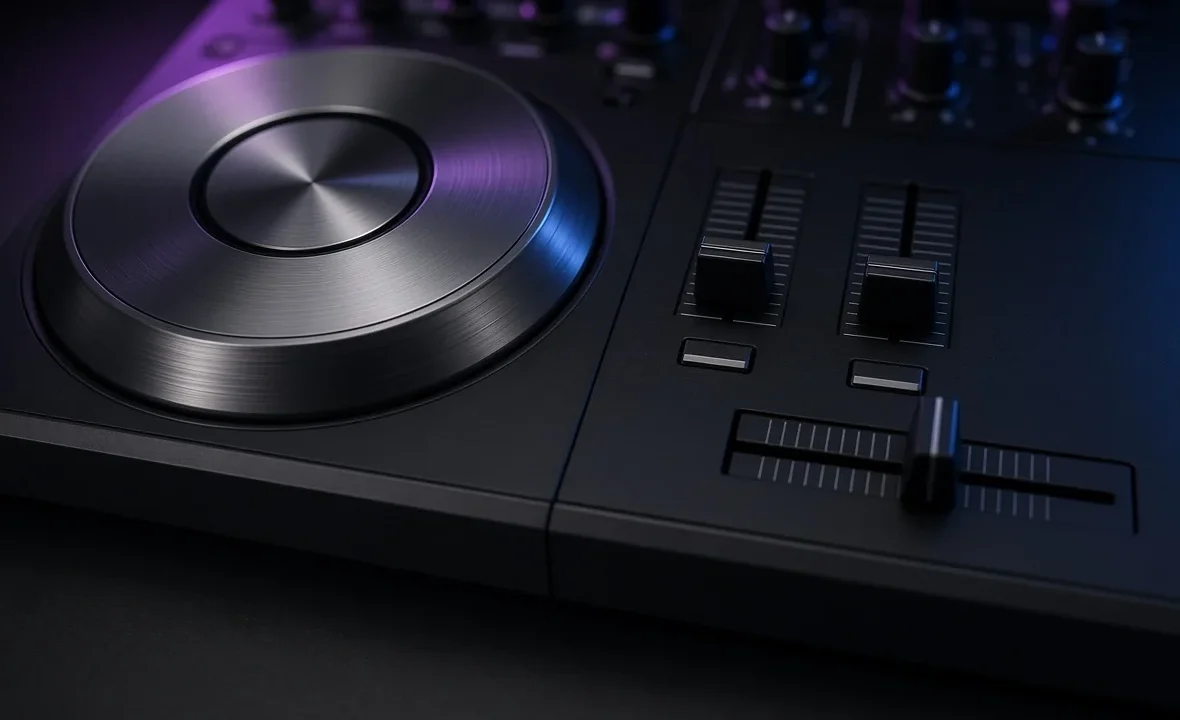
- Controllers and CDJs: the jog wheel needs to be in vinyl or touch mode, and jog sensitivity matters. A light, slippery wheel gives a short, weak spin. More on this in DJ jog wheels explained.
- Slip mode: with slip mode on, the track keeps playing silently underneath the spin, so you can let it snap back in time instead of cutting to a new song. It is the easiest way to practise the motion.
- Vinyl: real platters give the most natural sound, but you must be firm and keep your hand off the label so the needle does not jump.
- Software effects: rekordbox, Serato and other apps include brake and backspin-style effects you can trigger from pads. They are consistent, but crowds can hear the difference. Check your own software’s FX list on rekordbox.com or your app’s manual.
When to Use It (and When Not To)
| Good moment | Bad moment |
|---|---|
| Switching from one genre or tempo to another | Mid-way through a long progressive build |
| Rewinding a crowd favourite (“pull up”) | Every other transition in the set |
| After a breakdown, before a drop | In the middle of a vocal line |
| Open-format and party sets | Deep, hypnotic warm-up sets |
The rule I follow: a spinback is punctuation. One or two in an hour make a set feel alive; ten make it feel nervous. In a peak-time room it can work beautifully — see how to play a peak-time set — but in a warm-up, it usually just breaks the mood you are building.
A Note From NaJade
I play mostly progressive house and melodic sets, where the whole point is that you can’t hear the joins. So I don’t spin back often. But at weddings and open-format parties in Bangkok, a well-timed spinback into a song everyone knows gets a bigger reaction than any blend I have ever done. The ones that work all have the same thing in common: they happen on the last beat of a phrase, and the next track lands on the one. The ones that flop are always a little early or a little late. I practised mine at home with slip mode on, over and over, until I stopped thinking about it. That is honestly the whole secret.
Related: DJ transition techniques, how to scratch for beginners, jog wheels explained, and how to DJ with vinyl.
Frequently Asked Questions
What is a spinback in DJing?
Can you do a spinback on a DJ controller?
When should you do a spinback?
What is the difference between a spinback and a vinyl brake?
Does a spinback damage CDJs or turntables?
Why does my spinback sound off-beat?
About the Author
NaJade is a Bangkok-based DJ playing progressive house, melodic EDM, pop, and Thai music across clubs, rooftops, and weddings in Thailand. He teaches beatmatching and mixing to beginners both in person in Bangkok and online over Zoom. When he’s not behind the decks, he’s documenting the journey on YouTube, Instagram, and TikTok.