
By NaJade · DJ in Bangkok · Published October 20, 2026
This guide is part of how to learn to DJ: the complete guide.
Most booth disasters aren’t technical. They’re a question nobody asked a week before the gig.
A rider is the document that answers those questions in advance. It tells a venue or promoter what equipment you need, how the booth should be set up, and what you expect on the night. It isn’t a diva list — it’s a checklist that protects your set and makes the promoter’s job easier. Even if you’re only playing bars and small events, a simple one-page rider will make you look more professional and save you from turning up to a broken mixer or no booth monitor.
A DJ rider is a short document attached to your booking that lists your technical needs — players, mixer, monitors, connections — plus logistics and hospitality such as set times, guest list, drinks and transport. Keep it to one or two pages, be specific about model numbers, and say what you can bring yourself.
Tech Rider vs Hospitality Rider
Most DJs combine both into one document, but it helps to think of them as two halves.
| Part | What it covers | Who reads it |
|---|---|---|
| Technical rider | Players, mixer, monitors, power, booth layout, connections, soundcheck | Sound engineer, venue tech |
| Hospitality rider | Drinks, food, guest list, green room, transport, accommodation | Promoter, venue manager |
| Logistics | Arrival time, set times, contact names, payment details | Everyone |
The rider sits alongside your contract, not instead of it. The contract covers fee, cancellation and payment; the rider covers how the night actually runs. If you haven’t got a contract template yet, start with what to include in a DJ contract.
What to Put in Your Technical Rider
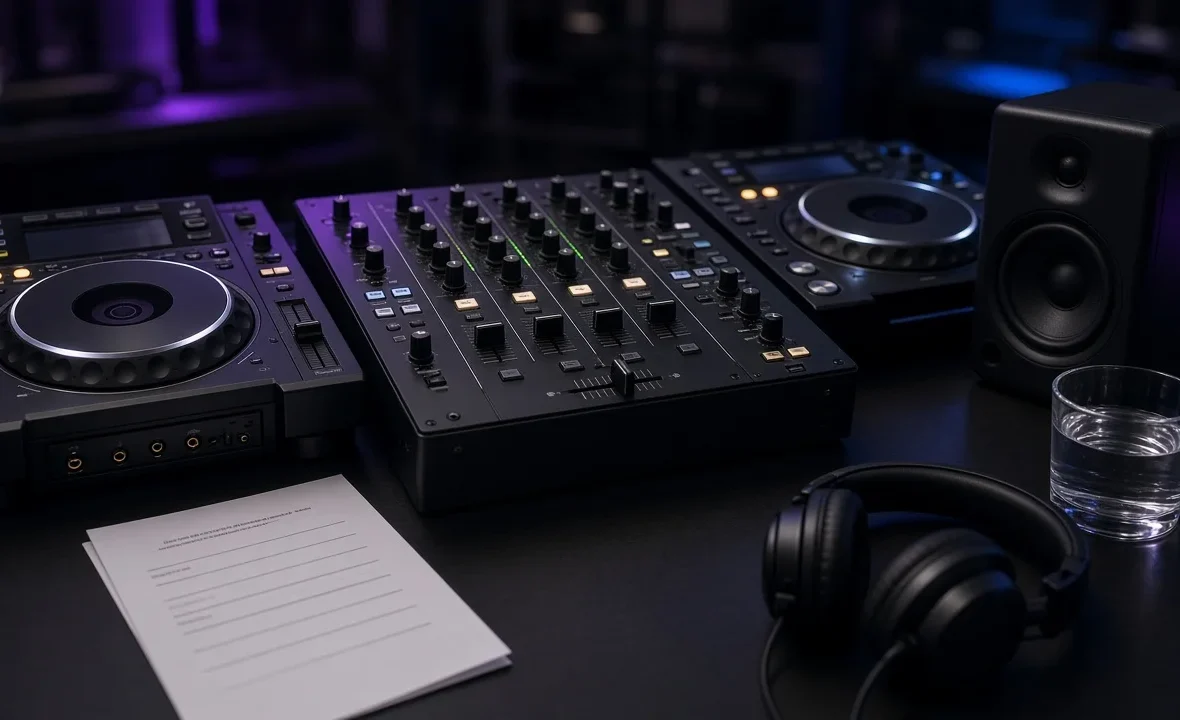
- Players. Model and quantity, e.g. “2× Pioneer DJ CDJ-3000 (or CDJ-2000NXS2), linked, latest firmware.” Say whether you play from USB, laptop or vinyl.
- Mixer. e.g. “Pioneer DJ DJM-900NXS2, DJM-A9 or DJM-V10.” List one or two acceptable alternatives rather than a single model.
- Booth monitors. At least one powered monitor at ear height, with its own volume control on the mixer. This matters more than almost anything else.
- Power and space. A free power socket at the booth for a laptop, and a stable, level surface with room for your gear.
- Connections. If you bring a controller or laptop, ask for two free channels or a spare input and say which cables you’ll bring.
- Microphone. If you’ll speak — weddings, events — ask for a wireless mic routed through the mixer.
- Soundcheck. Ask for 15–30 minutes before doors, or a line check during changeover.
Be specific but realistic. Smaller Bangkok bars often run an XDJ or a controller rather than a full CDJ setup, and that’s fine — the point is to know in advance. Reviews such as the CDJ-3000 review and DJM-900NXS2 review explain why these models are the club standard.
What to Put in Your Hospitality Rider
- Drinks. Water in the booth is the one thing every DJ should ask for. Add a modest drinks allowance if you like.
- Guest list. A number, e.g. “+2,” and a deadline for sending names.
- Food. Only if you’re arriving early or travelling; a meal or a food allowance is normal for longer bookings.
- Transport and accommodation. Essential for out-of-town or international bookings: flights, airport pick-up, hotel and late-night transport home.
- A safe place for your bag. A green room or lockable space for your backpack and spare gear.
A Simple One-Page Rider Layout
- Header: DJ name, logo, phone, email, and a single on-the-night contact.
- Set details: date, venue, arrival time, set time and length.
- Technical requirements: players, mixer, monitors, mic, power.
- What I bring: USBs, headphones, laptop, controller, cables.
- Hospitality: water, drinks, guest list, food, transport.
- Booth diagram: optional, but useful if your setup is unusual.
- Sign-off line: “If any of this is a problem, please let me know before the event.”
That last line is the most important one. It turns the rider into a conversation, not a demand. For more templates and examples, the Backstage DJ tech rider guide and Stagent’s artist rider guide are both solid references. Keep your rider with your press materials — see how to make a DJ press kit.
What Not to Put in a Rider
| Avoid | Why | Do this instead |
|---|---|---|
| Novelty demands | Makes you look difficult before you’ve played | Keep requests practical |
| One exact model only | Many venues can’t match it | List acceptable alternatives |
| Huge drink lists | Promoters remember the bill | Water plus a modest allowance |
| Vague wording | “Good monitors” means nothing | Name the gear and position |
| Five pages | Nobody reads it | One page, two at most |
Your rider should grow with your fee. A local opening slot needs a few lines; a headline booking with travel justifies more. See how much a DJ should charge for how the two connect.
A Note From NaJade
For my first couple of years in Bangkok I didn’t have a rider. I’d ask “what gear do you have?” on LINE and get “Pioneer” as the answer. Once that meant a controller with a broken channel and no monitor in a room full of concrete. Now I send one page with every booking, and nine times out of ten the reply is “no problem” — the tenth time, I find out early enough to bring my own gear. Promoters have told me they like it, because it shows I’ve thought about their night, not just my set. Start small: players, mixer, monitor, water, arrival time. That alone fixes most problems.
Related: DJ contracts, what to bring to a DJ gig, DJ booth etiquette and how to get DJ gigs.
Frequently Asked Questions
What is a DJ rider?
What should be in a DJ tech rider?
Do beginner DJs need a rider?
What is a hospitality rider for a DJ?
Is a DJ rider legally binding?
How long should a DJ rider be?
About the Author
NaJade is a Bangkok-based DJ playing progressive house, melodic EDM, pop, and Thai music across clubs, rooftops, and weddings in Thailand. He teaches beatmatching and mixing to beginners both in person in Bangkok and online over Zoom. When he’s not behind the decks, he’s documenting the journey on YouTube, Instagram, and TikTok.