
By NaJade · DJ in Bangkok · Published September 29, 2026
This guide is part of EDM genres explained.
The one major dance genre that isn’t built on a four-on-the-floor kick — which changes everything about how it sounds and how you mix it.
Drum and bass is the outlier in electronic music, and it’s worth understanding precisely why. Every other major dance genre — house, techno, trance, progressive — runs on a kick drum on every beat. Drum and bass doesn’t. It’s built on breakbeats: chopped-up, re-sequenced drum patterns running at 170–175 BPM, with basslines that owe more to dub and hip-hop than to anything in house. That single structural difference is why it developed its own scene, its own venues and its own culture, largely separate from the rest of dance music.
Drum and bass emerged in the UK in the early 1990s from the rave scene and breakbeat hardcore. It runs at 170–175 BPM on breakbeats rather than a four-on-the-floor kick, with deep basslines phrased closer to dub and hip-hop than to house or techno. Once tempos passed 165 BPM it became incompatible with straightforward house and techno mixing — which is exactly how it became its own world.
What Makes It Different
| Drum and bass | House / techno | |
|---|---|---|
| Tempo | 170–175 BPM | 120–140 BPM |
| Rhythm | Breakbeats — chopped, re-sequenced | Four-on-the-floor kick |
| Bass | Phrased like dub and hip-hop | Groove-driven, on the grid |
| Origin | UK rave scene, early 1990s | Chicago / Detroit, 1980s |
| Roots | Breakbeat hardcore, jungle, dub, reggae | Disco, electro, funk |
| Culture | Pirate radio, dubplates, soundsystems | Clubs, record stores |
That tempo row is more consequential than it looks. As the BPM range rose above 165, drum and bass became incompatible with straightforward DJ mixing alongside house and techno — you simply couldn’t play them at the same speed on club equipment. The genre was effectively forced to build its own infrastructure, and it did.
Where It Came From
The UK rave scene
Drum and bass traces its roots to the UK rave scene and breakbeat hardcore of the late 1980s, developing through its darker derivatives — darkcore and hardcore jungle. Tracks like Lennie De Ice’s “We Are I.E.” (1991), which combined breakbeats with reggae-influenced basslines, are frequently cited as precursors to jungle and drum and bass.
The production breakthrough
The technical move that created the genre: producers began cutting apart drum loops and using the component sounds to build entirely new rhythms. That’s a fundamentally different approach from programming a kick pattern, and it’s why drum and bass percussion is so intricate. To match those complex drum lines, basslines emerged that had far less in common with house and techno patterns than with the phrasing of dub and hip-hop.
The result was a sonic identity defined by the depth of its bass and increasingly rapid-fire breakbeat percussion, with a much greater focus on the intricacies of sampling, synthesis and effects processing than its contemporaries.
Pirate radio and dubplate culture
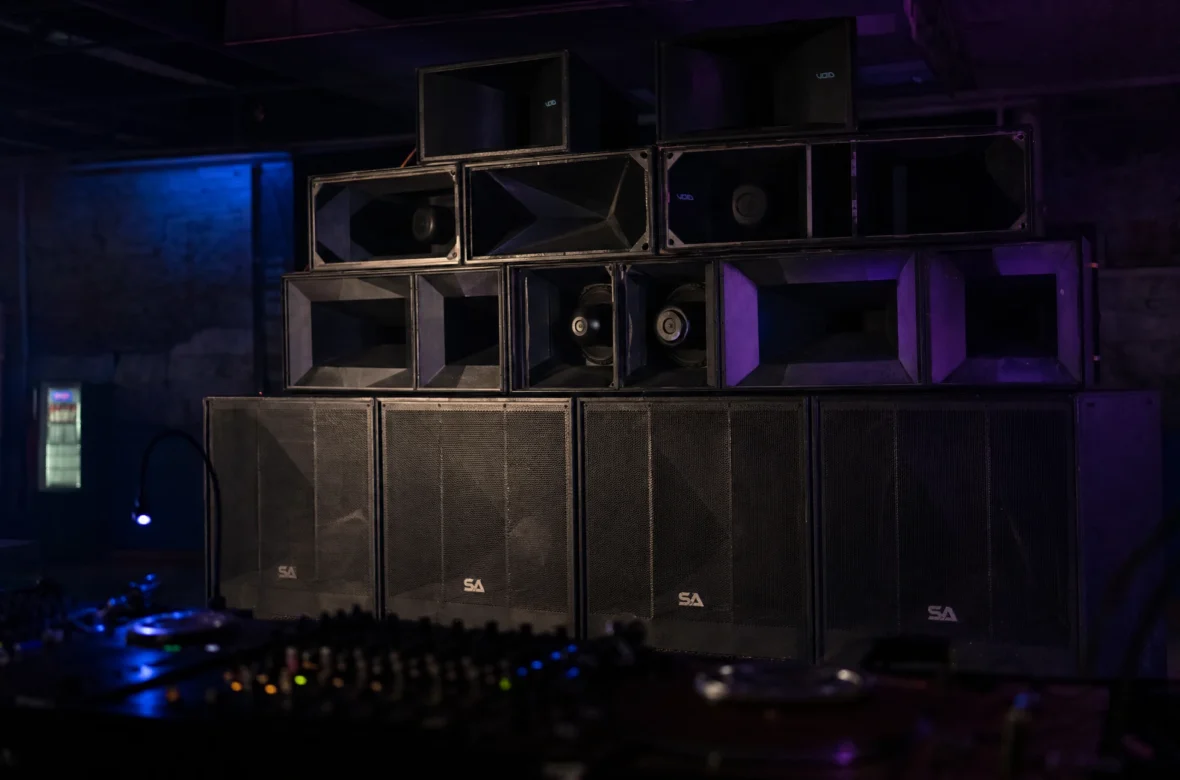
Before it became a global genre, drum and bass was an underground movement built on pirate radio, dubplates and soundsystem culture — a distribution network entirely outside the music industry, inherited from Jamaican sound system traditions via the UK’s reggae scene. That lineage explains a lot about the genre’s relationship with bass, and about why its community has always felt more like a scene than a market.
The Subgenres
- Liquid funk — the melodic, soulful end, often with vocals and jazz influence. The most accessible entry point.
- Neurofunk — dark, technical and heavily sound-designed. The genre at its most futuristic.
- Jump up — bouncy, hook-led and built for reaction. The most immediate.
- Techstep — the harder, more industrial branch that emerged in the mid-90s.
- Darkstep and hardstep — the heavier, more aggressive ends.
- Drumfunk and drill’n’bass — the experimental extremes, where the percussion becomes the entire composition.
Drum and bass has also been extraordinarily generative as a parent genre. Dubstep, UK garage, grime and footwork all descend from it or developed alongside it — which is a remarkable output for a style that began as a regional UK rave offshoot.
Mixing Drum and Bass
- The tempo isolates it. At 170–175 you can’t casually blend into house or techno. Plan your set around that, or use an echo out to cross the gap — see how to use DJ effects.
- Half-time feel helps. Because the drums run at double speed over a half-time bass pulse, drum and bass often feels like 85 BPM — which is why it can sit next to slower material more comfortably than the number suggests.
- The bass is the mix problem. Two drum and bass basslines overlapping is far messier than two house basslines. Kill the low end early and decisively — see how to use EQ.
- Double drops are a genre tradition here, more so than anywhere else in dance music.
- Phrasing still applies. The breakbeats are complex but the arrangement still runs in 8, 16 and 32-bar phrases — see counting bars and phrases.
- Blends tend to be shorter than in progressive house, because the percussion is too busy to layer for thirty-two bars.
A Note From NaJade
I don’t play drum and bass, and I’d encourage anyone learning to DJ to spend time with it anyway — because it will teach you things about rhythm that four-on-the-floor genres can’t. When every track has a kick on every beat, you can beatmatch by feel without really listening to the drums. Drum and bass removes that crutch entirely; you have to understand what the percussion is doing to know where you are. The other reason I admire it is cultural. This is a genre that built itself on pirate radio and dubplates, got pushed out of the mainstream mixing ecosystem by its own tempo, and responded by constructing a complete parallel scene that has now lasted thirty-five years and spawned half a dozen other genres. That’s not a footnote in dance music history — that’s one of the most productive things that ever happened to it.
Related: EDM genres explained, what is tech house, and how to count bars and phrases.
Frequently Asked Questions
What is drum and bass?
What BPM is drum and bass?
What’s the difference between jungle and drum and bass?
What are the main drum and bass subgenres?
What genres came from drum and bass?
Is drum and bass hard to mix?
About the Author
NaJade is a Bangkok-based DJ playing progressive house, melodic EDM, pop, and Thai music across clubs, rooftops, and weddings in Thailand. He teaches beatmatching and mixing to beginners both in person in Bangkok and online over Zoom. When he’s not behind the decks, he’s documenting the journey on YouTube, Instagram, and TikTok.