
By NaJade · DJ in Bangkok · Published September 29, 2026
This guide is part of DJ mixers explained: the complete guide.
Six channels, four-band EQ, and the best sound Pioneer makes — a mixer built for DJs who outgrew the club standard. Magnificent, and wrong for most people. Here’s the honest verdict.
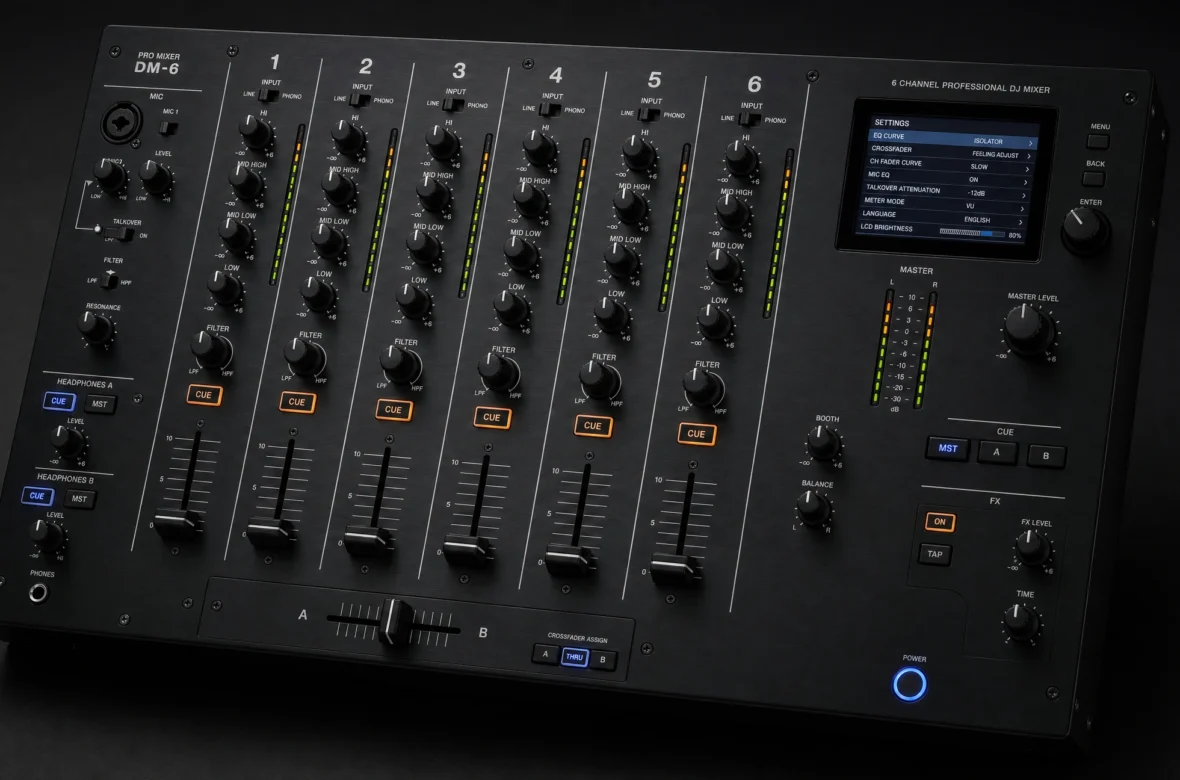
The Pioneer DJ DJM-V10 is a different kind of mixer, and it’s important to understand that before comparing it to anything. It isn’t a replacement for the club-standard DJM-A9 — it’s Pioneer’s answer to Allen & Heath and boutique mixers like the PlayDifferently Model 1, aimed at audiophile DJs and those whose routing and performance needs have genuinely outgrown a four-channel booth mixer. Six channels, a four-band EQ, separate high- and low-pass filters, per-channel send FX, and the best converters in Pioneer’s catalogue. It’s magnificent — and it’s the wrong purchase for most DJs reading this. Here’s why.
The Pioneer DJM-V10 (~$3,400+) is a 6-channel performance and audiophile mixer — Pioneer’s answer to Allen & Heath and boutique mixers, not a club-standard replacement. It offers a 4-band EQ, separate high- and low-pass filters with resonance, per-channel send FX, a touchscreen, and 32-bit converters with 64-bit processing. It’s for DJs with complex routing or high sonic standards. The catch: it’s huge, expensive, and overkill for most setups.
DJM-V10 at a Glance
The key specs and what they mean for you:
| Spec | DJM-V10 | What it means for you |
|---|---|---|
| Type | 6-channel performance / audiophile mixer | Not a club-standard replacement |
| Channels | 6 — or 4 plus two stereo send/returns | Run players plus outboard gear |
| EQ | 4-band per channel + 3-band isolator | Far finer tonal control than a 3-band |
| Filters | Separate high- and low-pass with resonance | Twice the resolution of a single filter knob |
| Audio | 32-bit A/D and D/A, 64-bit DSP, SABRE DAC, AES/EBU out | Pioneer’s best-sounding mixer |
| Send FX | Per-channel sends + two external send/returns | Route outboard FX like a studio desk |
| Extras | Touchscreen settings, compressor, dual headphone outs, booth EQ, long-fader option | Deep customisation and B2B friendliness |
| Price | ~$3,400+ (check local) | Above the A9; premium tier |
(Prices vary by region and over time — confirm the current Thailand/local price before buying.)
Who It’s Actually Aimed At
This is the crucial framing. Pioneer positioned the V10 for DJs for whom a DJM-900NXS2 felt limiting — people running multiple players plus drum machines, samplers, or synths; people building live-leaning hybrid sets; people who care intensely about sound quality and routing flexibility. It competes with Allen & Heath’s Xone range and boutique mixers, not with the booth standard. If you’re mixing two decks of house music, this mixer is not solving a problem you have — the A9 or a used 900NXS2 is your answer, and the V10 is simply a more expensive way to do less.
What’s Extraordinary About the V10
The Best Sound Pioneer Makes
The audio path is the star: 32-bit A/D and D/A conversion with 64-bit internal DSP, a 32-bit SABRE DAC on master and booth outputs, and a low-jitter clock. There’s also an AES/EBU digital output that preserves signal quality over long cable runs — genuinely useful in large installations. The result is rock-solid bass, dimensional mids, and clean highs. The A9 later inherited much of this technology, which tells you how good it is.
Four-Band EQ and Split Filters
Moving from three EQ bands to four changes how you mix — you get separate control over low-mids and high-mids, which is exactly where clashes between two tracks usually live. The filters are split into dedicated high-pass and low-pass controls with resonance, giving twice the usable resolution of the single filter knob on a 900NXS2. For long, layered blends this is a real creative upgrade, not a spec-sheet flourish.
Routing Like a Studio Desk
The V10 replaces Sound Color FX with a send section: two physical external send/return loops plus built-in send effects (short delay, long delay, reverb, dub echo). You can send at full mix and return to another channel, EQ the wet signal separately, or reconfigure the unit as a four-channel mixer with two stereo send/returns. Add a touchscreen for saving and recalling settings, fader curves, and MIDI configuration, an onboard compressor, dual headphone outputs for back-to-backs, and booth EQ — it’s a performance instrument, not just a mixer.
What to Watch Out For
- It’s overkill for most DJs. The honest headline. If you don’t have outboard gear or complex routing needs, you’re paying a large premium for capability you’ll never use.
- Price. At around $3,400+ it’s Pioneer’s most expensive standard mixer, above even the club-standard A9.
- It’s enormous. Six channels means a wide, deep, heavy unit — check your booth, desk, and flight case before committing.
- No Sound Color FX. Replaced by the send section, which is more powerful but less immediate. DJs who love the one-knob colour effects of a 900NXS2 will miss them.
- Send effects aren’t tempo-synced. Their time and feedback parameters can’t be locked to the beat grid, which is a genuine limitation for rhythmic effect work.
- No built-in LAN hub. Like the A9, larger networked rigs need an external Ethernet switch — Denon’s X1850 includes one for a third of the price.
- Not the club standard. You won’t find these in most booths, so it’s an own-rig or specialist-venue mixer.
Who the DJM-V10 Is Really For
It’s for hybrid and live-leaning performers running players alongside drum machines, samplers, or synths; for DJs who need genuine send/return routing; for audiophiles and studio owners who want the cleanest signal path Pioneer offers; and for large installations where AES/EBU and six channels earn their keep. Skip it if you play two or four decks of straightforward DJ sets — the DJM-A9 is the club standard and a used DJM-900NXS2 is far better value. Skip it too if you scratch (DJM-S11) or want analogue character, where Allen & Heath’s Xone:96 is the more natural rival.
A Note From NaJade
The V10 is the most impressive mixer Pioneer makes, and for most people reading this it’s still the wrong one — and I’d rather say that plainly than sell you upward. The four-band EQ and split filters genuinely change how you can blend, and the sound is superb. But those advantages only pay off if your setup actually demands them: outboard gear, send chains, six sources, a room where the converters matter. If you’re mixing progressive house on two players like I mostly do, an A9 or a used 900NXS2 gives you everything you need and leaves thousands of baht for music, monitors, or a decent flight case. The test I’d apply is simple — can you name, right now, the specific thing you’d plug into channels five and six? If not, you don’t need this mixer. And whichever you choose, the room responds to your selection and your timing, never to your EQ band count.
Compare the whole range in my complete DJ mixer guide, or see the players that pair with it in the Pioneer DJ range guide. Want help building a hybrid or club-style rig? My DJ lessons run in person in Bangkok or online over Zoom.
Frequently Asked Questions About the DJM-V10
Is the DJM-V10 better than the DJM-A9?
Do I need six channels on a DJ mixer?
What does the DJM-V10’s 4-band EQ do?
How much does the DJM-V10 cost?
Does the DJM-V10 have Sound Color FX?
Who should buy the DJM-V10?
About the Author
NaJade is a Bangkok-based DJ playing progressive house, melodic EDM, pop, and Thai music across clubs, rooftops, and weddings in Thailand. He teaches beatmatching and mixing to beginners both in person in Bangkok and online over Zoom. When he’s not behind the decks, he’s documenting the journey on YouTube, Instagram, and TikTok.