
By NaJade · DJ in Bangkok · Published September 29, 2026
This guide is part of DJ mixers explained: the complete guide.
Discontinued, dethroned — and right now the smartest value buy in DJ mixers. The mixer that ruled booths for a decade is finally affordable. Here’s the honest verdict.
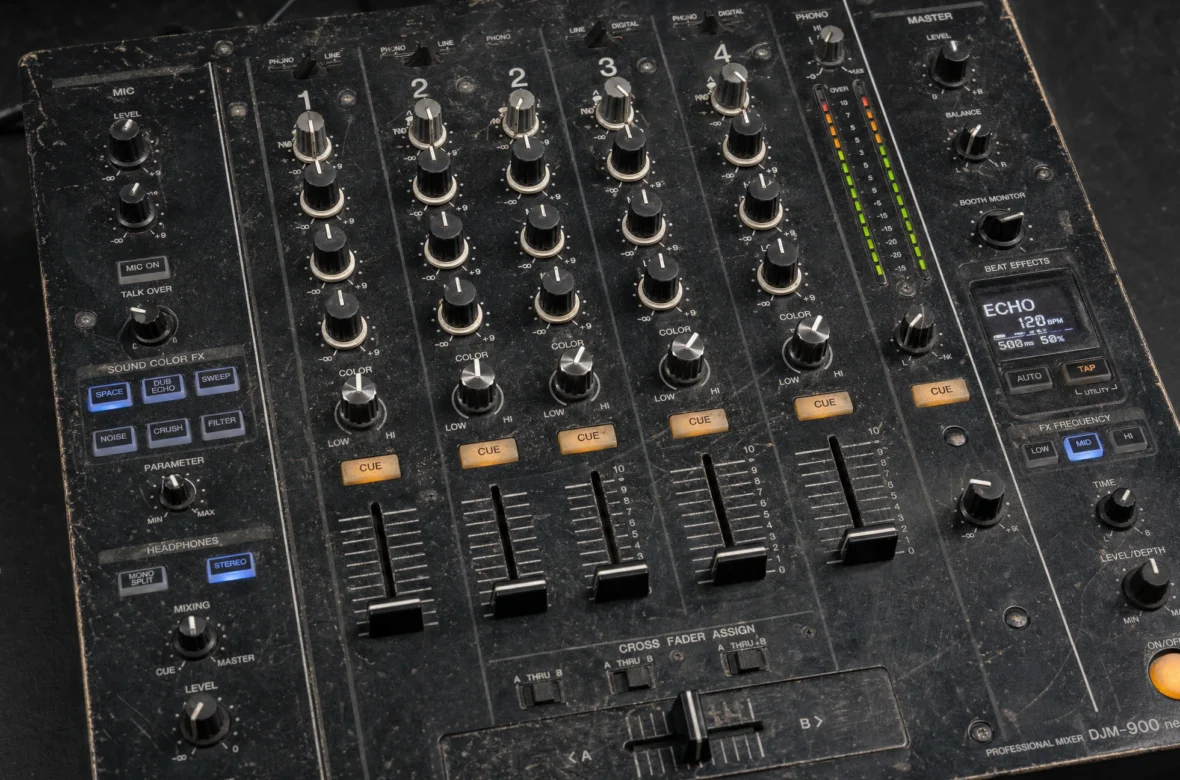
From 2016 until very recently, the Pioneer DJM-900NXS2 was the DJ mixer. It sat in so many booths that its layout became the industry template — rival manufacturers openly copied it, and a generation of DJs learned to mix with their hands in exactly those positions. Pioneer has now discontinued it in favour of the DJM-A9, and that’s precisely why it’s suddenly interesting: it’s still installed in thousands of venues, it still sounds and feels great, and clubs upgrading are putting perfectly good units onto the used market. Here’s why it might be the best-value mixer you can buy today.
The Pioneer DJM-900NXS2 was the industry-standard 4-channel club mixer from 2016 until its recent discontinuation in favour of the DJM-A9. It offers Sound Color FX, Beat FX, a 3-band EQ with isolator, a built-in soundcard, and Pro DJ Link — a workflow near-identical to the current standard. Still installed in thousands of venues, and now excellent value used. The catches: it’s discontinued, and its sound is a step behind the A9’s 32-bit conversion.
DJM-900NXS2 at a Glance
The key specs and what they mean for you:
| Spec | DJM-900NXS2 | What it means for you |
|---|---|---|
| Type | 4-channel club mixer | The former industry standard |
| Era | 2016–recently; now discontinued | Still in thousands of booths worldwide |
| EQ | 3-band per channel, isolator range −26dB to +6dB | Full-kill EQ for confident transitions |
| FX | Sound Color FX + Beat FX | The effects vocabulary most DJs know |
| Soundcard | Built-in multi-channel USB audio | DVS and laptop use without extra hardware |
| Networking | Pro DJ Link with CDJs | Links players; still needs a hub for larger rigs |
| Crossfader | Magvel Fader | Smooth, durable, scratch-capable |
| Price | Used — varies widely | The value opportunity right now |
(Used prices move constantly with condition and region — shop around and inspect before buying.)
Why a Discontinued Mixer Is Worth Buying
Normally “discontinued” is a warning. Here it’s the opportunity. Three things make the 900NXS2 unusual: it remains installed in thousands of venues, so learning it still has direct practical value; its layout is essentially the same as the A9’s, so skills transfer cleanly to the current standard; and clubs upgrading are selling well-maintained units, pushing prices down on a mixer that was untouchably expensive for years. For a home or mobile DJ building a separates rig, that combination is hard to beat — you’re buying a genuine club mixer at a fraction of its original cost.
What’s Still Great About It
The Layout That Became the Industry Language
I/O across the top, mic and Sound Color FX on the left, four channels with EQ down the middle, Beat FX on the right. That arrangement is now so standard that other manufacturers — including Denon — build to it. Learning the 900NXS2 means learning the grammar of club mixing, and stepping onto an A9 later requires essentially no relearning. For a DJ working toward club gigs, that’s genuinely valuable practice.
Effects and EQ That Still Hold Up
The combination of Sound Color FX (per-channel filter, noise, and colour effects on a single knob) and Beat FX (tempo-synced delays, echoes, reverbs and more) is the effects vocabulary most working DJs actually use, and it’s all here. The 3-band EQ with a wide isolator range down to −26dB gives you proper full-kill control for confident swaps and long blends. Nothing about this feels dated in use.
Built-In Soundcard and Pro DJ Link
The integrated multi-channel USB soundcard means DVS and laptop performance work without buying an interface — useful for Serato or rekordbox users. Pro DJ Link ties it to Pioneer CDJ players for tempo and track info sharing. It’s a complete, self-sufficient centrepiece for a separates rig.
What to Watch Out For
- It’s discontinued. No new units, and long-term parts and service support will taper off. Fine for now; worth considering over a ten-year horizon.
- The sound is a step behind the A9. The DJM-A9‘s 32-bit conversion is audibly cleaner on a big system. On a home setup you’re unlikely to notice; in a club you might.
- Buy used carefully. Check every channel fader and the crossfader for wear or crackle, test all inputs and outputs, confirm the soundcard works on a laptop, and look for booth abuse — ex-club units can be heavily used.
- No built-in LAN hub. Larger multi-player rigs need an external switch, same as the A9.
- It’s still not cheap. Even used, this is a serious mixer at a serious price — the DJM-750MK2 may suit smaller budgets better.
- Heavy and large. A proper club mixer, with the weight and case requirements to match.
Who It’s Really For
It’s ideal for the DJ building a club-style separates rig on a realistic budget — home, mobile, or small-venue — who wants genuine club-standard feel and workflow without paying A9 money. It’s also a smart pick for anyone practising toward club gigs, since the skills transfer directly, and for venues needing a reliable, familiar mixer at lower cost. Skip it if you want the newest sound and long-term support (buy the A9), if you need six channels or deep routing (DJM-V10), if you scratch (DJM-S11), or if you’re on Denon SC players where the X1850‘s LAN hub integrates better.
A Note From NaJade
There’s a window that opens whenever an industry standard gets replaced, and we’re in it right now. For years the 900NXS2 was the mixer most of us couldn’t justify; today clubs are swapping them out and you can own one for a fraction of what it cost new. If you’re building a separates rig at home, I think that’s the single best-value decision available in DJ mixers at the moment — you get real club feel, the layout you’ll meet in booths, and effects you’ll actually use. Two cautions. Inspect any used unit properly: faders are the wear point, and ex-club mixers have lived hard lives. And be honest that it’s a sunset product — brilliant for the next several years, less so as a forever purchase. Buy it for what it is: a decade’s industry standard, finally affordable. And as always, the room responds to your selection and your timing, not the model number under your hands.
Compare the whole range in my complete DJ mixer guide, or see the players that pair with it in the Pioneer DJ range guide. Want help building a club-style rig? My DJ lessons run in person in Bangkok or online over Zoom.
Frequently Asked Questions About the DJM-900NXS2
Is the DJM-900NXS2 discontinued?
Should I buy a used DJM-900NXS2 or a new DJM-A9?
Is the DJM-900NXS2 still good in 2026?
What should I check when buying a used DJM-900NXS2?
Does the DJM-900NXS2 work with DVS and Serato?
DJM-900NXS2 vs Denon X1850: which is better value?
About the Author
NaJade is a Bangkok-based DJ playing progressive house, melodic EDM, pop, and Thai music across clubs, rooftops, and weddings in Thailand. He teaches beatmatching and mixing to beginners both in person in Bangkok and online over Zoom. When he’s not behind the decks, he’s documenting the journey on YouTube, Instagram, and TikTok.