
By NaJade · DJ in Bangkok · Published September 29, 2026
This guide is part of DJ mixers explained: the complete guide.
The mixer that replaced a decade-long champion — and the one you’re now most likely to find waiting in a professional booth. Worth $2,699 of your own money? Here’s the honest verdict.
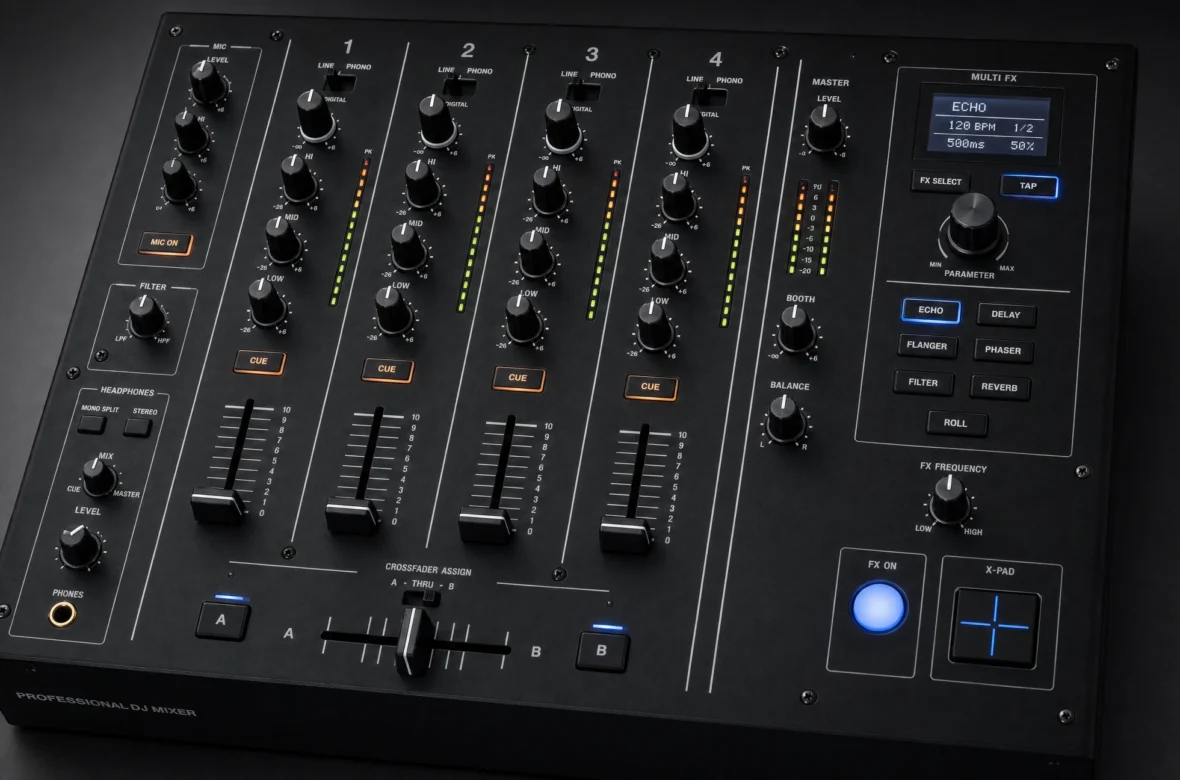
The Pioneer DJ DJM-A9 arrived in 2023 with a hard job: succeed the DJM-900NXS2, a mixer so dominant it defined what a club booth looked like for nearly ten years. Three years on, that transition has happened — the 900NXS2 is discontinued, clubs are installing A9s, and it’s increasingly the rider expectation. It’s an evolution rather than a revolution, but the upgrades are real: noticeably better sound from 32-bit converters, a superior crossfader, and modern connectivity. It’s also seriously expensive. Here’s who should actually buy one.
The Pioneer DJM-A9 (~$2,699 / £2,469) is the current club-standard 4-channel mixer, replacing the discontinued DJM-900NXS2. It brings 32-bit A/D and D/A conversion for noticeably cleaner sound, a third-generation Magvel crossfader, an expanded mic section, and connectivity for two laptops plus Bluetooth. It’s the booth you’ll walk into. The catches: it’s club money, it needs an external router for remote features, and the layout is deliberately familiar rather than new.
DJM-A9 at a Glance
The key specs and what they mean for you:
| Spec | DJM-A9 | What it means for you |
|---|---|---|
| Type | 4-channel club-standard mixer | The current booth default |
| Released | March 2023 — replaces DJM-900NXS2 | 900NXS2 now discontinued |
| Conversion | 32-bit A/D and D/A throughout the I/O | Audibly cleaner, warmer lows |
| Crossfader | 3rd-generation Magvel Fader | Smooth mixing, stable scratching |
| Sound Color FX | With new mechanical knob-lock switch | Won’t overshoot the centre detent |
| Connectivity | Two laptops + Bluetooth input; digital outs; record out | Easy B2B hand-offs and lossless outs |
| Size | ~74mm wider and 44mm deeper than the 900NXS2 | Sits flush beside CDJ-3000s; check your case |
| Price | ~$2,699 / £2,469 (check local) | Serious club-tier outlay |
(Prices vary by region and over time — confirm the current Thailand/local price before buying.)
Why It Matters: The New Rider Standard
The DJM-900NXS2’s dominance is hard to overstate — from 2016 it was so ubiquitous that its layout became the template competitors openly copied. Pioneer has now officially discontinued it, and venues upgrading are choosing the A9. That shift matters practically: if you’re aiming at club and festival work, the A9 is increasingly what you’ll find under your hands, and increasingly what riders specify. The good news is that Pioneer deliberately didn’t reinvent the layout — if you’ve mixed on a 900NXS2 you’ll feel at home immediately, which is exactly right for a piece of gear thousands of touring DJs must use cold.
What’s Great About the DJM-A9
The Sound Is a Genuine Step Up
This is the headline improvement and the thing reviewers agree on most. The A9 uses 32-bit A/D and D/A conversion across the whole signal path — effectively inheriting the audio guts of the flagship DJM-V10 — with excellent preamps that hold a wide dynamic range with minimal distortion even when pushed hard. In practice: warmer, fuller lows and cleaner mids and highs. It’s not night-and-day on small speakers, but on a proper club system it’s clearly audible, and it’s the main reason DJs who try one don’t want to go back.
Better Faders and a Clever Knob Lock
The channel faders are higher quality and slicker than the 900NXS2’s, and the third-generation Magvel crossfader handles both smooth blends and rapid scratching. A neat addition is a switch that mechanically locks the Sound Color FX knobs, so heavy-handed DJs can throw a filter in and out fast without overshooting the 12 o’clock “off” detent — a small, thoughtful fix to a genuinely annoying problem.
Modern Connectivity and More Room
The A9 handles two laptops plus a Bluetooth feed simultaneously, which makes B2B hand-offs and guest DJs painless. There’s a dedicated record output and lossless digital outs for the four main channels. It also grew — about 74mm wider and 44mm deeper — and that extra space went into expanding the microphone section on the left and the Beat FX section on the right, making everything easier to reach mid-set. It now sits flush alongside CDJ-3000 players, which is clearly the intended pairing.
What to Watch Out For
- The price is club money. At around $2,699 it’s a serious outlay, and for home or small-gig use the gains are real but hard to justify.
- No built-in Ethernet router. The most-cited complaint: remote-management and networking features need an external router you have to supply yourself. Denon’s X1850 includes a LAN hub at a fraction of the price.
- Evolution, not revolution. If you’re hoping for dramatic new performance features, this isn’t that — it’s a refinement of a proven formula.
- It’s bigger. The extra width and depth is welcome ergonomically but means checking your flight case, booth cut-out, and desk space.
- Not the flagship. The 6-channel DJM-V10 sits above it for routing and channel count, and costs more again.
- Budget for software. If you’ll use it with DVS or a laptop, factor a rekordbox or Serato licence on top.
Who the DJM-A9 Is Really For
It’s for venues, club installations, and working residents or touring DJs who want to own exactly what they’ll meet in the booth — and for anyone building a no-compromise CDJ-3000 rig at home who values sound quality above cost. Skip it if you mostly play at home or small gigs: a used DJM-900NXS2 gets you most of the way for far less, and the DJM-750MK2 covers a lot of working setups at a fraction of the price. Skip it too if you scratch (a DJM-S11 suits better), or if you’re running Denon SC players, where the X1850 integrates more cleanly.
A Note From NaJade
The A9 is genuinely excellent, and I’d be delighted to find one in any booth I played. But I want to separate two different questions, because people conflate them. “Is it the best 4-channel club mixer Pioneer makes?” — yes, comfortably, and the sound upgrade is real on a big system. “Should you buy one?” — that depends entirely on whether you’re playing rooms where it earns its keep. For a venue or a full-time resident, it’s money well spent and future-proof. For a home DJ, you’re paying club prices for improvements you’ll mostly hear on club speakers, and a used 900NXS2 is the smarter move by a mile right now while clubs offload them. Buy the mixer your gigs justify, put the difference into music and monitoring, and remember the room responds to your selection and your timing, not your converter bit depth.
Compare the whole range in my complete DJ mixer guide, or see the players that pair with it in the Pioneer DJ range guide. Want help learning a club-style workflow? My DJ lessons run in person in Bangkok or online over Zoom.
Frequently Asked Questions About the DJM-A9
Is the DJM-A9 the new club standard?
Is the DJM-A9 worth upgrading from a DJM-900NXS2?
How much does the DJM-A9 cost?
What’s the difference between the DJM-A9 and DJM-V10?
Does the DJM-A9 have a built-in network hub?
Is the DJM-A9 good for scratching?
About the Author
NaJade is a Bangkok-based DJ playing progressive house, melodic EDM, pop, and Thai music across clubs, rooftops, and weddings in Thailand. He teaches beatmatching and mixing to beginners both in person in Bangkok and online over Zoom. When he’s not behind the decks, he’s documenting the journey on YouTube, Instagram, and TikTok.